
Schools are failing students in a very specific way right now. Not in reading scores or STEM rankings, but in preparing kids for a world where the thing they’re being trained to do, process information and produce answers, is now something a $20 monthly subscription can do faster. The real gap isn’t academic. It’s structural. And no amount of extra homework fixes a structural problem.
I’ve spent years studying how educational systems respond to disruption, and my honest read is this: most schools are still optimizing for a 2005 job market while teaching kids who will retire in 2075. The mismatch is serious, and the cost isn’t abstract. Students who graduate without emotional regulation skills, resilience frameworks, or the ability to collaborate under pressure don’t just struggle at work. They struggle at life.
Why “soft skills” is the wrong name for what we’re talking about
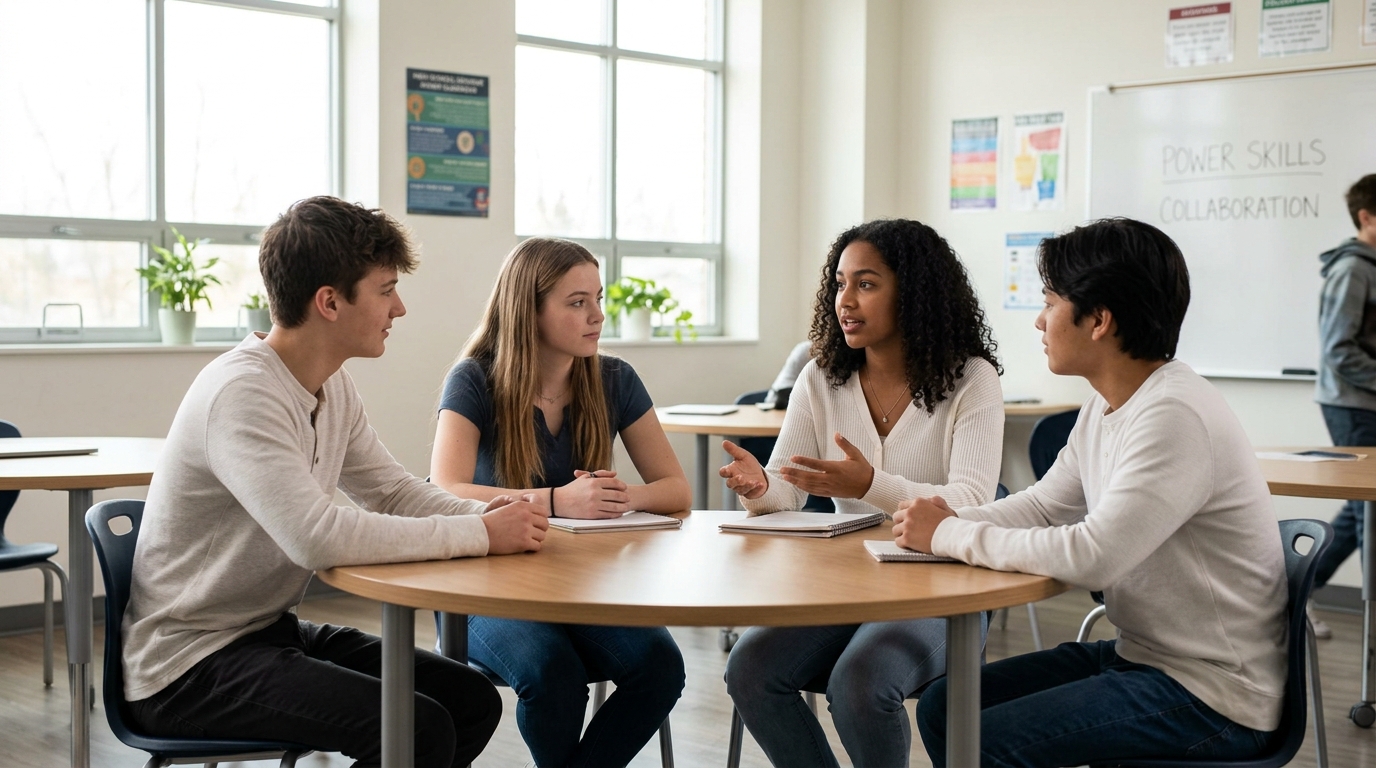
Calling emotional intelligence or resilience a “soft skill” is one of those pieces of education-world jargon that accidentally does real damage. It implies optional. It implies secondary. The reality is the opposite.
McKinsey Global Institute’s 2023 workforce report identified that demand for “social and emotional skills” will grow by 26% in the U.S. through 2030, while demand for basic cognitive tasks drops sharply due to automation. These aren’t soft. They’re load-bearing.
Here’s what I’d call them instead: power skills. Things that get harder to replicate as intelligence scales up, not easier.
The power skills that actually matter in an AI-saturated environment:
- Emotional regulation: knowing what you’re feeling, why, and what to do with it before acting
- Collaborative conflict resolution: moving through disagreement productively without shutting down or blowing up
- Critical self-reflection: updating your own beliefs when evidence contradicts them
- Sustained attention: choosing, deliberately, what to focus on in a world designed to fragment your focus
- Ecological literacy: understanding how your choices connect to systems bigger than yourself
That last one gets underweighted in most “future skills” conversations, and I’ll come back to it.
The structural challenge schools aren’t naming clearly enough
A lot of the mental health crisis in schools gets framed as a student problem. Anxiety is up. Depression rates among teens climbed significantly between 2012 and 2019, according to data published by the National Institute of Mental Health, a rise that correlates with smartphone adoption but also with a quieter issue: students increasingly sense that the work they’re doing in school doesn’t connect to anything real.
That disconnection is a structural problem, not a personal one.
When a student sits through a history class where they memorize dates that a Google search returns in 0.4 seconds, part of their brain registers the mismatch. Not consciously, usually. But the low-grade sense that “this doesn’t matter” accumulates. Over years, it looks like apathy. Often, it’s a rational response to a genuinely irrational situation.
Here’s the framework I’d use to diagnose whether a school is structuring for real-world readiness:
The structural readiness checklist
Rate your school or curriculum against these four markers. If fewer than three are present, you’re looking at a structural gap:
| Marker | What it looks like in practice | Red flag |
|---|---|---|
| Emotion as curriculum | Dedicated class time for identifying and processing emotions, not as an add-on to advisory | Emotional check-ins are optional or teacher-dependent |
| Failure as pedagogy | Students regularly attempt hard things, fail visibly, and debrief what happened | Grades punish all failure equally |
| Ecological connection | Learning connects to local environmental systems, not just abstract sustainability facts | “Green” content is a single unit, not woven through subjects |
| Student agency | Students make meaningful choices about what and how they learn | Choice is limited to homework format or book reports |
A school can have excellent test scores and fail all four. I’ve seen it. The outcome is kids who are technically competent and emotionally brittle.
What resilience actually looks like when you teach it on purpose
“Teaching resilience” sounds vague. In practice, it has very specific classroom shapes.
Dr. Ann Masten’s research at the University of Minnesota, published across several decades in her work on ordinary magic in development, shows that resilience isn’t a personality trait. It’s a set of practiced responses, maintained relationships, and environmental structures. In other words, you can build it. You can also destroy it by creating environments that reward only performance outcomes and punish struggle.
The practical version of this in a classroom looks like:
- Effort grading alongside outcome grading: assigning explicit grade weight to process documentation, not just final products
- Public failure practice: teachers modeling mistakes and thinking out loud about how they’re recovering
- Time-bound stress cycles: structured pressure (debates, presentations, timed challenges) followed by structured debrief, mirroring how high-functioning adults actually operate under deadline pressure
What doesn’t work: vague encouragement (“you can do it!”), mandatory gratitude journaling without emotional processing support, or resilience “modules” that run for two weeks in October and disappear.
Emotional intelligence isn’t therapy. It’s a learnable system.

One reason schools resist teaching emotional intelligence is a fear of scope creep. Teachers worry they’ll be expected to be therapists. That’s a legitimate concern, and it’s also based on a misunderstanding of what EQ instruction looks like at the classroom level.
Daniel Goleman’s original emotional intelligence framework, developed in his 1995 book “Emotional Intelligence,” identifies five domains: self-awareness, self-regulation, motivation, empathy, and social skills. None of these require a licensed therapist to teach. All of them have evidence-based classroom applications.
At the classroom level, teaching EQ looks like:
- Using literature to practice identifying emotional states in characters, then connecting to personal experience
- Running structured discussions where students practice perspective-taking before responding
- Building “emotional vocabulary” explicitly, the same way you build academic vocabulary
- Teaching the physiological basics of stress response (the role of cortisol, the function of the amygdala) so students understand what’s happening in their bodies during anxiety, not just that it feels bad
That last piece matters more than most curricula acknowledge. Students who understand the stress response are measurably better at interrupting it. Research from Stanford University’s Center for Education Policy Analysis suggests that self-regulation skills taught explicitly in middle school produce academic benefits that persist through high school, not because students become emotionally perfect, but because they stop losing hours to unmanaged anxiety spirals.
The human skills AI genuinely can’t replicate (and why that matters for curriculum design)
Here’s where I want to be direct, because I see a lot of fuzzy thinking on this topic.
Some human skills are hard to automate because they require a body. Eye contact, physical presence, touch-based care, the ability to be actually present in a room with someone who’s grieving or scared or celebrating. These matter enormously in professions like nursing, teaching, counseling, coaching, and skilled trades.
Some human skills are hard to automate because they require authentic judgment with real stakes. A machine can generate legal arguments. It cannot sit across from a client, read their fear, weigh what they haven’t said, and make a call that accounts for who this specific person is.
But the deepest reason AI can’t replicate certain human skills is more subtle. It’s that some skills are only valuable because they come from a person who chose to develop them. A handmade piece of furniture isn’t valuable despite being made by hand. It’s valuable because of it. The same logic applies to a mentor relationship, a piece of deeply personal art, or a community organizer who’s spent twenty years building trust in a specific neighborhood.
Schools that want to future-proof students need to lean into this. The curriculum question to ask is: “Does this skill become more or less valuable as AI becomes more capable?” If the answer is less valuable, that content deserves fewer contact hours. If the answer is more valuable, it deserves explicit teaching, practice, and assessment.
Skills that become more valuable as AI scales:
- Genuine human connection and relationship maintenance
- Physical world competence (making, building, growing, repairing)
- Ethical reasoning with incomplete information
- Cross-cultural empathy in high-stakes contexts
- Care work of all kinds
Green education isn’t a separate track. It’s a mental health intervention.
This part usually surprises people, so I’ll explain the mechanism directly.
Research from the University of Exeter’s European Centre for Environment and Human Health, published in journals including Environmental Science and Technology, shows that regular contact with natural environments reduces anxiety, improves attention, and increases a sense of meaning and agency. That last one is significant. A major driver of adolescent mental health decline is a felt sense of helplessness, particularly around large, complex problems they didn’t cause and can’t individually fix
Climate anxiety is real. Studies published in The Lancet Planetary Health (2021) found that 59% of young people aged 16 to 25 globally reported being “very” or “extremely” worried about climate change. But the research also shows a specific pattern: passive awareness of climate problems increases anxiety, while active engagement with ecological systems and solutions reduces it.
This means the way schools teach environmental content matters as much as whether they teach it. A single unit on deforestation statistics increases anxiety. A sustained engagement with a local ecological project, a school garden, a watershed study, an energy audit of the school building, builds agency instead. And agency is the structural antidote to helplessness.
Weaving ecological literacy through subjects looks like:
- Math classes that use local air quality data, energy consumption figures, or waste stream statistics instead of abstract numbers
- History classes that trace environmental context alongside political context
- Science labs that involve monitoring local biological systems over time, not just single-session experiments
- Design challenges that include materials impact as a design constraint
The outcome isn’t just students who care about the environment. It’s students who practice systems thinking, who understand that their individual choices connect to collective outcomes, and who’ve had the experience of working on real problems with real stakes. Those are power skills. The green content is the vehicle.
What teachers need that they’re not getting
None of this lands if teachers are running on fumes. And most of them are.
The American Federation of Teachers’ 2021 educator survey found that 90% of teachers reported feeling burned out, and 86% reported that their mental health was negatively affected by the pandemic and its aftermath. Teachers cannot model emotional regulation they’re not practicing. They cannot teach resilience from a place of sustained depletion.
The structural fix here isn’t a wellness app or a self-care reminder in the staff newsletter. It’s:
- Reducing non-teaching workload through administrative support and smarter scheduling
- Building in structured collaboration time where teachers actually discuss pedagogy, not logistics
- Providing genuine professional development in EQ and mindfulness practices, not optional lunch-and-learn sessions
- Creating explicit school policies that protect teacher planning time as non-negotiable
Schools that invest in teacher wellbeing as a structural priority consistently outperform those that treat it as a perk. The RAND Corporation’s 2023 report on teacher working conditions found a direct link between planning time adequacy and student achievement outcomes. The mechanism is straightforward: rested, supported teachers make better instructional decisions and build better relationships with students.
A decision framework for schools redesigning curriculum around power skills
If you’re a curriculum director, principal, or even a parent trying to evaluate where a school stands, this framework gives you a practical way to prioritize.
I call it the Priority Stack Filter. Work through it top to bottom:
Level 1: Is the skill automatable within 10 years? If yes (data entry, basic research synthesis, formulaic writing): deprioritize contact hours. If no: move to Level 2.
Level 2: Does the skill require a body, a relationship, or authentic judgment? If yes: this is a high-priority power skill. Treat it as core curriculum. If no: move to Level 3.
Level 3: Does the skill build a student’s sense of agency and connection? If yes: include it, especially as a vehicle for content that must remain. If no: evaluate whether it’s earning its place in the schedule.
Running existing curriculum through this filter reveals quickly where hours are going that could be better spent. A typical school day devotes significant time to tasks that fail Level 1. Reallocating even 15% of that time to explicit power skill development would be meaningful.
The traps most schools fall into when they try to fix this
I want to name these directly because they’re common and they feel like progress while producing very little of it.
Trap 1: Treating SEL as a separate class Social-Emotional Learning works best when it’s woven into the fabric of every class, not siloed into a Tuesday morning advisory period. The moment it becomes a separate thing, it gets treated as optional, both by students and by teachers who are behind on content coverage.
Trap 2: Buying a curriculum package instead of building teacher capacity A pre-packaged mindfulness program isn’t useless. But it’s a floor, not a ceiling. Schools that invest in training teachers to facilitate emotional learning outperform schools that buy a product. The research on this is consistent: implementation quality depends almost entirely on teacher buy-in and skill, not on the curriculum’s quality in isolation.
Trap 3: Measuring the wrong things If the only metrics you’re tracking are test scores and attendance, you’ll never see whether your wellbeing programming is working. Schools need instruments for measuring psychological safety in classrooms, student sense of belonging, and teacher-reported relationship quality. The Panorama Education student survey and similar tools exist. Use them.
Trap 4: Talking about resilience while removing all difficulty This one’s subtle. Some schools have responded to the mental health crisis by reducing academic pressure across the board. That’s not wrong in cases where pressure was genuinely unreasonable. But resilience requires actual difficulty, navigated with support. Removing all struggle removes the training ground. The goal is calibrated challenge with scaffolded recovery, not ease.
What a well-designed school week could actually look like
This isn’t a utopian vision. Every piece of this exists somewhere in some school right now.
| Day | Integrated power skill element | Subject vehicle |
|---|---|---|
| Monday | Emotional check-in with vocabulary building | Homeroom/advisory |
| Tuesday | Collaborative problem-solving with conflict protocol | Group project across subjects |
| Wednesday | Local ecological system monitoring | Science, math, or social studies |
| Thursday | Structured failure debrief (what didn’t work and why) | Any project-based class |
| Friday | Reflection and self-assessment | Portfolio update across subjects |
This doesn’t add hours. It repurposes how existing hours are used. The content doesn’t disappear. It gets taught through a lens that builds power skills simultaneously.
Where this actually starts: one classroom, one teacher, one semester
The systems-level fix takes years. But individual teachers can start immediately, and often the most meaningful change happens at the classroom level before it ever reaches policy.
If I were a classroom teacher reading this, here’s where I’d start:
- Pick one unit this semester and build in a deliberate failure point, a genuinely hard challenge students are expected to struggle with, followed by a structured debrief on what they noticed about themselves under pressure
- Add three to five emotional vocabulary words to whatever vocabulary instruction you already do
- Replace one abstract data set in math or science with local environmental data (your city’s EPA air quality index data is free and updated daily)
- Spend two minutes at the start of class twice a week asking students to name what they’re carrying emotionally, not to process it in class, but to normalize naming it
None of these require administrative buy-in. None of them require budget. And none of them will fix the structural problem alone. But they build something students take with them beyond the classroom, which is more than most content does.
The schools that will produce graduates ready for the next thirty years aren’t the ones with the best test scores right now. They’re the ones treating human development as the actual curriculum, with academic content as the medium through which that development happens. Start there.