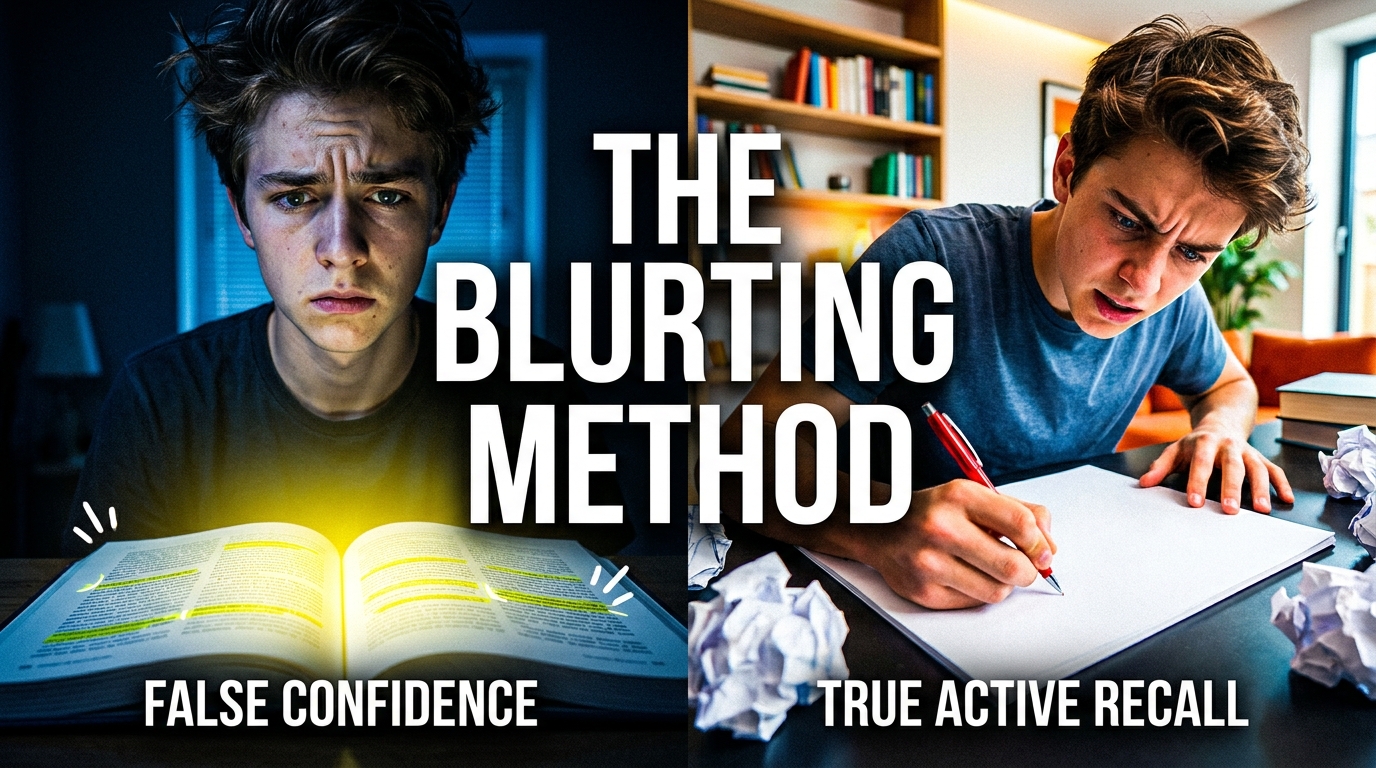

You stare at your notes for hours but freeze as soon as the exam paper hits your desk. Reading text and highlighting lines gives you a false sense of security that entirely crumbles under academic pressure. The blurting method forces your brain to retrieve information on command so you actually remember the material when your grade depends on it.
The Hottest Study Trend of 2026 Explained
I see students waste countless hours making their notes look pretty. They buy expensive highlighters and spend entire weekends rewriting textbook chapters. Then they fail their exams.
TikTok popularized the blurting method in 2026 because it attacks this exact problem. The strategy is incredibly simple. You review a section of your study material. You close the book. You grab a blank sheet of paper. You write down every single thing you can remember about that topic. Finally, you open the book back up and check your messy paper against the real text to see exactly what you missed.

It forces you to confront what you actually know. I love this technique because it strips away your ego. You cannot hide behind neat handwriting or color-coded sticky notes. You either know the information or you do not.
Most people hate this method at first. It feels deeply uncomfortable to sit in front of a blank page and realize your mind is completely empty. That discomfort is exactly why the strategy works. Your brain only builds strong connections when it struggles to retrieve data.
Destroying the “Read and Review” Myth
Let us talk about what your teachers probably told you to do. Generic study advice usually revolves around reading a chapter and reviewing your notes periodically. I think this is the worst advice you can possibly follow.
Reading is a passive activity. When your eyes scan a page, your brain recognizes the words. Recognition feels a lot like memorization. You see a bolded vocabulary word and think you know it. You recognize the definition because the textbook just handed it to you. The moment you take that textbook away, the recognition disappears.
Blurting destroys this illusion of competence. It forces active recall. You have to pull the information out of your own head without any external prompts.
| Study Strategy | Mental Effort Required | False Confidence Level | Long-Term Retention Rate |
| Re-reading Chapters | Very Low | Extremely High | Very Poor |
| Highlighting Text | Low | High | Poor |
| Copying Notes | Moderate | High | Moderate |
| The Blurting Method | Extremely High | Zero | Excellent |
I want you to look at that table closely. The higher your mental effort during a study session, the better your long-term memory becomes. Blurting requires massive mental effort. You are building pathways in your brain from scratch instead of just tracing over lines someone else already drew.
The Brain Science Behind Active Recall
I do not want to sound like a textbook, but you need to understand the mechanics of retrieval practice. Cognitive psychologists have studied this for decades. Every time you force your brain to remember a fact, you strengthen the neural pathway attached to that specific memory.
Think of your memory like a path through a dense forest. Reading a textbook is like flying over the forest in a helicopter. You can see the path clearly from the sky. You think you know the way. Blurting is like walking through that forest with a machete. It is hard work. You get lost. You have to chop down branches. But after you walk that exact path five or six times, it becomes a clear dirt road.
When you sit down for a real exam, you do not have the helicopter. You just have your own brain. The blurting method forces you to practice the exact skill you need for the test. You practice retrieving data under pressure.
A Five-Minute Biology Walkthrough
I want to show you exactly how this looks in the real world. Let us use a common biology topic. We will use cellular respiration because it frustrates almost every science student.
Step 1: The Focused Review
You set a timer for two minutes. You open your biology textbook to the section on the mitochondria and cellular respiration. You read the section with intense focus. You look at the formulas. You read the definitions for glycolysis and the Krebs cycle.
Step 2: The Blackout
The timer goes off. You close the textbook completely. You push it away from your desk. You open a blank notebook.
Step 3: The Brain Dump
You set the timer for another two minutes. You write down everything you can possibly remember about cellular respiration. You write down the equation for glucose. You draw a messy circle and label it the Krebs cycle. You write “ATP” in big letters. You dump every fragment of information out of your brain onto the paper. Do not worry about spelling. Do not worry about neatness. Just get it out.
Step 4: The Harsh Correction
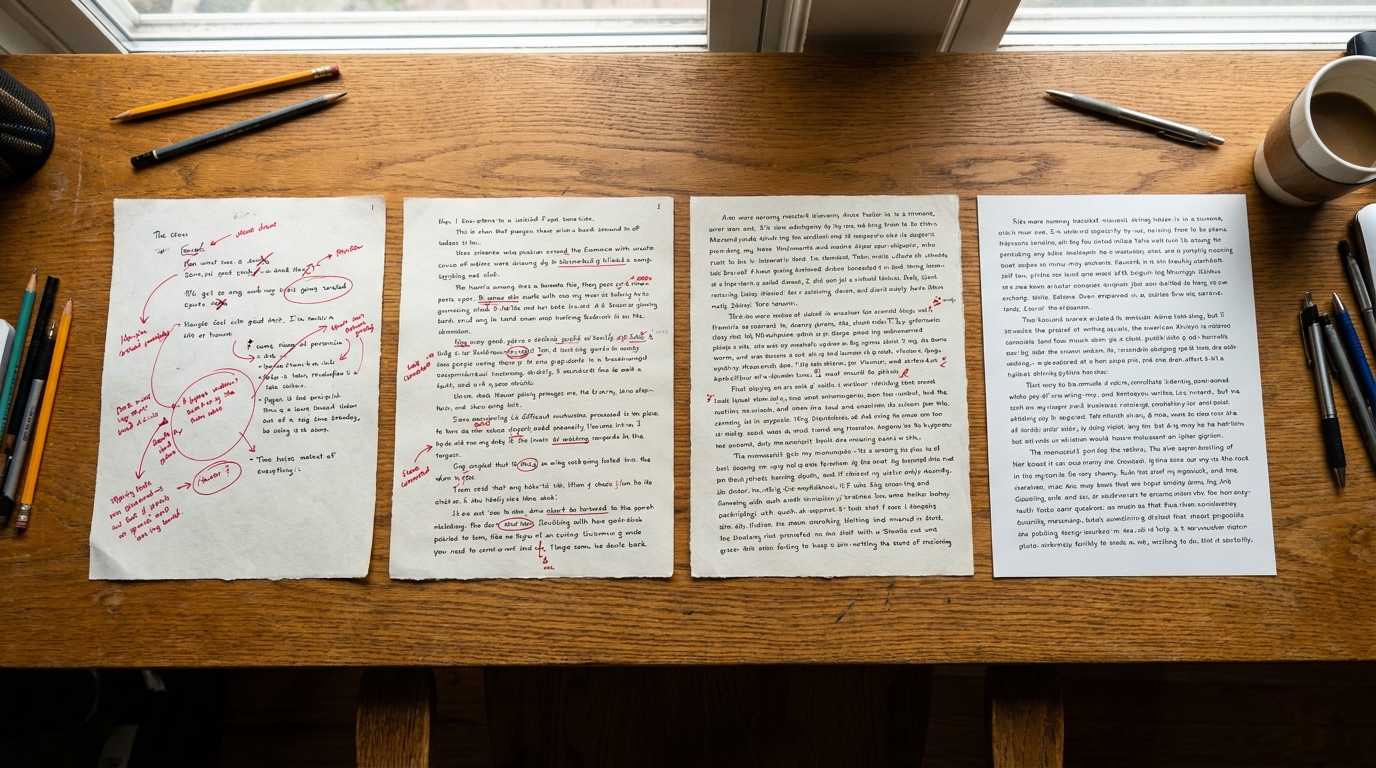
The timer sounds again. You grab a brightly colored pen. I usually use bright red or loud orange. You open the textbook back up. You compare your messy notes to the actual text. You realize you forgot the electron transport chain completely. You write “ELECTRON TRANSPORT CHAIN” in big red letters on your paper. You correct the chemical formula you messed up.
You just completed a blurting cycle. It took exactly five minutes. You now know exactly what your brain retained and exactly what it dropped. Your next review session will focus exclusively on the red ink.
The Tools You Actually Need
People love to overcomplicate study routines. You do not need expensive software subscriptions to pull this off. Minimalist tools prevent distractions.
- A stack of cheap printer paper.
- A basic black pen for your initial writing.
- A brightly colored pen for your corrections.
- A simple digital timer or kitchen clock.
I strongly advise against doing this on a laptop. Typing is too fast. When you type, your fingers move on autopilot. Writing by hand forces your brain to slow down and process the material on a deeper level. The physical friction of a pen on paper aids memory retention.
| Tool Type | Speed of Output | Mental Friction | Correction Visibility |
| Handwriting on Paper | Slow | High | Excellent (Using red ink) |
| Typing on a Laptop | Fast | Low | Poor (Looks too clean) |
| Using a Tablet and Stylus | Moderate | Moderate | Good (Color changing) |
If you absolutely must use digital tools, an iPad with an Apple Pencil is an acceptable compromise. Just ensure you turn off all notifications before you start your timer.
Common Mistakes and Pitfalls to Avoid
I have watched hundreds of students try this strategy. Most of them make the exact same errors during their first week. You need to avoid these specific traps.
- Peeking at the source material early. This is the deadliest mistake. You hit a mental block thirty seconds into your timer. You feel the urge to just glance at the textbook to jog your memory. Do not do it. Sit in the uncomfortable silence. Force your brain to dig for the answer.
- Worrying about formatting. Your blurting page should look like garbage. It is a temporary document. If you start trying to make straight lines or perfect bullet points, you are wasting cognitive energy on aesthetics instead of recall.
- Reading too much before starting. You cannot review an entire fifty-page chapter and then expect to blurt it out. Your short-term memory cannot hold that much data. Break the chapter down into small, manageable chunks. Review one single page or one specific sub-concept at a time.
- Skipping the red ink phase. Writing down what you know is only half the battle. Identifying your blind spots is the actual goal. If you do not aggressively correct your mistakes with a colored pen, you will just memorize incorrect information.
Upgrading the Blurt with Spaced Repetition
Blurting once is great. Blurting systematically over time will practically guarantee you ace your class. This natural decay of memory over time is scientifically referred to as the Ebbinghaus forgetting curve.
Your brain naturally forgets information over time. This is called the forgetting curve. To beat the forgetting curve, you have to force your brain to recall the information right before it fades away entirely.
Let us say you blurted out the causes of the French Revolution on Monday. By Wednesday, your brain will start dropping those details. You need to sit down on Wednesday, close your book, and blurt the French Revolution again. You will notice your red ink corrections are much smaller this time.
| Session Timeline | Activity | Expected Outcome |
| Day 1 | Initial review and first blurt | Heavy red ink corrections |
| Day 3 | Second blurt from scratch | Moderate red ink corrections |
| Day 7 | Third blurt from scratch | Minimal corrections |
| Day 14 | Final blurt before exam | Near perfect recall |
You do not need to look at your notes every single day. You just need to space out the friction points. This schedule trains your brain to move the data from short-term holding into permanent storage.
The Mind Map Variation
Some people are highly visual learners. Writing blocks of text feels unnatural to them. If you fall into this category, you can adapt the method using mind mapping.
The rules remain exactly the same. You read the material and then close the book. Instead of writing linear paragraphs, you draw a circle in the middle of your paper. You write the main topic inside that circle. You start drawing branches outward to connect related concepts.

If you are studying marketing principles, you put “Consumer Behavior” in the center. You draw a line to “Cultural Factors”. You draw another line to “Psychological Factors”. You keep expanding the web until your brain runs dry.
When you open the book to correct your work, you use your red pen to draw the missing branches. This gives you a literal picture of where your knowledge network is broken.
The Audio Variation for Talkers
I know students who freeze up completely when they hold a pen. The blank paper terrifies them. The audio blurt is a brilliant workaround for this specific problem.
You review the textbook chapter. You close the book. You pick up your phone and open a voice recording app. You hit record and start explaining the concept out loud as if you are teaching a class of middle schoolers.
You will hear yourself stumble. You will hear yourself say “um” a lot. You will realize exactly where your explanation stops making sense. When you finish talking, you play the recording back while reading the textbook. You pause the audio every time you catch yourself making a mistake. You write down those specific mistakes on a piece of paper.
Teaching a concept out loud exposes your knowledge gaps faster than almost any other method. If you cannot explain it simply, you do not understand it well enough.
Who Should Avoid the Blurting Method
I firmly believe this is the most effective study technique available today. However, it is not a magic solution for every single academic situation. There are specific groups of people who will find this method incredibly frustrating.
Do not use this method if you are learning a brand new skill from absolute zero. If you are sitting in your very first Spanish class and do not know how to conjugate basic verbs, blurting will not help you. You cannot retrieve information that was never encoded in your brain in the first place. You need foundational knowledge before you can test your recall.
This method also struggles with heavy mathematical proofs. If you are taking advanced calculus, you need to understand the underlying logic of the equations. Trying to blindly memorize and reproduce a three-page proof without grasping the core math will just lead to confusion. You should use practice problems for math instead of memory dumps.
Finally, highly anxious students often struggle with this technique initially. Staring at a blank page triggers panic. If seeing a blank page makes your chest tight, you need to modify the approach. Write down five specific questions before you close the book. Answering specific questions feels much less intimidating than a massive open-ended brain dump.
Tracking Your Academic Progress
You need to know if the effort is actually paying off. Subjective feelings of confidence are usually wrong. You need objective data to prove you are learning.
The easiest way to track your progress is to save your messy papers. Keep them in a dedicated folder. Date the top of every page. Over a two-week period, you should see a drastic visual shift in your documents.
Your first page on a topic will be sparse. It will have very little black ink and a massive amount of red ink corrections. Your fourth page on that same topic should be dense with black ink. The red corrections should be tiny details or minor spelling errors.
If your pages are still covered in red ink after four sessions, you have a comprehension problem. You are not just forgetting the material. You do not understand it. You need to stop blurting, go to your professor, and ask them to explain the core concept to you again.
Modifying the Technique for History Classes
History is rarely just a list of random dates. Good history classes test your understanding of cause and effect. You need to structure your output to reflect this.
When you sit down to blurt a historical event, divide your paper into three distinct columns.
| Causes | The Main Event | Long-Term Consequences |
| Economic debt | The Boston Tea Party | Intolerable Acts passed |
| Taxation without representation | Destruction of property | Unification of colonies |
You review your chapter on the American Revolution. You close the book. You try to fill out all three columns from memory. This prevents you from just memorizing arbitrary dates. It forces you to map out the logical progression of historical timelines.
When you check your work with your red pen, pay close attention to the connections. Did you remember the event but forget why it happened? That is where you focus your reading tomorrow.
Modifying the Technique for Language Learning
Foreign languages require a massive amount of sheer vocabulary memorization. The blurting strategy works incredibly well here if you restrict the scope.
Do not try to dump an entire chapter of French grammar onto a page. It is too messy. Instead, use category restrictions. Set your timer for one minute. Force yourself to write down every single French food vocabulary word you can remember.
Next, set the timer for two minutes. Write out the full conjugation for five irregular verbs.
Check your spelling meticulously with your red pen. In language learning, a single wrong letter changes the entire meaning of a sentence. This targeted, high-speed dumping builds the quick recall you need to actually speak the language in real-time conversations.
Scheduling Your Study Sessions
You cannot use this technique for four hours straight. It demands too much glucose from your brain. You will experience severe cognitive fatigue. You will hit a wall and your pages will remain completely blank.
You need to implement strict timeboxing. I recommend a modified Pomodoro schedule.
Work in thirty-minute blocks. Spend the first ten minutes reading and reviewing the textbook. Spend the next ten minutes doing your closed-book brain dump. Spend the final ten minutes doing your red-pen corrections and analyzing your mistakes.
Once that thirty-minute block is over, you must walk away from your desk. Go drink a glass of water. Stare out a window. Let your brain cool down. You can do about four of these blocks in a single evening before your returns start diminishing heavily.
Quality always beats quantity when it comes to active recall. I would rather see a student do two intensely focused blurting sessions than spend six lazy hours highlighting a textbook in front of a television.
Dealing with Frustration and the Blank Page
I want to set realistic expectations. The first few times you try this, you will feel stupid. You will read a page of text, close the book, and realize you cannot remember a single sentence.
Do not quit when this happens. This is the exact moment actual learning begins.
When your mind goes blank, do not immediately open the book. Give yourself a physical prompt. Write down a single keyword related to the topic. Just staring at that one word can often unblock the mental dam and get the information flowing again.
If you truly cannot remember anything after two minutes of trying, open the book. Read the first sentence of the paragraph. Close the book again. Use that single sentence as a diving board to jump back into the exercise.
Remember that every time you struggle to recall a fact, you are telling your brain that this information is important. You are signaling to your nervous system that it needs to hold onto this data. The struggle is the entire point of the exercise.
Adapting to Massive College Textbooks
High school students can usually blurt an entire chapter at once. College students cannot. University textbooks are too dense. If you try to dump an entire college biology chapter from memory, you will fail miserably.
You have to change your scope. Look at the headings in your textbook. Treat every single sub-heading as an entirely separate study session.
If a chapter has twelve sub-headings, you have twelve separate blurting tasks. You review section 1.1. You close the book. You write out section 1.1. You correct it. Then you move to section 1.2.
This compartmentalization keeps your brain from becoming overwhelmed by sheer volume. It also naturally organizes your messy notes into a logical structure you can easily reference later in the semester.
Making Group Study Actually Work
Group study sessions are usually a massive waste of time. Friends sit around, order pizza, complain about their professors, and occasionally glance at a flashcard.
You can make group study highly effective by turning the blurting method into a competitive game. Get three classmates together in a library room. Pick a complex topic. Everyone gets a blank whiteboard or a large piece of paper.
Set a timer for five minutes. Everyone dumps their knowledge silently. When the timer rings, everyone steps back. You go around the room and grade each other’s boards using the textbook as the answer key.
You will immediately see different perspectives. Your friend might have remembered a crucial detail about economic policy that completely slipped your mind. You will borrow their insights. They will borrow your structural organization. It turns a solitary, painful exercise into an interactive challenge.
Conclusion
Stop wasting your time on study methods that feel easy. Reading text over and over again is comfortable. It requires zero mental strain. It also produces zero real results when test day arrives.
The blurting method forces you into the uncomfortable zone of active recall. It exposes your weaknesses immediately. It shows you exactly where your memory is failing. By confronting those gaps with a red pen and repeated effort, you build indestructible neural pathways. You will walk into your next exam knowing exactly what you hold in your brain.
Are you brave enough to stare at a blank piece of paper and test your real knowledge? Which specific class are you going to try this method on first?