

You’ve read the flashcard, highlighted the textbook, and still can’t remember a single date from that history chapter three hours later. Sound familiar? Every student hits this wall because plain repetition just doesn’t stick the way we’re told it will. This is where brainrot studying comes in, a method that turns your notes into memes and jokes so your brain actually wants to hold on to them.
What Brainrot Studying Actually Is
Brainrot studying is the trend of taking dry academic content and turning it into memes, skits, exaggerated jokes, or absurd visual gags that stick in your head. Instead of writing “the mitochondria is the powerhouse of the cell” in a notebook for the tenth time, you turn it into a meme format you already know, like a labeled diagram with a cursed image of a cell flexing, or a TikTok-style voiceover joke about mitochondria being the gym bro of the cell.
The name comes from “brainrot,” a term Gen-Z uses (half jokingly, half seriously) to describe the fast, chaotic, meme-heavy content that floods social media feeds. Somewhere along the way, students realized the same chaotic, high-stimulation format that makes doomscrolling addictive could be pointed at studying instead. If short-form content can make you remember a random meme format for years, why not use that same wiring to remember your chemistry formulas?
It’s not a new idea dressed up in new clothes either. Teachers have used mnemonics, songs, and rhymes for decades because plain facts don’t stick as well as facts wrapped in something emotional or weird. Brainrot studying is just that same idea, updated for a generation that grew up scrolling.
How It Actually Works in Practice
Here’s what it looks like when students actually do this:
- Turning a biology process into a meme template (like the “distracted boyfriend” format, with labels for each step of photosynthesis)
- Writing a fake text message conversation between historical figures to explain a political conflict
- Making a short, exaggerated “skit” video acting out a math concept with dramatic reactions
- Creating a meme comparing two similar-sounding vocabulary words with a “which one is which” gag
- Recording a voiceover over gameplay footage (a very popular brainrot format) while explaining a concept out loud
The common thread: information gets wrapped in something funny, chaotic, or emotionally charged instead of staying flat and neutral.
Why This Actually Helps Memory (Not Just a Gimmick)
A lot of people dismiss this as procrastination in disguise. I get the skepticism, but there’s real reasoning behind why this works better than plain rereading for a lot of students.
Emotional Encoding Makes Facts Stickier
Your brain doesn’t treat all information equally. Flat, boring facts get filed away weakly because there’s nothing tagging them as important. But information tied to an emotion, laughing, cringing, feeling shocked, gets tagged differently. That emotional tag acts like a sticky note on the memory, making it easier to pull back up later.
This is the same reason you remember embarrassing moments from years ago in vivid detail but can’t remember what you had for lunch last Tuesday. The emotional charge changes how strongly the memory gets stored.
When you turn a boring fact into a joke, you’re forcing your brain to react emotionally to it, even if it’s a small reaction like a laugh or an eye roll. That reaction is doing real work behind the scenes.
Novelty Grabs Attention Your Brain Actually Pays For
Your brain is wired to notice things that are different from the usual pattern. A textbook page looks like every other textbook page you’ve seen. A meme with a weird, unexpected twist breaks the pattern, and your brain naturally pays closer attention to things that break pattern.
This is called novelty encoding. It’s why you remember the one weird thing that happened during an otherwise normal day, but the boring parts blur together. Brainrot studying deliberately injects novelty into content that would otherwise be flat and forgettable.
Active Creation Beats Passive Reading
There’s another layer here that people miss. Making a meme about a concept forces you to actually understand the concept first. You can’t turn photosynthesis into a joke if you don’t know what photosynthesis actually does. The act of creating the meme is a form of active recall and elaboration, both of which are proven ways to strengthen memory far more than simply rereading notes.
So brainrot studying isn’t just “make it funny.” It’s “understand it well enough to make it funny,” which is a much higher bar than passive review.
Social Sharing Reinforces the Memory Again
A lot of these memes get shared with classmates or posted online. Explaining the joke to someone else, or seeing them react to it, means you’re reviewing the material again in a social context. That’s a second and third exposure to the same fact, wrapped in a different experience each time. Spaced, varied repetition is one of the most well established ways to make information stick long term, and brainrot studying naturally builds that in without feeling like repetition.
Five Real Examples of Brainrot Studying
Let’s get specific, since vague examples don’t help anyone actually try this.
1. The “Corporate Needs You To Find The Differences” Meme for Compare-and-Contrast Topics This format works great for anything with two similar things that get mixed up, like mitosis versus meiosis, or two historical treaties that sound alike. You label each side with the actual differences, which forces you to know exactly what separates the two concepts.
2. Fake Group Chat Screenshots for Historical Events Students recreate a group chat between historical figures, written in modern texting slang, to explain an event. A “group chat” between Founding Fathers debating the Constitution, with each message representing an actual historical position, turns dry information into a story with characters and stakes.
3. “POV” Format Videos for Science Processes The “POV: you are a red blood cell trying to deliver oxygen” format turns a static process into a first-person mini story. Acting it out, even just talking through it in a silly voice, forces you to walk through each step in order, which is basically a form of self-testing.
4. Meme Templates with Swapped Captions for Vocabulary Taking a well-known meme template and swapping the usual joke text for two vocabulary words that get confused, like “affect” and “effect,” gives you a visual anchor. Next time you’re stuck, the image pops back into your head before the definition does, and the image drags the definition along with it.
5. Exaggerated Skits for Formulas or Processes with Steps Recording a short, over-the-top video acting out each step of a multi-step process (like the steps of the water cycle, or a math formula) with dramatic reactions at each stage turns a boring sequence into a mini performance. Performing something out loud is a stronger memory cue than reading it silently.
The Real Risk: Distraction Disguised as Studying
Here’s the part most articles about this trend skip over, and it matters more than any of the benefits above.
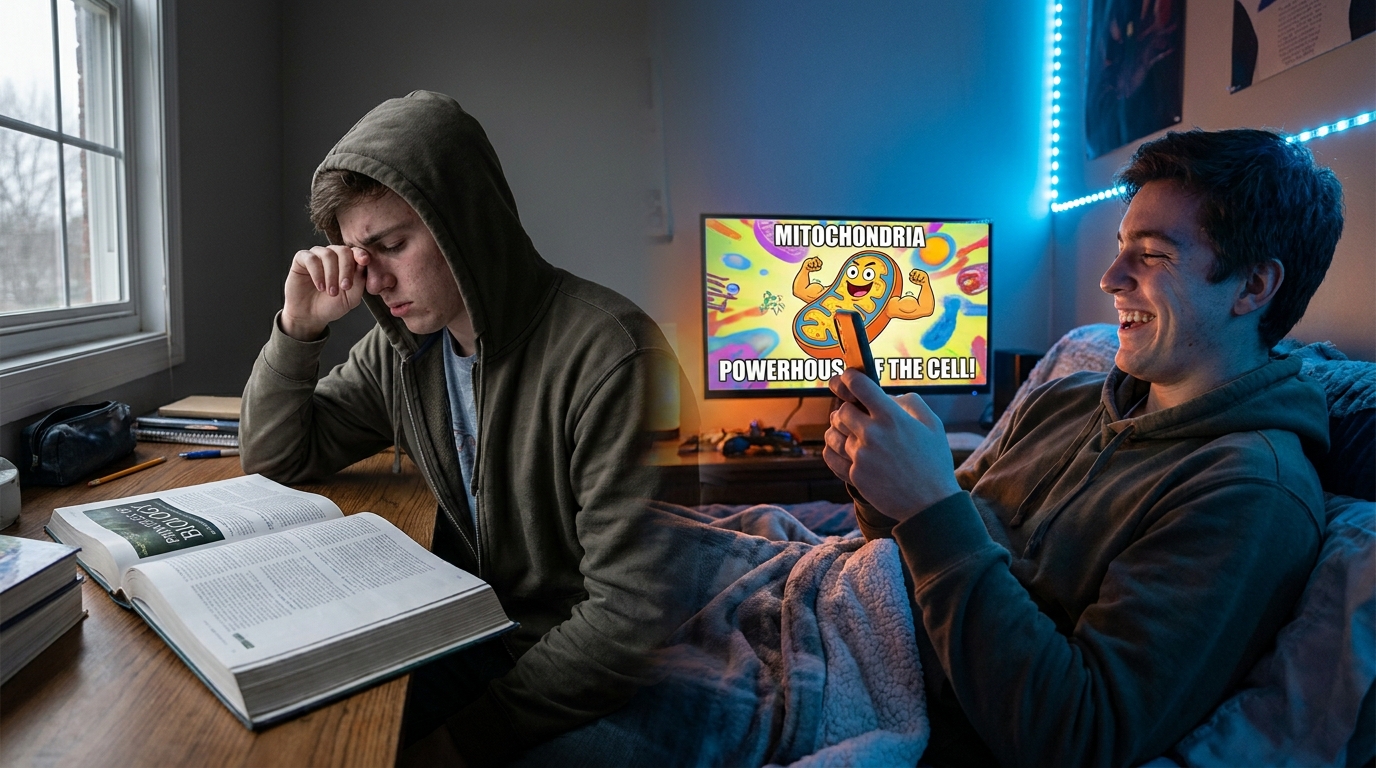
The same qualities that make brainrot studying effective, novelty, humor, stimulation, are the exact same qualities that make social media addictive in the first place. That’s not a coincidence. It means the line between “making a meme to study” and “scrolling memes instead of studying” is thinner than it feels in the moment.
A lot of general study advice out there tells students to just “use memes to make studying fun” without addressing this risk at all. That advice sounds nice but sets students up to fail, because it treats brainrot studying like a free win with no downside. It isn’t. Here’s where it actually goes wrong:
- You spend more time perfecting the joke than learning the fact. Editing a video for twenty minutes to get the timing right doesn’t teach you more chemistry. If the meme-making itself becomes the goal, you’ve lost the plot.
- You start scrolling for “inspiration” and never come back. Opening a meme app to find a format to copy is a direct path into the same feed that was distracting you in the first place.
- You mistake recognition for recall. Seeing your meme and smiling because you remember making it isn’t the same as being able to explain the concept cold on a test, without the meme in front of you.
- You only review the funny parts. Brainrot studying naturally pulls you toward the punchline-worthy facts and skips over the less “meme-able” but equally important details.
How to Use It Without Falling Into the Trap
The fix isn’t to avoid the technique, it’s to put guardrails around it.
| Guardrail | Why It Matters |
|---|---|
| Set a timer for meme creation (10-15 minutes per concept) | Stops perfectionism from eating your study time |
| Turn off notifications and stay in one app while making content | Prevents “research” from turning into scrolling |
| Test yourself without looking at the meme afterward | Confirms you actually learned the fact, not just the joke |
| Make memes for the hardest concepts, not just the funniest ones | Keeps you from skipping the boring-but-important material |
| Review the meme again a few days later, not just once | Uses spaced repetition instead of a single burst of effort |
Brainrot Studying vs Traditional Study Methods
It helps to see this side by side with other common study techniques instead of treating it like a total replacement for everything else.
| Method | Effort to Prepare | Memory Strength | Distraction Risk | Best For |
|---|---|---|---|---|
| Rereading notes | Low | Weak | Low | Quick refreshers only |
| Flashcards (active recall) | Medium | Strong | Low | Vocabulary, definitions, dates |
| Brainrot studying (memes/skits) | Medium to High | Strong (emotional + novel) | High | Confusing pairs, sequences, processes |
| Teaching someone else | Medium | Very strong | Low | Deep understanding of a full topic |
| Practice tests | Medium | Very strong | Low | Exam readiness |
Notice that brainrot studying scores well on memory strength but also carries the highest distraction risk of the group. That’s the honest trade-off. It’s not a magic replacement for flashcards or practice tests, it works best as one tool mixed in with the others, not the only method you rely on.
Who Actually Benefits Most From This Method
This style isn’t equally useful for everyone or every subject. It tends to work best for:
- Visual and story-based learners who remember images and narratives more easily than plain text
- Subjects with confusing, similar-sounding, or easily mixed up concepts
- Students who already spend time on social media and can redirect that same creative energy productively
- Topics with a clear sequence of steps, since acting out a process forces you to get the order right
It tends to work less well for:
- Subjects requiring precise numerical calculation practice, like solving equations, where repetition of the actual process matters more than memorizing a fact
- Students who already struggle with screen time management, since the format increases exposure to meme apps
- Last-minute cramming the night before an exam, since making quality memes takes real time upfront
Common Mistakes Students Make With Brainrot Studying
- Making memes about facts they already know well. The novelty benefit is wasted on stuff you’ve already memorized. Point this technique at your weakest areas instead.
- Never revisiting the meme after making it. One exposure isn’t enough for long term memory. Even a great meme fades if you never see it again.
- Using someone else’s meme instead of making your own. Scrolling through a “study meme” someone else made on the internet skips the active creation step that made this technique effective in the first place. Watching isn’t the same as making.
- Treating meme-making as a break from studying instead of part of it. If you tell yourself “I’ll study for real after I make this meme,” you’ve already framed it as separate from real work, which makes it easier to let it run long.
- Ignoring subjects that don’t lend themselves to humor. Not every topic needs to be forced into a joke. Some material is better served by straightforward practice, and forcing a meme onto it wastes time without adding memory benefit.
Frequently Asked Questions
Does brainrot studying actually work, or is it just an excuse to be on my phone? It can genuinely help memory when you’re actively creating something (not just scrolling existing memes), but the same features that make it effective also make it easy to get distracted. The technique itself is sound. The discipline around using it is what determines whether it helps or hurts.
How much time should I spend making a study meme? Ten to fifteen minutes per concept is a reasonable cap. If you’re spending longer than that, you’re likely polishing the joke instead of reinforcing the fact.
Can this replace flashcards or practice tests? No. It works best as an addition to active recall methods like flashcards and practice tests, not a replacement for them. Use it for the concepts that keep confusing you, and lean on more traditional methods for everything else.
Is this method backed by real memory research, or is it just a trend? The underlying principles, emotional encoding and novelty improving memory, come from well established memory research that predates the meme trend by decades. What’s new is the specific format (memes and short-form video), not the underlying psychology.
What subjects work best with this technique? Subjects with confusing pairs of concepts, multi-step processes, or content that benefits from a story or sequence tend to work best. Pure calculation-heavy subjects benefit less, since those need repeated practice of the process itself rather than memory of a fact.
Where This Leaves You
Brainrot studying isn’t a lazy shortcut and it isn’t a miracle cure either. It’s a real technique built on real memory principles, wrapped in a format this generation already understands instinctically. Used with a timer and a clear focus on your weakest topics, it can turn forgettable facts into things you actually remember on test day. Used without any boundaries, it turns into another reason to be stuck in a meme app instead of your notes.
Have you tried turning your notes into memes or skits? What’s the weirdest one you’ve made that actually helped something stick? Drop it in the comments, I’d genuinely like to hear it.


