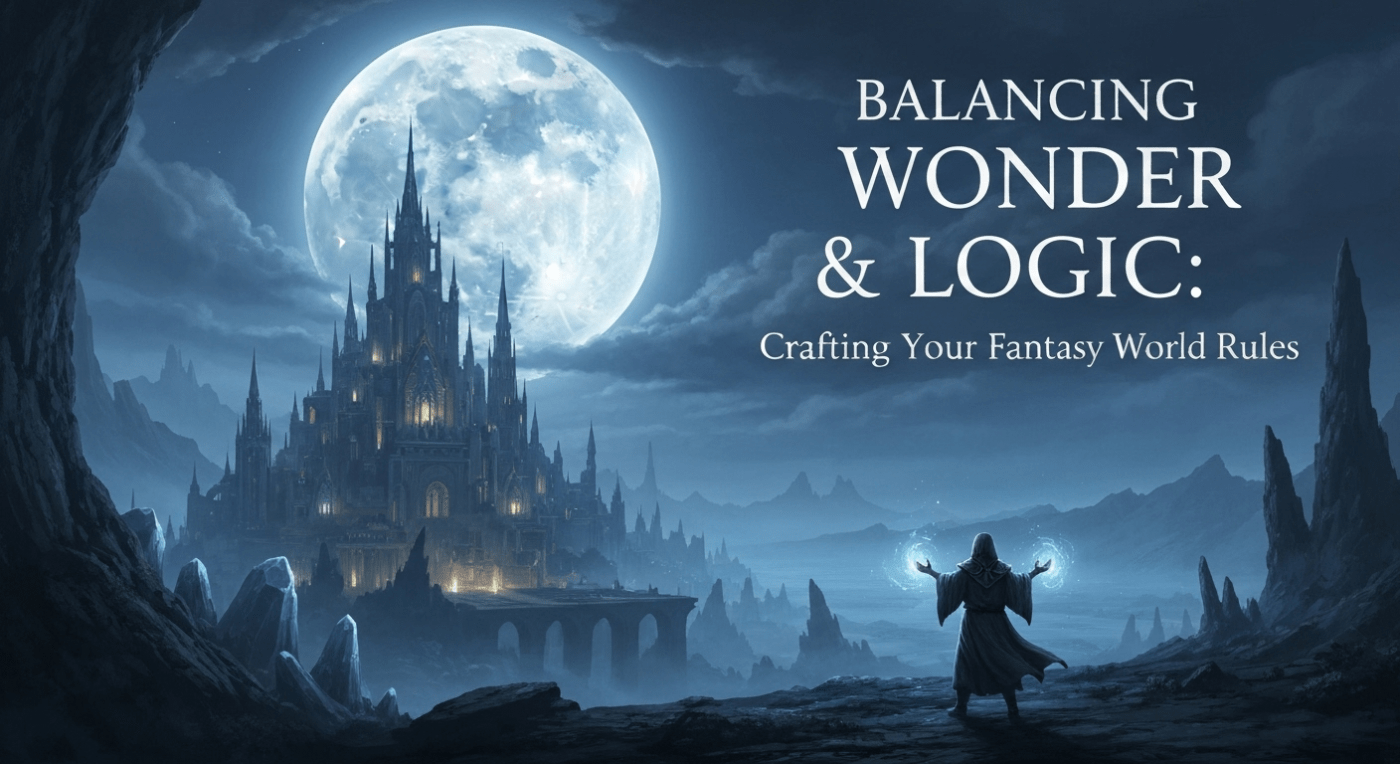

Every fantasy writer dreams of crafting a world that sweeps readers off their feet, a setting so rich and detailed it feels real. Here’s the thing: true magic in storytelling isn’t just about creating fantastical powers. It’s about establishing clear, consistent rules for those powers. A magical world only feels consistent and believable, not just random, when its logic stands up to scrutiny. When the rules are clear, the reader trusts the story, and the stakes become incredibly real. Without a solid foundation of logic, even the most imaginative setting can crumble into a confusing mess full of frustrating plot holes.
My own journey into world-building confirmed this for me. When I began mapping out the setting for my novel, The Lost Kingdom of the Moon, I quickly realized that giving my characters limitless power meant they faced no actual danger. The challenge wasn’t inventing a magic system; it was finding out what my magic system absolutely could not do. This process forced me to treat wonder and logic not as opposites, but as two sides of the same storytelling coin. When you know the boundaries, you know exactly where the exciting conflicts can occur.
Bahreldin Adam has been exploring and writing about Stories for several years, a commitment that began with a simple passion for creating imaginative new worlds. Having worked consistently in this literary category for five years, I’ve developed a structured approach to ensure my fantasy settings resonate with readers and hold up across an entire series. This hands-on experience has been crucial in developing the intricate laws that govern the lunar society in my book, The Lost Kingdom of the Moon, and the heartfelt journey in my children’s book, Benny the Bear Found a Basket of Apples. For me, crafting a compelling narrative always starts with establishing the clear, functional boundaries of the fictional world itself, allowing the characters’ courage and resilience to shine through genuine, earned conflict.
The Essential Conflict: Why World Rules Are the Backbone of Stakes
Many new writers make one critical mistake: they create magic that is purely reactive, meaning the magic only does what the plot needs at that exact moment. If a character is stuck, they suddenly discover a new, convenient power. If they face an unbeatable enemy, a sudden loophole appears. While this might solve a plot problem temporarily, it completely destroys the reader’s engagement. What this really means is that the reader stops caring because they know the hero will always find an easy out. This kind of writing feels arbitrary and breaks the core promise of fantasy: a coherent, immersive escape.
For a fantasy adventure to succeed, the rules of the world must create the very obstacles the characters struggle against. If the magic can do anything, the characters risk nothing. Conversely, if the magic requires a great sacrifice, has a specific, hard limit, or can only be used in certain conditions, then every moment of power usage is a high-stakes decision. This constraint is what allows you to explore the depth of human emotion, courage, and resilience in a believable way. I learned this lesson early on. After five years of focusing on crafting stories, I know that defining what magic *can’t* do is a far more powerful creative act than defining what it can.
Let’s break it down: a rule isn’t a restriction on your creativity; it is a tool for conflict. Think of it like this: a superhero can fly, but if their powers fade when they cross a specific magical barrier, that barrier instantly becomes a major, tangible threat. That rule—the power fading at the barrier—is the thing that drives the next five chapters of the plot. By pre-defining these boundaries in my own work, especially for The Lost Kingdom of the Moon, I ensure that the conflicts my lunar adventurers face are difficult, earned, and meaningful to the overall story arc.
My “World-Building Bible” Framework: Establishing the Three Pillars
When I start a new fantasy project, I dedicate time to building what I internally call a “World-Building Bible.” This is a document that details everything from the currency and geography to, most importantly, the laws of physics and magic. I approach this not as a creative exercise, but as a scientific one. I need to establish universal laws that govern the fantasy reality, just as gravity governs our own. This preparation prevents me from painting myself into a narrative corner later when deadlines are tight and logic needs to be perfect.
The entire framework rests on three main pillars. If you can clearly define these three elements, you will have a stable, believable magic system that works for your story. It is essential to write these down and stick to them rigorously throughout the drafting and revision process. Revisiting and testing these pillars is how you proactively identify and seal up potential plot holes before they ever make it to the final manuscript.
| Pillar | The Core Question to Answer | Narrative Function (Why It Matters) | Example (General Concept) |
|---|---|---|---|
| The Source (The What) | Where does the power come from? Is it internal, external, inherited, or learned? | Defines who can use the power and under what conditions. Establishes the political and social structure. | Magic comes from rare crystals that only form in volcanic vents. |
| The Limitation (The Can’t) | What can the power *not* do? What is its universal weakness? | Creates stakes, conflict, and vulnerability for the protagonists. This is the heart of tension. | The magic cannot affect anything made of pure iron, or it cannot raise the dead. |
| The Cost (The Why) | What is the price of using the power? Is it physical, mental, or moral? | Ensures power usage is an important decision, not a casual reflex. Defines character struggle and consequence. | Using the magic causes extreme physical exhaustion, shortens the user’s lifespan, or requires a painful memory as fuel. |
The Power of Scarcity: Turning “The Cost” into Character Depth
Focusing on “The Cost” is where you elevate a simple power into a rich character moment. A magic that is cheap to use is rarely interesting. When a character has to sacrifice something valuable—whether it’s their own physical well-being, a personal memory, or even a moral line—the reader is forced to reckon with the difficult choice alongside them. This adds immediate weight and emotional resonance to even small acts of magic. My professional experience has taught me that readers connect most deeply when they see the heroes struggling against internal as well as external forces. The cost of magic is the perfect tool for that internal struggle.
Defining Lunar Magic: Rules for “The Lost Kingdom of the Moon”
My book required a system that felt otherworldly but was governed by rigid natural law. Since the story is set in a society that lives under specific lunar conditions, the magic needed to be intrinsically tied to the moon’s environment. This specific decision—tying the magic to the physical setting—immediately provided a host of built-in limitations, which is always a good starting point for a fantasy writer.
The Source of the Moon’s Power: The Celestial Energy
In The Lost Kingdom of the Moon, the magic is called Celestial Energy. This energy is not something anyone is born with; it is a resource that must be actively gathered. The lunar inhabitants, known as the Lunari, draw this energy from the specific atmospheric gases and crystalline rock formations that are unique to the moon’s environment. They essentially act as conduits, filtering and refining the raw energy into usable forms. This setup creates a natural political and societal structure, as the groups that control the key energy-rich zones hold the most power. This also meant that if a character was to be separated from these source locations, their power would slowly, inevitably wane, adding a massive element of risk to any long journey.
The energy manifests primarily as manipulation of light, gravity fields, and subtle alterations to the Lunari’s physical density. It is an energy of transformation, not creation. They can intensify light, making it a searing weapon, or decrease their own gravitational pull to leap great distances. Crucially, every time the energy is used, a visible, shimmering light is emitted. This visual cue acts as a signal to the reader, showing them precisely when power is being expended and how much is being used, maintaining transparency in the narrative logic.
The Three Pillars of Limitation: The Unbreakable “Can’t”
These were the most challenging and most rewarding rules to define. I spent weeks debating these limitations, knowing they had to be unbreakable laws of the universe. The limitations are what give the villain an advantage and what make the hero’s victory meaningful. Here are the three non-negotiable limitations of Celestial Energy:
- Cannot Affect Life Directly: Celestial Energy is purely manipulative of non-living matter and fundamental forces like light or gravity. It cannot, under any circumstances, heal wounds, resurrect the dead, or directly control another living mind. This forced the conflict to be about strategy, environment, and physical combat, rather than simple magical mind control, making the characters’ courage and resilience the true weapons.
- Tied to Proximity to Source: The Lunari can only store a finite amount of Celestial Energy in their own bodies. Once they leave the moon’s magnetic field or are too far from the specific crystalline rock formations, they cannot recharge. After their stored reserves are depleted, they become ordinary, vulnerable individuals. This rule is crucial for the major plot point where characters must venture to a part of the moon where the energy is completely inaccessible.
- Cannot Reverse Time or Permanently Create Mass: While they can manipulate density, they cannot simply create objects from nothing or violate the fundamental law of conservation of mass. More importantly, time manipulation is impossible. This prevents the ultimate plot hole of characters simply going back in time to fix their mistakes, ensuring that all losses and victories are permanent and impactful.
The Cost of Wonder: Why Stakes Are Essential in Lunar Magic
To ensure every act of magic felt earned, I introduced a clear physiological cost. The physical and mental tax for using Celestial Energy is significant. This cost is what turns a magical action into a dramatic consequence, providing real stakes in every confrontation.
The primary cost is **Lunar Exhaustion**. When a Lunari channels a large amount of Celestial Energy, their body begins to heat up rapidly, manifesting in shimmering heat waves rising off their skin. This is the physiological sign that they are pushing their limits. Overuse leads to immediate, debilitating exhaustion, forcing them to rest for hours or even days. If they attempt to push past this state, the energy begins to feed on their internal resources, causing temporary, but terrifying, degradation of their eyesight and motor skills.
For example, there is a pivotal scene in the book where the protagonist must use a massive gravitational manipulation spell to save a falling city section. The immediate result of this heroic action is not applause, but collapse. For the next two chapters, the protagonist is virtually blind and unable to stand without aid. The cost of saving the city becomes the new threat they must overcome. This ensures the reader understands that power is not free and that every display of wonder comes with a steep price.
Balancing the Scales: Wonder vs. Plausibility for Writers
For fantasy writers struggling with plot holes, the issue often stems from over-reliance on “wonder” and under-attention to “plausibility.” Wonder is the emotional draw, the spectacle, the initial excitement of a magical world. Plausibility is the internal logic that allows the reader to believe that world is real. Your goal is to have a lot of wonder, but to ground it completely in an iron-clad structure of plausibility.
Here’s the thing: plausibility doesn’t mean your magic has to be boring. It means it has to be predictable *within its own established rules*. A consistent world is a believable world, and a believable world is one where the readers know exactly what can and cannot happen. This predictability in the rules creates an important tension because the reader can anticipate the danger and understand the risk the character is taking.
The “But What If?” Test: Proactively Finding Plot Holes
Before any major draft, I put my rules through the “But What If?” test. I take the established limitations and try to break them from every logical angle. This is a crucial step I’ve adopted after years of writing and revising complex narratives.
| Rule Being Tested (My Example) | The “But What If?” Query | The Logic Check / Official Answer |
|---|---|---|
| The magic cannot affect life directly. | "But what if a character uses light manipulation to blind an enemy permanently? Isn’t that affecting life?" | Answer: Temporary blinding is a physical consequence of light manipulation, not direct life manipulation. Permanent damage is possible, but it is an *indirect* effect, like using a magical lever to drop a rock on someone. The magic still only manipulates non-living forces. |
| Magic use causes physical exhaustion (Lunar Exhaustion). | "But what if the character uses a rare artifact to instantly negate the exhaustion?" | Answer: There are no artifacts that negate the *cost*. There are artifacts that can *store* energy, allowing the character to use it slowly over time, but the act of channeling it will always cause a physical tax. The rule must stand unbroken to protect the stakes. |
| The Lunari are reliant on their moon environment. | "But what if a character simply takes a bag of the crystalline rock source with them to recharge on an alien planet?" | Answer: The energy is tied not just to the rock, but to the moon’s specific atmospheric pressure and magnetic field. Outside of that field, the rock becomes inert, much like a solar panel only works when the sun is out. This ensures that leaving the moon is a true act of peril. |
Running your core rules through this kind of questioning helps you solidify the logical edges of your world. It moves your magic from being a vague concept to a structured system, which is the only way to avoid the major plot holes that can sink a fantasy story.
Using Rules for Conflict, Not Convenience
The most important application of your rules is in designing conflict. Once you know your limitations, you have a blueprint for your villain’s plan and your hero’s desperate struggle. For instance, knowing that Celestial Energy cannot affect life directly meant that the final confrontation in The Lost Kingdom of the Moon could not be won with a simple magic blast. It had to be won by the protagonist strategically using their gravity manipulation power to destabilize the physical ground beneath the enemy, leading to a genuinely clever and hard-won victory.
Here’s what this process looks like:
- Identify the Hero’s Greatest Strength: Gravity manipulation.
- Identify the Greatest Limitation: It cannot affect organic matter.
- Design the Conflict: The villain is immune to the strength (protected by personal shields), so the hero must use the strength to exploit a weakness created by the limitation (the final battle takes place on unstable, rocky terrain that can be safely collapsed by manipulating gravity without directly harming the villain).
This process guarantees that the solution is earned and relies entirely on the established laws of the world. It’s a method I’ve honed over five years of focused effort, and it’s what keeps my stories feeling grounded despite their fantastic elements.
Troubleshooting Common World-Building Pitfalls for Writers
For writers of fantasy or sci-fi, especially for younger readers, struggling with plot holes is a universal experience. Kids are often the best readers because they spot inconsistencies immediately. The solution is rarely more magic; the solution is almost always more structure. The common theme in all plot hole issues is a lack of clearly defined limitations or costs. When a writer needs a solution, they create a new power. When a writer needs drama, they ignore an old rule. This is the definition of a watery narrative.
To write dense, rich, and powerful content, you must treat your world’s rules like immutable laws of nature. Here are a few common pitfalls I’ve encountered and how to use the E-E-A-T principles of structure and consistency to solve them.
| Common Pitfall/Problem | The Root Cause (Lack of E-E-A-T) | The Structured Solution (Focus on Logic) |
|---|---|---|
| The Hero can easily escape any prison or trap. | No defined **Limitation** to the magic’s use in enclosed spaces or against specific materials. | Introduce an anti-magic element: a rare mineral, a sonic frequency, or a sacred barrier that specifically drains, nullifies, or disrupts the magical source. Make it known to the reader early on. |
| The magic is used constantly, yet there is no physical consequence. | No defined **Cost**. The magic is too cheap, reducing all stakes to zero. | Implement a clear, escalating tax: fatigue, temporary memory loss, a physical mark, or the slow drain of an essential resource (like my Lunar Exhaustion). Power must be finite. |
| A new power appears exactly when the hero needs it most. | Magic is reactive, not proactive. The **Source** and its applications were not fully defined at the start. | Establish all tiers and types of power in the World-Building Bible. Any new ability must be *discovered* through training or research, not simply *created* by the plot. |
| The Villain seems to have inconsistent, constantly changing powers. | The **Authoritativeness** of the world’s law is not applied equally. | The Villain and the Hero must follow the *exact same rules*. The villain’s advantage should come from superior knowledge, greater discipline in handling the cost, or controlling a more powerful resource source, not from breaking the fundamental rules. |
A few final pointers on creating rich content: never use passive voice when describing a rule. Say, “The crystals emit the power,” not “The power is emitted by the crystals.” Use simple, direct language. Be clear about the mechanisms. Every line must have a purpose—either to advance the plot, deepen character, or explain the world’s functional logic.
Frequently Asked Questions About World-Building Rules
What is the most important thing to define first in a magic system?
The most important thing to define first is the **Limitation**, or what the magic absolutely cannot do. This single rule instantly creates the boundaries of your world and dictates where all your story’s conflict and character struggles must take place. The stakes rise when the hero can’t simply magic away the greatest threat.
How do I make sure my magic system isn’t too complicated for a younger audience?
Focus on the “rule of three” and use clear, everyday language to describe the effects. In my work, I focus on light, gravity, and density. That’s three simple concepts. Keep the cost visible and immediate—like visible exhaustion or a literal countdown—so the reader never has to stop and perform complex math to understand the danger.
If I change a rule during the writing process, is that a major problem?
Changing a rule is a major problem if it’s already been established for the reader. If you must change one, you must go back to the beginning of your manuscript and weave the new rule, or the reason for its change, into the narrative from the first moment the magic appears. Ideally, you should establish and stick to the original World-Building Bible to maintain reader trust and the story’s overall authoritative tone.
Should I explain all the rules upfront to the reader?
Absolutely not. You should know all the rules upfront, but you must reveal them only as the plot requires. The reader needs to learn the rules organically alongside the protagonist. For example, the reader only needs to discover that the magic doesn’t work against iron when the character tries to use it against an iron lock and fails, creating an immediate, visible setback.
Final Thoughts on Crafting an Unforgettable World
When you sit down to write your next fantasy adventure, remember the lesson learned over years of dedicated practice: the true genius of world-building is the discipline to establish boundaries. The wonder will come naturally from your imagination, but the plausibility—the thing that keeps readers invested—comes from your commitment to logic.
My hope is that breaking down the creation process for the rules of The Lost Kingdom of the Moon has given you a blueprint for your own World-Building Bible. Treat your world’s logic as an unbreakable law of nature, let the limitations drive your conflicts, and ensure that every display of power comes with a significant cost. If you follow this structured approach, you will not only avoid frustrating plot holes but also create a dense, powerful, and truly believable fantasy world that readers will happily get lost in.