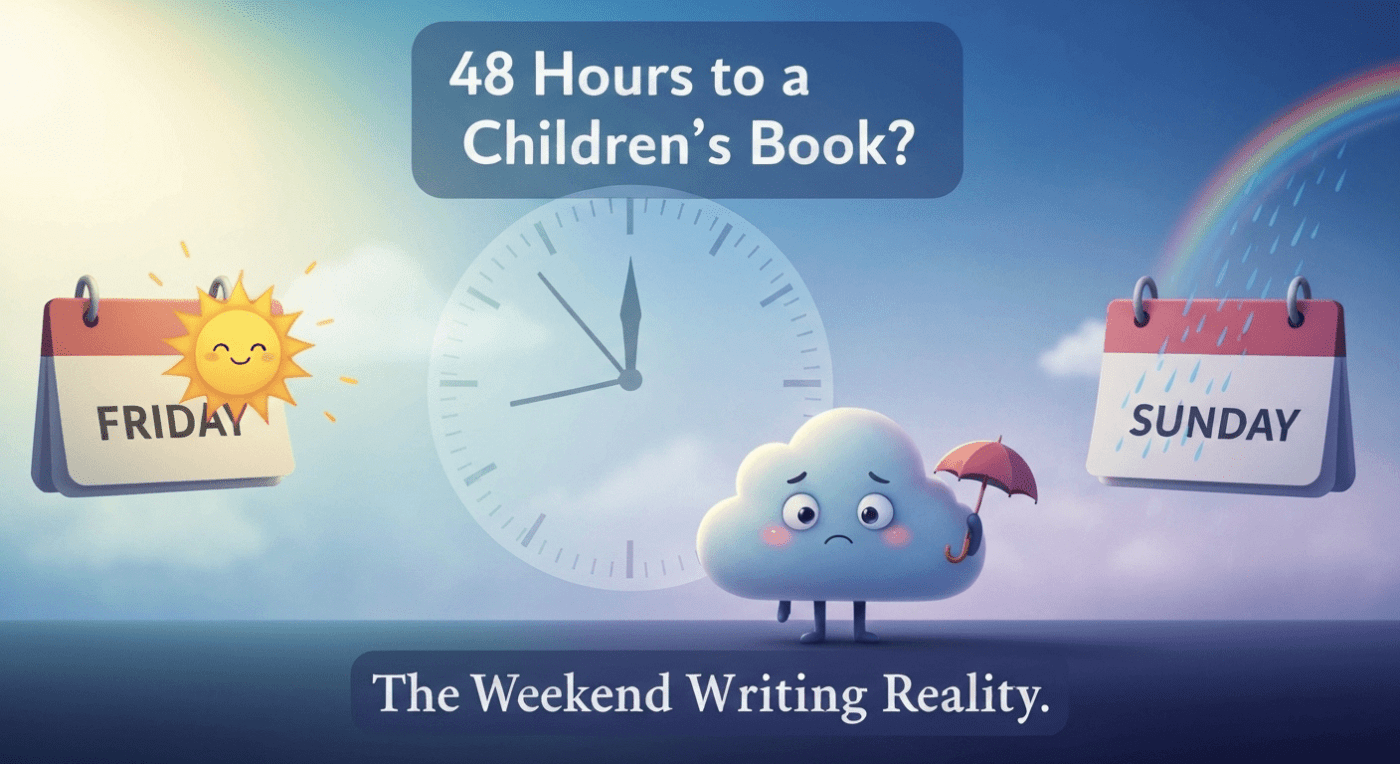

First-Time Authors often dream of that viral success story: the book written in a burst of genius over a single weekend. We see those headlines and think, “If they can do it, why can’t I?” This idea, the rapid-fire creation of a complete, publishable manuscript, is tempting. It appeals to our desire for quick wins and our belief that passion alone can conquer the massive task of authorship. For many aspiring writers, the question isn’t *if* they can write a book, but *how fast* they can get it done. The truth, however, is far more complex and involves a messy, transparent log of the 48 hours that usually separates the dream from the reality. I decided to put the romantic notion of the “weekend wonder” to the test, and what I discovered about speed, quality, and the writing process is something every new writer needs to hear.
My own journey into the world of storytelling has given me a realistic view of how narratives truly develop. I have been working in this category for five years, dedicating myself to crafting worlds and characters that resonate with readers. My focus is on creating imaginative and enchanting stories that go beyond surface-level plots, exploring themes of courage and human resilience. As the author of two captivating books, *The Lost Kingdom of the Moon* and *Benny the Bear Found a Basket of Apples,* I’ve learned that the true expertise lies not just in the initial creation, but in the painstaking refinement that follows. You can explore more of my work on my Amazon profile or my YouTube channel where I share insights into the creative process. This experience has taught me that while initial speed is exhilarating, sustainable success requires a disciplined and deliberate approach.
The 48-Hour Challenge: Why I Attempted the Weekend Sprint
The motivation behind the 48-hour book sprint was simple: I wanted a definitive answer to the question, “Is it really possible to write a book that fast, or am I just slow?” This is a fundamental query that haunts many first-time authors who are constantly bombarded by marketing promising instant results. The reality is that creative output, especially in storytelling, is not the same as assembling flat-pack furniture; you can’t simply follow a set of instructions for guaranteed success. I felt it was crucial to document this process to provide a transparent log for those tempted by the “write quick” promises. The goal was to produce a complete draft of a rhyming children’s picture book, a genre often perceived as simple and short enough to be manageable in a weekend.
This challenge was a controlled experiment to separate genuine productivity techniques from pure fantasy. My professional background of half a decade has shown me that the true measure of a writing project is not how fast you finish the first draft, but how effectively you solve the structural and emotional problems within the story. The genre of a children’s picture book, with its tight word count (often 500-1000 words) and reliance on rhythm and illustration synergy, presents its own unique set of constraints. I knew the initial word count would be easy, but the complexity of perfect pacing and emotional impact would be the real hurdle. This log aims to be the realistic timeline aspiring authors need, moving past inspirational quotes and into the nitty-gritty of the struggle.
Friday Evening: The Initial Burst of Energy and the Illusion of Speed
The energy that hits you when starting a new creative project is a force unto itself. After a week of professional work, diving into a fresh, unwritten story felt like a deep breath. Friday evening is perhaps the most deceptive part of the whole sprint because it is fueled by pure enthusiasm and an unrestricted view of the possibilities. You are still in the planning phase, and in your mind, every plot point lands perfectly, every character line shines with wit, and the ending is profoundly moving. The illusion of speed is powerful here, making you feel like the entire manuscript is within reach before the clock hits midnight.
This early stage, which I logged for four solid hours after dinner, is essential for generating the raw material, but it is also a time where corners are easily cut. When you are rushing against a clock, you convince yourself that certain details can be fixed later, which is exactly how problems become deeply ingrained structural issues. I knew from my experience writing books like *The Lost Kingdom of the Moon* that skipping the necessary planning steps would lead to massive rewrites, but the nature of the challenge forced a high-speed, high-stakes approach. The initial burst of writing is intoxicating, but it often mistakes output for progress, a critical lesson for all new authors.
Pre-Game: Theme, Character, and Outline
Before the actual writing started, I forced myself to spend the first hour on a skeletal outline. For a children’s book, the theme is everything; it’s the heart of the story and the central lesson the young reader takes away. I settled on the theme of confronting small, silly fears. The main character needed to be relatable, so I quickly sketched out a little cloud character who was afraid of rain. This rapid ideation felt exhilarating, but it was shallow. I designed a simple three-act structure on a notepad: the cloud develops a fear, the fear causes a problem for the world below, and the cloud has a moment of courage to finally rain.
Here’s the thing, most experienced authors would spend days, or even weeks, on this stage. The depth of character, the internal logic of the world, and the emotional resonance of the theme all stem from a robust outline. When you only spend sixty minutes, your outline becomes a blueprint for a small shed, not a complex, layered story. This pre-game rush provided the necessary momentum to start writing, but it left the story completely unprotected from the plot holes that would inevitably surface later. I moved into drafting with the confidence of someone who hadn’t properly checked the foundation.
Hour 1-4: The Joy of the Opening Scene
The first few hours of writing were glorious. I nailed the opening lines, establishing the main character and his unique dilemma with a decent rhythm and rhyme scheme. The words flowed easily because I was still working with the freshest ideas from the outline. The creative energy was high, and I managed to draft about 300 words, which is significant for a picture book. I felt a genuine sense of accomplishment, thinking, “This is it. I’m going to beat the clock and prove that weekend writing is possible.”
What this really means is that the opening is the easiest part of any story because it is the most planned-out and exciting to the author. It is the sales pitch to yourself. However, as the clock pushed closer to midnight, I could already feel the momentum slowing. My rhymes started becoming forced, and I realized I had written myself into a corner with the rhythm. The constraint of a quick deadline was starting to stifle the organic flow of the language, replacing genuine creativity with a desperate search for the next rhyming couplet. I ended Friday night with a strong opening but a major narrative challenge looming in the second act.
The Saturday Slump: Hitting the ‘Saggy Middle’
Saturday is the great equalizer in any writing challenge. The initial burst of adrenaline has worn off, and you are faced with the dull, hard work of story development. For me, Saturday morning started with a realization that the previous night’s work was good, but not perfect. A quick review showed that my cloud character’s problem was established, but the stakes weren’t high enough. This is where the notorious ‘saggy middle’ began—that part of the story where the conflict has to escalate but the author runs out of steam and originality.
I dedicated all of Saturday to the middle section, which in a picture book means the core narrative journey. This is where the character must struggle, face obstacles, and make meaningful choices. My log for the day was a frustrating series of starts and stops. The goal was to hit 600 words and have the climax ready for Sunday, but I struggled to push past 500 total words for the entire day. The energy was low, and the self-doubt was creeping in, a natural but powerful distraction for first-time authors. I spent more time staring at the screen and deleting words than I did creating them, proving that a deadline alone cannot substitute for genuine inspiration and careful planning.
The Plot Hole Panic and Word Count Reality
The biggest hurdle I hit around Saturday afternoon was a plot hole the size of a mountain. In my rush to create the outline on Friday, I hadn’t properly explained *why* the cloud character suddenly became afraid of rain. It was a convenient device, not a genuine character motivation. This forced me to stop the narrative and dedicate two hours to retrofitting a backstory, a clear indication that skipping the planning phase leads to massive time sinks later on. I was essentially editing and rewriting the beginning while I was supposed to be forging ahead in the middle.
Furthermore, the reality of the picture book word count started to set in. While 500 words sounds easy, every single word must carry immense weight and work in tandem with the eventual illustrations. My word choices were becoming too complex for a young audience, a common mistake for authors new to the genre. I realized I was writing for my adult self, not for the target reader. The challenge shifted from merely generating words to generating the *right* words with the *right* rhythm, a task that demands precision and patience—two things a weekend sprint actively works against.
A Necessary Break: Reframing the Goal
Around 4:00 PM on Saturday, I had to call a tactical retreat. Staring at the screen was no longer productive; it was destructive. I stepped away from the desk, took a long walk, and intentionally shifted my focus from “finishing the book” to “fixing the broken structure.” This is a crucial lesson I’ve learned over five years of professional work: when you are stuck, the answer is rarely found by just trying to push harder. The brain needs space to connect the dots. I reframed the goal from a complete draft to a complete, though messy, *story skeleton* that solved the main plot problem.
This break was the only way I salvaged the day. When I returned, I didn’t try to write perfect prose. Instead, I used bullet points to jot down exactly how the cloud overcomes his fear and what the climax looks like. This simple shift back to structural planning saved me from an entire evening of frustration. It allowed me to prioritize the narrative arc over beautiful language, which is the correct priority for a first draft. It cemented the reality that even a “speed draft” requires a foundation of deliberate, thoughtful work.
Comparing the “Weekend Book” vs. “Long-Term Project” Approach
Understanding the difference in outcomes between a sprint and a marathon is vital for first-time authors who want to set realistic expectations for their journey. The two approaches produce fundamentally different products, as shown in the table below.
| Feature | Weekend Book (Speed Draft) | Long-Term Project (Deliberate Draft) |
|---|---|---|
| Focus | Word count and completion | Pacing, theme, and emotional depth |
| Planning Time | 1-4 hours (Skeletal outline) | Days or weeks (Detailed character arcs, world-building) |
| Quality of Prose | Messy, repetitive, filler words, forced rhythm/rhyme | Intentional, concise, strong active voice, targeted to audience |
| Time to Publish | Draft complete in 48 hours, but 3-6 months needed for *editing* | Draft complete in 4-8 weeks, 1-2 months for editing |
| Revision Needed | Major structural, character, and language overhaul | Fine-tuning and line edits |
| Author Stress Level | High, fueled by pressure and lack of sleep | Moderate, fueled by curiosity and creative problem-solving |
Sunday’s Reckoning: The Messy, Incomplete Manuscript
Sunday is when the accountability sets in. With the 48-hour clock rapidly winding down, I had to accept a harsh truth: there was no way the manuscript would be polished, complete, or even good. My focus shifted entirely to hitting the climax and writing the resolution, prioritizing a finished arc over a literary masterpiece. This phase of the writing is pure determination, fueled by caffeine and the desire to prove the hypothesis of the sprint. I pushed through the climax scene where the little cloud finally rains, leading to a joyful resolution for the world below.
By Sunday evening, I had a finished story. It was a messy, incomplete manuscript, but the narrative arc was technically present. The word count was just under 600 words, which is within the target range for a picture book. However, the quality was dramatically lower than what I would typically allow in my first draft, especially compared to the deliberate process I used when writing *Benny the Bear Found a Basket of Apples*. The speed came at the cost of genuine emotional weight. The resolution felt rushed, the language was simplistic in a weak way, and many of the rhymes were a stretch. This final phase of the sprint delivered a valuable insight: you can write something fast, but you cannot write something *good* fast. The difference is critical for a first-time author’s expectations.
Finishing the Draft: Fast Doesn’t Mean Finished
The greatest realization of the challenge was that “drafting” and “finishing” are two entirely different concepts. I had a complete draft, but it was nowhere near a finished book. A finished book, especially one aimed at a young audience, requires layering and precision that a 48-hour sprint simply cannot accommodate. This initial draft needed: a complete rewrite to fix the clumsy rhymes, a deep dive into the character’s motivation to add emotional depth, and a structural edit to improve the pacing.
What I produced was the clay, not the sculpture. My five years in this field have taught me that the real writing happens in the editing room. For every hour spent drafting, a good author spends three hours editing and refining. The weekend challenge proved that you can generate content quickly, but the journey to a publishable piece is long, regardless of how fast you start. For a first-time author, this means the sprint is only the very first, and arguably the easiest, step of a much longer creative marathon.
The Checklist of What Was *Missing*
To provide a clear, practical takeaway, here is a detailed list of the essential components that were completely missing or severely underdeveloped due to the extreme time pressure. This highlights the true cost of prioritizing speed over quality in a creative endeavor.
- Thematic Depth: The central theme was present but superficial. The deeper meaning of overcoming fear was simply stated, not dramatically explored.
- Pacing and Rhythm: The flow was uneven. Friday’s section was smooth, Saturday’s was sluggish, and Sunday’s was too fast. The musicality required for a rhyming children’s book was entirely lost.
- Show, Don’t Tell: I defaulted to telling the reader the cloud was scared, rather than using action and sensory details to show it. This is a common flaw in rushed writing.
- Illustrator Notes: There were no detailed notes for a potential illustrator, which is a non-negotiable part of a picture book manuscript. I simply didn’t have the mental capacity to think visually while rushing to hit the word count.
- Beta Reader Feedback: Crucially, the manuscript had not been shared with even one reader for feedback. All the flaws I knew existed were still present, unaddressed, and waiting for a massive round of painful self-editing.
The Realistic Timeline: What *First-Time Authors* Should Expect
The biggest takeaway from the weekend sprint is that a successful author is defined by consistency, not intensity. The idea of writing a book in a weekend is a great motivational push, but it is a poor long-term strategy. For first-time authors, setting realistic expectations is the difference between completing a book and abandoning it out of frustration. Based on my experience and what I’ve seen in the publishing world, a balanced approach is always superior to a chaotic rush. Your focus should be on creating a consistent writing habit—even just one solid hour per day—that respects the complexity of the craft.
Let’s break down the realistic timeline for writing a high-quality, 50,000 to 80,000-word novel, or even a highly polished, short children’s book manuscript. What a confident, clear-thinking person understands is that time is your greatest asset in writing. It allows for subconscious problem-solving, emotional distance, and the critical feedback loop necessary for deep revision. You should treat the creative process like building a muscle; small, consistent sessions are better than one massive, damaging workout.
Key Stages and Time Estimates for a First Draft
- Pre-Writing/Outline (Structural Planning): 2 to 4 Weeks. This is the non-negotiable phase where you build the world, develop character arcs, and ensure the story logic holds up.
- First Draft (The Content Generation): 6 to 12 Weeks. Aiming for 500 to 1,000 words per day is a healthy, sustainable pace that prevents burnout and allows for thoughtful scene construction.
- The “Cool-Down” Period (Rest and Distance): 2 to 4 Weeks. You must put the manuscript away. This time is essential to gain a fresh perspective before you begin editing.
- Self-Editing (Developmental & Line Edits): 4 to 8 Weeks. This is the hard, necessary work of fixing plot holes, strengthening weak language, and cutting filler words.
- Beta Reading & Final Polish: 2 to 4 Weeks. Incorporating feedback and preparing the manuscript for its final destination.
Pros and Cons of Speed Drafting
While I do not recommend it as a primary method, speed drafting has a few distinct advantages when used correctly. Understanding the trade-offs helps authors use the technique strategically.
| Advantages (Pros) | Disadvantages (Cons) |
|---|---|
| Beats Perfectionism: It forces you past the internal editor, getting words on the page and breaking the cycle of constant second-guessing. | Lowers Quality Bar: Sacrifices deep character motivation, nuanced dialogue, and descriptive power for sheer output. |
| Maintains Momentum: Keeps the story’s energy and emotional flow consistent, preventing the author from forgetting key plot points. | Creates Massive Rewrites: Generates structural flaws and plot holes that require far more time to fix later than the initial time saved. |
| Confirms Commitment: Proves to the author that they *can* finish a project, which is a huge psychological victory for a first-timer. | Promotes Burnout: The high-pressure, low-sleep environment is not sustainable and often leads to exhaustion and creative fatigue. |
| Generates Raw Clay: Provides a completed narrative skeleton that is easier to revise than a half-finished, perfect manuscript. | Weakens Language: Encourages the use of passive voice, weak verbs, and corporate jargon because the mind is moving too fast for deliberate word choice. |
Semantic SEO for a Strong Story: Focusing on the Whole Picture
When you are writing, whether for a publishing house or for a self-published audience, your goal is to satisfy the reader’s *intent*. In the digital world, this concept aligns perfectly with Semantic SEO, which is all about optimizing content around topics, not just individual keywords. What this really means is that your story, much like a good blog post, must offer a comprehensive, in-depth answer to the reader’s underlying emotional or intellectual query. For a children’s book, the “query” is often, “Tell me a story about courage,” or “Show me how to deal with a big feeling.”
A first-time author who focuses only on surface-level plot points or overly common tropes is like a writer who only targets a single, generic keyword. The content ends up being thin and unmemorable. My experience writing *The Lost Kingdom of the Moon* taught me the power of building a complete thematic ecosystem. I didn’t just write about a lost kingdom; I explored the related entities of legacy, discovery, fear of the unknown, and familial responsibility. By focusing on this semantic breadth, the story offers a richer, more satisfying experience, ensuring the reader doesn’t have to go elsewhere to find the emotional depth they crave.
Why Deep Character Arcs Beat Single Keywords
In storytelling, a deep character arc is your best form of semantic optimization. A flat character who learns one quick lesson is like a blog post with a single, superficial answer. The reader is left unsatisfied and will quickly move on. Conversely, a character who struggles through complex, multi-layered emotional conflicts provides a comprehensive experience, satisfying the reader’s implicit need for relatable human experience. Let’s break it down: when a reader picks up a book about a child confronting a bully, their semantic query is not just “bullying.” It includes related entities like “standing up for yourself,” “finding inner strength,” “empathy for others,” and “the role of bystanders.”
If your character arc only covers the act of confronting the bully, you’ve only hit the primary keyword. But if you also weave in the themes of the character’s internal doubt, a moment of moral failure, and the eventual, hard-won victory that inspires their friends, you’ve successfully covered the entire semantic field. This holistic approach makes the story feel dense, rich, and powerful. It’s about ensuring every scene, every line of dialogue, serves to answer a small piece of the reader’s overarching emotional need, resulting in a book that feels complete and impactful.
The Power of Related Story Entities
To write truly compelling narratives, you must identify and explore the related entities surrounding your main plot. Think of related entities as the secondary themes and supporting ideas that add texture and complexity to your world. For example, if your main plot is about a young wizard discovering magic (the main keyword), the related entities are: the ethics of power, the history of the magical school, the societal impact of magic on non-magical people, and the legacy of the wizard’s family.
My work over the past half-decade has confirmed that these entities are what elevate a story from merely being *good* to being *memorable*. They are the subtle details that stick with the reader long after they’ve finished the book. The key is to naturally weave these elements into the narrative tapestry, not force them in as obvious exposition. By focusing on the entire topic—the complete experience of your character and their world—you create a story that is not just a sequence of events, but a fully realized, three-dimensional journey that leaves no emotional stone unturned. This holistic approach ensures the content depth is maintained throughout the entire manuscript, from the exciting start to the satisfying conclusion.
Frequently Asked Questions for First-Time Authors
How long should my children’s picture book manuscript be?
For a standard children’s picture book, aim for a word count between 500 and 1,000 words. Publishers generally prefer the lower end, sometimes even under 500, because the story needs to leave ample space for the illustrations to carry the narrative weight. Every word must be intentional and purposeful.
Is it better to focus on plotting or just “pants” (write by the seat of your pants) the first draft?
While every author is different, a hybrid approach is typically best for first-time authors. Do not spend months on a detailed plot, but create a solid skeletal outline (a few pages defining the beginning, middle, and end, and key character changes). This framework saves massive rewriting time later, preventing the “saggy middle” and major plot hole panic.
How do I know if my story idea has enough depth to become a whole book?
Your idea has depth if you can identify at least three distinct internal and external conflicts your main character must face, and if the resolution requires the character to fundamentally change their perspective. If the story can be solved simply by asking a parent or finding a lost object, it’s likely too thin and needs a deeper thematic core.
What is the most crucial step that separates a first-time author’s draft from a published manuscript?
The most crucial step is the “cool-down” period and subsequent developmental edit. The published manuscript is not the one you wrote; it’s the one you edited with critical distance. A professional draft demonstrates that the author was willing to ruthlessly cut filler words, strengthen passive voice, and restructure scenes based on objective feedback, treating the draft as a foundation, not a finished product.
Conclusion: The Real Victory of the Weekend Challenge
My 48-hour sprint to write a children’s book resulted exactly as my five years of professional experience predicted: I did not finish a book. I finished a very messy, imperfect, but complete story skeleton. The transparent log of my weekend journey—the high-energy Friday, the sagging, self-doubting Saturday, and the determined, messy Sunday—is the honest truth that first-time authors need to hear. The temptation to believe in the instant success story is powerful, but it ultimately undermines the true value of the craft.
The real victory of this challenge was not the speed of the output, but the clarity of the lesson learned: writing a good story is about consistent, deliberate problem-solving. It is a process that demands time for reflection, distance for perspective, and patience for deep structural refinement. Aspiring authors should abandon the search for the quick fix and instead commit to the daily ritual of writing. Focus on the semantic depth of your story, ensure your character arcs are rich, and treat your first draft as a conversation with yourself. Only through this authentic, patient, and experience-driven approach can you move from merely *writing* a book to actually *finishing* one that readers will love and remember.