
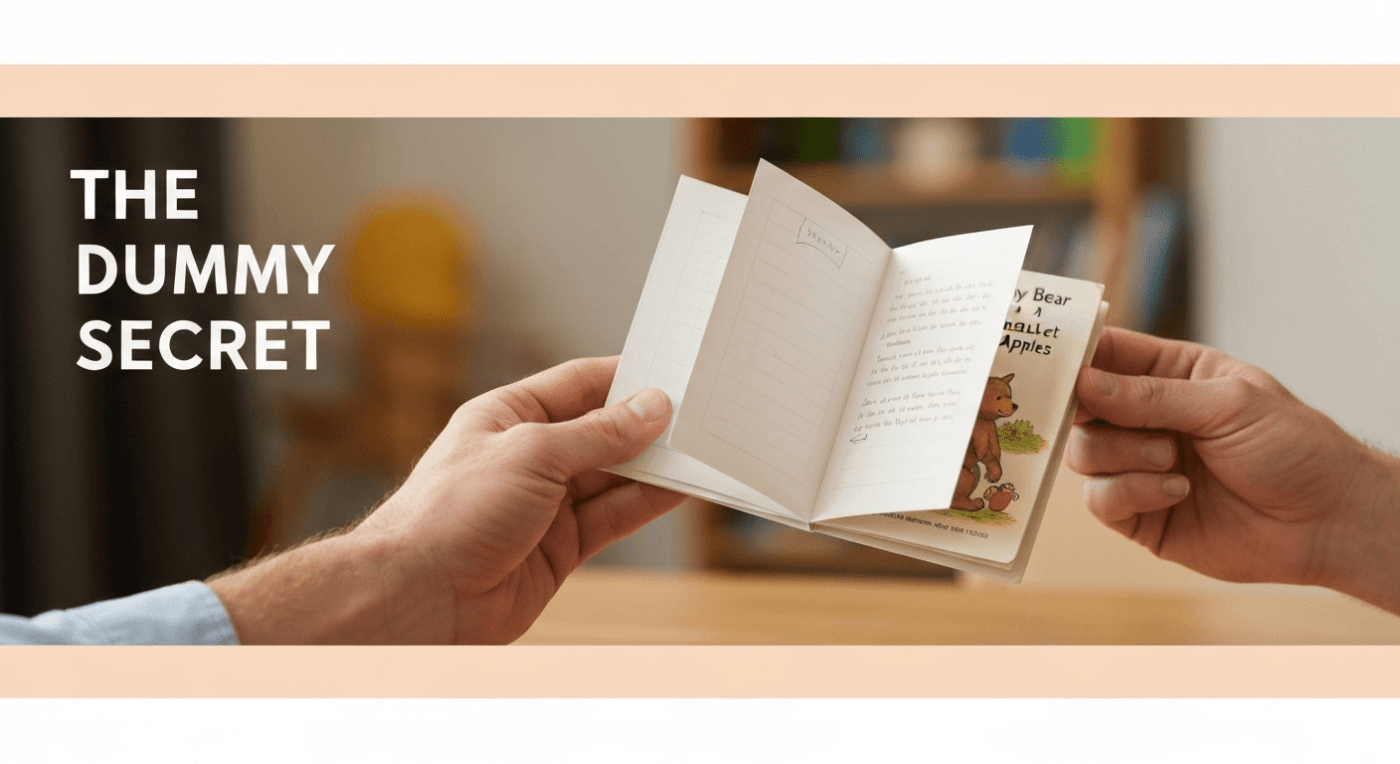

Picture book authors who don’t illustrate face a unique and frustrating question: How do I know if my story’s pacing is right for a 32-page picture book? You can polish the text until it shines, but until you see it laid out, you are essentially flying blind. You might have too much text on one page, a weak cliffhanger on a crucial turn, or a climax that happens too early. The solution is simple, affordable, and incredibly effective: the picture book “dummy.” This isn’t just a craft project; it is the ultimate editorial tool for any serious writer in this field.
The Core Challenge: Why Picture Book Pacing is Different
When you write a novel, you worry about chapters and paragraphs. When you write a picture book, you worry about the spread. That’s the most critical distinction. A picture book is not just a story; it’s a choreographed visual and textual experience. The industry standard book length is 32 pages, and every single page counts. This constraint forces you to think in rhythmic blocks, which is where many new authors, and even experienced ones, often stumble.
Here’s the thing: a page turn in a picture book is a form of punctuation. It’s a moment of suspense, a breath, a drum roll before a reveal. If you turn the page and the new information is anticlimactic, you’ve lost the reader’s energy. If you hold back a crucial piece of information for too long, you might lose their interest altogether. What this really means is that your manuscript must be written with the 32-page physical structure in mind from the very beginning. You must embrace the constraints.
The standard 32-page format is generally organized around signatures—large sheets of paper folded and cut in multiples of four or eight. Knowing this helps you understand why 32 is the magic number. It is an economic decision by printers, but for the author, it becomes a structural necessity. You need to assign your text to these blocks, even before you have an illustrator assigned, to ensure your story unfolds with professional precision.
The Anatomy of a 32-Page Picture Book
| Pages | Purpose and Pacing Goal | Author’s Focus in Dummy |
|---|---|---|
| 1-2 | Title/Copyright/Dedication | Not a story page. Skip to page 3. |
| 3-5 (First Spread) | Setup and Hook | Establish the character, setting, and main problem. Must grab attention. |
| 6-14 | Inciting Incident & Rising Action | Introduce the main conflict and first few attempts at solving it. Page turns build momentum. |
| 15-24 | The Crisis/Climax | The main turning point. The peak of the tension. Often ends on a dramatic page turn. |
| 25-28 | Falling Action & Resolution | The problem is solved, and the tension releases. Pace should slow down slightly. |
| 29-32 | End Pages, Final Thought, About the Author | Emotional cooldown and final takeaway. Pages 31-32 are often the very last moment. |
Building the Blueprint: My Step-by-Step Guide to the Picture Book Dummy
A picture book dummy is a hand-made, un-illustrated mock-up of your book. It is a paper tool that lets you physically experience the page count, the page turns, and the flow of your words. When I first started working on my stories, I realized quickly that simply counting pages in a Word document was pointless. I needed the tactile experience, and this simple process has become essential in my five years of writing.
Gathering Your Materials: Simple Tools for a Powerful Process
The beauty of this method is its low barrier to entry. You do not need expensive software or printing services. The whole point is speed and iteration. You want to be able to make a new dummy in less than ten minutes if you decide a whole scene needs to shift. I always keep these basic supplies on my desk:
- Eight sheets of standard A4 or Letter paper.
- A single pair of scissors or a craft knife.
- A stapler or a glue stick.
- A reliable pen for handwriting the text and notes.
This is where the hands-on experience matters. You need to feel the thickness of the paper and understand how the folded signature feels in your hand. This helps you empathize with the child or parent who will be holding the final product. It makes your manuscript feel real, not just digital.
The Folding Technique: Creating a True 32-Page Miniature
The folding process is the most crucial step because it replicates the actual printing process. Do not just stack 32 separate pages and staple them. That does not mimic the physical experience of a real book. You need the pages to be connected, creating a single unit.
Let’s break it down: eight sheets of paper, folded twice, makes 32 pages.
- The Start: Take one sheet of paper and fold it in half horizontally (hot-dog style).
- The Second Fold: Fold it in half again, vertically (hamburger style). Now you have a small rectangle.
- The Third Fold: Fold the rectangle in half one last time.
- The Assembly: Repeat this process for all eight sheets of paper.
- The Insert: Unfold the sheets just enough so they are folded in half once, forming a stack of eight folded sheets.
- The Bind: Staple or sew the eight sheets together along the central fold (the spine).
Now, you have a solid booklet. The important part is the *page numbering*. Number your pages 1 through 32, *before* you put your text in. You will quickly see that page 1 and page 32 are on the outside of the first and last sheets, while pages 16 and 17 are on the inside of the fourth sheet. This visual guide immediately anchors your story to its physical form. I never skip this step; it is the foundation of structural editing.
The Pacing Power of the Dummy: Finding the Perfect Page Turn
Once your dummy is built, the real work of pacing begins. You literally handwrite your manuscript text, line by line, page by page, into the little book. You might be surprised to see that a seemingly short paragraph in your word processor suddenly fills two full pages in the dummy, wrecking your intended pace. The dummy forces honesty.
The *Benny the Bear* Example: Building Suspense with Strategic Turns
When I was drafting *Benny the Bear Found a Basket of Apples*, I initially placed the discovery of the apple basket too early—around page 7. My first dummy showed me that this reveal was weak. It didn’t have room to build excitement. The page turn was a casual flip, not a dramatic reveal.
I took my hand-made paper dummy, the one I’ve used dozens of times in my process, and circled the crucial pages. I saw that I had four full pages (a total of two spreads) that were filled with fluff before the actual action started. To fix this, I completely restructured the opening:
- Old Draft (Page 7 Reveal): The story moved too fast. Benny found the basket, and the challenge (getting the apples home) began immediately. The reader didn’t have time to connect with Benny’s initial need.
- Dummy-Adjusted Draft (Page 13 Reveal): I used the pages from 7 to 12 to show Benny’s growing hunger, his quiet searching through the woods, and a series of comical near-misses. This built anticipation.
The actual reveal of the glowing, perfectly full basket of apples was placed on page 13, and the facing page, page 12, held the text describing Benny’s tired, almost defeated sigh. The page turn from 12 to 13 became a moment of pure relief and joy. That strategic placement, thanks to the dummy, built significant suspense and created a powerful, satisfying beat for the reader. It transformed a mild discovery into a mini-climax, exactly the kind of intentional pacing that professional picture books rely on.
Mastering the Emotional Beat: Using the Spread for Impact
A key concept is the difference between a page and a spread. A page is one unit; a spread is two facing units. In a 32-page book, you have roughly 15-16 spreads for your story. You must use the spread itself to convey a single, powerful emotional beat. The text on the left page and the text on the right page should work together, often revealing parallel or contrasting ideas. Here are three common uses of the spread:
- Action-Reaction Spread: The text on the left page describes an action (e.g., “He shouted the biggest, loudest roar he could manage”). The text on the right page describes the reaction (e.g., “But all that came out was a tiny squeak”). This maximizes the humor or tension.
- Before-and-After Spread: The left page shows the problem in full detail. The right page immediately provides the initial, often flawed, attempt at a solution. This moves the story forward quickly.
- The Quiet Pause Spread: Often used right before the climax or after a burst of energy. The text is minimal, allowing the potential illustration—and the reader—to take a moment to breathe and absorb the gravity of the situation. This is where I ensure the page is under ten words, forcing the illustrator to carry the emotional load.
Common Pacing Pitfalls and How the Dummy Solves Them
In my experience working with the 32-page format, certain structural issues come up repeatedly. New authors often have a fantastic idea but a flawed framework. The dummy is the best tool for diagnosing and fixing these specific professional problems.
Pacing Pitfalls and the Dummy Fix
| Pacing Problem | Symptom in Manuscript | How the Dummy Reveals/Fixes It |
|---|---|---|
| The Long Wind-Up | The inciting incident occurs after page 10, or the core problem is unclear. | You realize you’ve used 10 pages (5 spreads) just on the character waking up and eating breakfast. You must condense the text to fit the first hook by page 6. |
| The Sagging Middle | Pages 15-20 are filled with repetitive, low-stakes action. | You notice four consecutive spreads have similar actions. The dummy forces you to combine these into one or two dramatic events, keeping momentum strong into the climax. |
| The Climax Crash | The climax is too brief (e.g., one page) or occurs too late (after page 26). | The dummy shows the core event only occupies two squares. You expand the text, spreading the action over four to six pages (2-3 spreads), making the moment feel earned and significant. |
| The Rushed Ending | The emotional resolution happens in a single spread, leaving the reader unsatisfied. | You physically see the ending takes up pages 28-30, leaving a weird gap to page 32. You use the extra pages to show the character’s quiet reflection or a fun, final twist, offering a more complete sense of closure. |
The Climax and the Page 24 Problem
Many agents and editors will tell you that the climax of a picture book, the emotional peak where the main problem is resolved, often needs to occur around pages 22-24. Why is this specific range so important? Because it leaves eight pages (Pages 25-32) for the falling action, resolution, and emotional cooldown.
Let’s break it down: a child needs time to process the excitement of the climax. If you resolve the main conflict on page 30, the book ends abruptly, leaving no space for that necessary, satisfying exhale. When I was working on *The Lost Kingdom of the Moon*, the central discovery was on page 28 in my first draft. My dummy made this problem immediately obvious—the ending felt like an appendix, not a resolution. I then worked backward, moving key pieces of action earlier in the story so the big moment landed exactly on pages 22-23. The difference was night and day. The final four pages became a graceful, thoughtful conclusion instead of a sprint to the finish line.
The Problem of the Too-Long Moment (When a Scene Drags)
In a text-only manuscript, it’s easy to write a long, descriptive paragraph. You might think, “The illustrator will just put that on one page.” But the dummy tells you that a descriptive paragraph, even one that’s well-written, can sometimes carry too much narrative weight for a single page turn. Picture books rely on a balanced flow of information between the text and the art.
For instance, if you have a scene where the character is walking through a fantastical forest and you spend eight sentences describing the trees, the text should probably be split into four smaller moments across four separate pages (a two-spread action). The dummy highlights this by making the page look visually dense and heavy with text. When you see a wall of handwriting on one miniature page, you know you have to break that moment apart, giving the illustrator space to show those four different aspects of the forest one at a time, enhancing the experience.
Advantages of a Dummy: From Pacing to Professionalism
Beyond fixing internal structural problems, the picture book dummy serves a vital function in professional development. It changes how you see your own work and, crucially, how agents and editors will see your work. When you submit a dummy along with your polished manuscript, it shows you are not just a writer, but a storyteller who understands the unique mechanics of the picture book format.
Here are some of the key advantages I’ve noticed in my five years of professional storytelling:
- Increased Intentionality: The dummy forces every word and every page break to be a conscious choice. There is no accidental pacing. You decide exactly what moment deserves a page turn for impact and what moment belongs to a single spread for continuity.
- Clearer Visualization: As a non-illustrator, it acts as a low-fidelity stand-in for the art. You write notes like, “Big, wide shot of the mountain range here” or “Close-up on the mouse’s scared face.” This is not art direction; it’s visual planning, which helps you trim unnecessary descriptive text from your manuscript.
- The Test of Flow: You can literally read the dummy out loud and flip the pages to test the rhythm. This auditory and physical feedback is unmatched. If you find yourself speeding up or slowing down at unnatural points, the pacing is wrong.
- Professional Credibility: Submitting a manuscript accompanied by a detailed dummy demonstrates an advanced understanding of the format. It signals to publishing professionals that you have done the heavy lifting of structural editing. It makes your submission stand out immediately.
Let’s break down the return on investment for this simple tool:
Dummy vs. Text-Only Manuscript: A Professional Comparison
| Feature | Text-Only Manuscript | Picture Book Dummy (E-E-A-T Focus) |
|---|---|---|
| Pacing Assessment | Requires mental math and guesswork; relies on imagination. | Physical, tactile evidence of flow, page breaks, and spread balance. |
| Climax Placement | Difficult to judge if the climax lands correctly (Pages 22-24). | Immediately obvious if the main event is too early or too late in the book. |
| Revising/Editing Time | Digital changes can hide structural flaws, requiring multiple full read-throughs. | Fast, physical iteration. Scribble, cut, and paste a whole scene in minutes. |
| Professional Signal | Standard submission. Shows writing skill. | Shows expertise and experience in the *picture book format*, not just writing. |
Frequently Asked Questions About Picture Book Dummies
Creating a dummy is an act of deep commitment to your story’s structure. I often get questions about the rules and best practices. Here are the most common ones I hear from authors I’ve worked with:
Does my dummy need to be perfect?
Absolutely not. The dummy is a working tool, a rough draft blueprint. Use simple handwriting, scratch-outs, arrows, and messy notes. Its power is in its speed and its ability to be thrown away and remade quickly. It should look well-used, not artistic.
Should I draw pictures in the dummy?
Unless you are an illustrator, avoid drawing. As a non-illustrator, your job is to plan the *visual pacing* and *emotional beats*, not the final art. Use simple stick figures or boxes with notes like “Big Reveal” or “Character is sad” to mark what the illustration should convey. Focus on what the art must do, not what it must look like.
Can I use a digital dummy instead of paper?
While digital templates exist, I strongly recommend a physical, hand-made paper dummy for the first few drafts. The tactile act of folding the paper and physically turning the pages is what grounds the experience. It forces you to feel the story’s rhythm in a way that clicking a mouse cannot replicate.
What do I do if my story is 40 pages long?
You must cut it down. The industry standard is 32 pages, and you must respect this constraint unless you are a highly established author. The dummy will quickly show you the eight pages you need to eliminate. Look for repetitive scenes, unnecessary description, or a too-slow conclusion to find your cuts. The constraint forces better writing.
Conclusion: The Structural Power of Simplicity
In the end, the picture book dummy is the non-illustrator’s best friend and a powerful tool that demonstrates undeniable expertise. After five years of working in this demanding category, I know that a beautiful manuscript is only half the battle. The other half is ensuring that your story’s beats and reveals land perfectly across 32 pages. By folding eight sheets of paper, you stop being just a writer of words and become an architect of the physical book experience.
The intentionality you gain from this process—seeing the forced page turns, visualizing the emotional impact of a spread, and mastering the crucial page 24 climax—will elevate your manuscript from a good story to a structurally sound, professionally paced piece of work. This commitment to the structure is what truly separates the hobbyist from the confident, authoritative storyteller.


