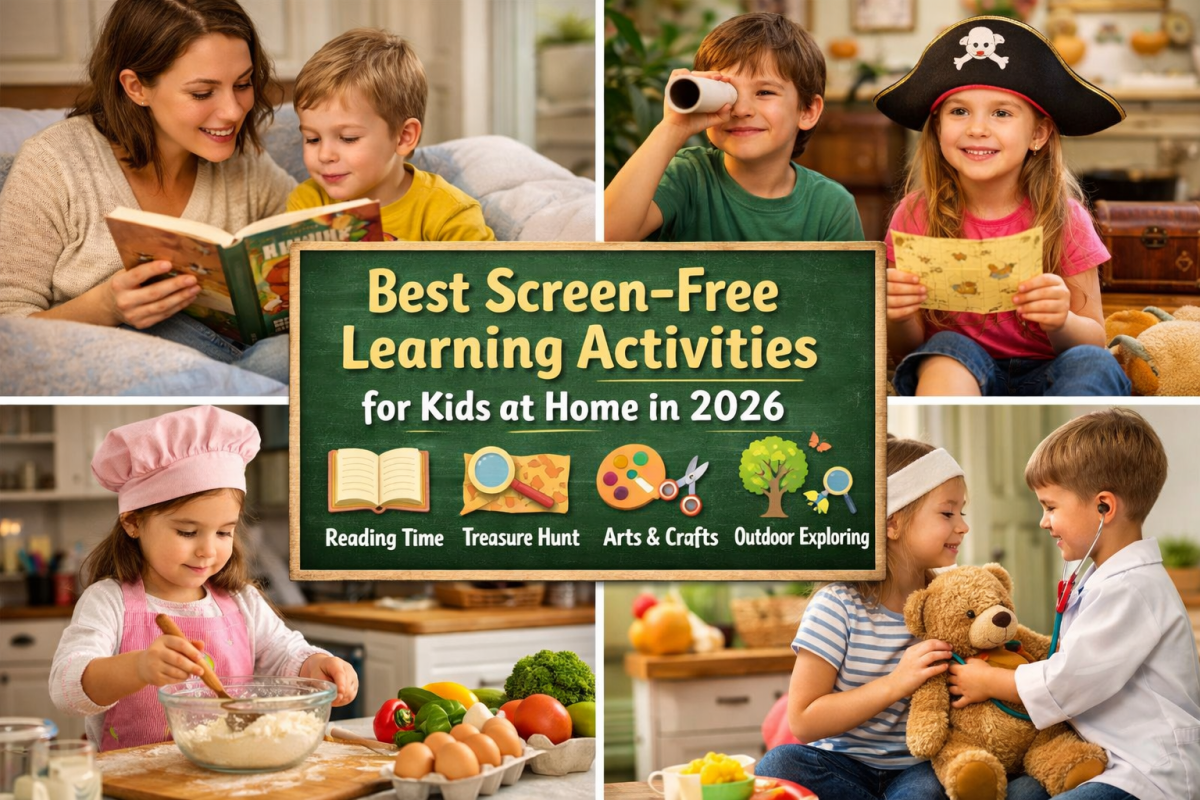
In 2026, many parents are looking for a better balance between technology and real-world learning at home. The conversation is not simply about removing screens. It is about using technology more intentionally while making more room for reading, play, movement, creativity, and family connection. Recent guidance from the American Academy of Pediatrics encourages families to create screen-free times and places, while UNICEF and OECD research continues to highlight the value of play, interaction, and healthy media habits for children’s development.
That is why screen-free learning activities are such a strong fit for families right now. They help children build language, focus, confidence, problem-solving skills, and creativity in simple ways that work in everyday home life. Even trend reporting for 2026 points to growing interest in offline learning, real-world adventure, and more intentional tech use for children.
At Bahrku, we believe some of the best learning moments happen away from the tablet and inside ordinary family routines. A story before bed. A counting game in the kitchen. A pretend shop in the living room. A homemade treasure hunt. These small activities do more than keep children busy. They help kids grow.
Why Screen-Free Learning Still Matters in 2026
Children learn best when they can talk, move, touch, imagine, ask questions, and explore with caring adults. UNICEF’s play-based learning resources emphasize that learning at home can grow through play, creative expression, and quality time together. Their broader work on learning through play also points to reading, singing, and interaction as important foundations for language, social-emotional, and cognitive development.
The goal is not to make families feel guilty about screens. The goal is balance. The AAP’s recent guidance focuses on healthy media habits, family relationships, and age-based support rather than simple screen bans. OECD research similarly describes both the opportunities and the risks of children’s digital lives, which makes intentional offline activities especially valuable at home.
1. Read-Aloud Story Time With Questions
Reading aloud remains one of the best screen-free learning activities for kids at home. It builds vocabulary, listening skills, imagination, emotional understanding, and attention. Research and literacy guidance continue to link reading engagement with stronger learning outcomes, and UNICEF’s play-and-learning materials also place reading alongside singing and play as core home learning activities.
To make story time more educational, pause and ask simple questions:
What do you think happens next?
Why is this character feeling sad?
What would you do in this situation?
Can you find something red on this page?
This turns reading into active learning instead of passive listening. For Bahrku readers, bedtime stories, kindness tales, and gentle adventures are especially useful because they support both literacy and emotional growth.
2. Create a Home Treasure Hunt
A treasure hunt is a powerful way to mix movement with learning. You can hide clues around the house using letters, numbers, colors, shapes, or simple riddles. For younger children, clues can focus on matching pictures or finding objects by color. For older kids, you can add short reading tasks, counting, or direction words such as under, beside, behind, and next to.
This kind of activity supports memory, listening, early literacy, and problem-solving. It also keeps children physically active and excited. In a year when many families are trying to build more real-world adventure into daily life, this is one of the easiest ideas to start with.
3. Kitchen Learning Activities
The kitchen is one of the best classrooms in the home. Children can count apples, sort vegetables by color, compare sizes, learn new food words, and practice sequencing while helping with simple recipes. Even a basic activity like making fruit salad can teach math, vocabulary, health awareness, and fine motor skills.
Ask questions like:
How many banana slices do we have?
Which fruit is bigger?
Can you find something yellow?
What comes first, washing or cutting?
These everyday learning moments are practical, memorable, and fun. They also connect beautifully with Bahrku-style content about healthy foods, playful learning, and family routines.
4. Arts and Crafts for Creative Thinking
Drawing, cutting, gluing, folding, coloring, and building all help children express ideas and strengthen hand control. Crafts also support patience, focus, and decision-making. You do not need expensive materials. Paper, cardboard, old magazines, safe scissors, crayons, and glue are enough for dozens of projects.
Try simple craft prompts such as the following:
Make your favorite animal.
Design a storybook cover.
Create a paper garden.
Build a rocket from a cereal box.
Play-based learning experts consistently emphasize creative expression as part of meaningful child development, and this makes arts and crafts one of the strongest screen-free activities for home learning.
5. Pretend Play and Role Play
Pretend play is not just entertainment. It is deep learning. A child pretending to run a shop, teach a class, care for animals, or travel to the moon is practicing language, social skills, imagination, memory, and flexible thinking. UNICEF’s learning-through-play framework supports this broader idea that playful experiences help children make sense of the world.
Set up a pretend grocery store, doctor’s office, bakery, or library at home. Use paper signs, toy money, simple costumes, and homemade labels. Ask children to explain what they are doing. When they narrate their play, they strengthen speaking and thinking skills at the same time.
6. Music, Rhythm, and Action Games
Songs, clapping games, movement challenges, and rhythm play are excellent for early learning. Children can practice counting, memory, listening, coordination, and language through action songs and playful instructions.
Try activities like:
Clap 3 times and jump 2 times.
Freeze when you hear the word blue.
March while counting to 10.
Sing the alphabet slowly, then faster.
Music and movement are especially useful for children who learn best through action. They can also make home learning feel lighter and happier, which helps children stay engaged longer.
7. Puzzle Time and Matching Games
Puzzles build persistence and problem-solving. Matching cards build memory and attention. You can use store-bought puzzles or make your own with paper cards, letter pairs, number pairs, or picture matches.
Simple screen-free puzzle ideas include:
Match animals to their babies.
Match upper-case letters to lower-case letters.
Match fruits to colors.
Put story events in the correct order.
These activities help children focus and think logically without feeling like formal lessons.
8. Nature Learning at Home
Even without a big garden, children can learn from nature. Collect leaves, observe clouds, grow herbs in a small pot, sort stones, or watch birds from a window. Offline learning in nature and everyday life is one of the visible parenting themes appearing in 2026 trend coverage, which makes this a timely activity for families who want calmer, more grounded routines.
Nature learning can include the following:
Leaf-rubbing art
Plant watering charts
Weather tracking
Bug observation
Sorting natural objects by size or texture
This teaches curiosity, observation, patience, and descriptive language.
9. Storytelling Without a Book
Not every literacy activity needs a printed book. Ask your child to invent a story about a bear, a moon, a garden, or a basket of apples. Start with one line and let them continue. You can also use picture cards or random household items to inspire story ideas.
For example:
One day, a tiny bird found a golden key…
The key opened a secret door in the garden…
Behind the door was…
This kind of oral storytelling helps children organize ideas, build vocabulary, and practice sequencing. It is also a beautiful way to connect family imagination with your Bahrku storytelling brand.
10. Simple Home Routines That Teach Real Skills
Children do not always need special activities. Real life is full of learning. Folding clothes teaches sorting and patterns. Setting the table teaches counting and responsibility. Packing a bag teaches planning. Tidying toys teaches categories and independence.
One reason intentional-tech parenting is gaining attention is that families want children to build practical, real-world confidence, not only digital familiarity. That makes everyday routines an important part of screen-free education in 2026.
How to Make Screen-Free Learning Work at Home
The best approach is simple and realistic. Choose one or two activities each day rather than trying to plan everything. The AAP recommends building healthy media habits through intentional family choices, including screen-free times and places, and tools like a family media plan can help families create routines that fit their needs.
Start with small habits:
Read together for 10 minutes after dinner.
Keep one basket of books and puzzles in the living room.
Create one screen-free hour in the evening.
Use weekends for crafts, treasure hunts, or nature walks.
Let your child help choose the activity.
Consistency matters more than perfection.
Final Thoughts
The best screen-free learning activities for kids at home in 2026 are not complicated. They are playful, practical, low-cost, and full of connection. Reading together, telling stories, cooking, building, crafting, pretending, singing, and exploring nature all help children learn in ways that feel human and joyful.
As families look for healthier ways to balance online and offline life, screen-free activities are becoming more valuable, not less. They give children something technology alone cannot replace: real attention, real movement, real creativity, and real family moments. That is the kind of learning children remember.