
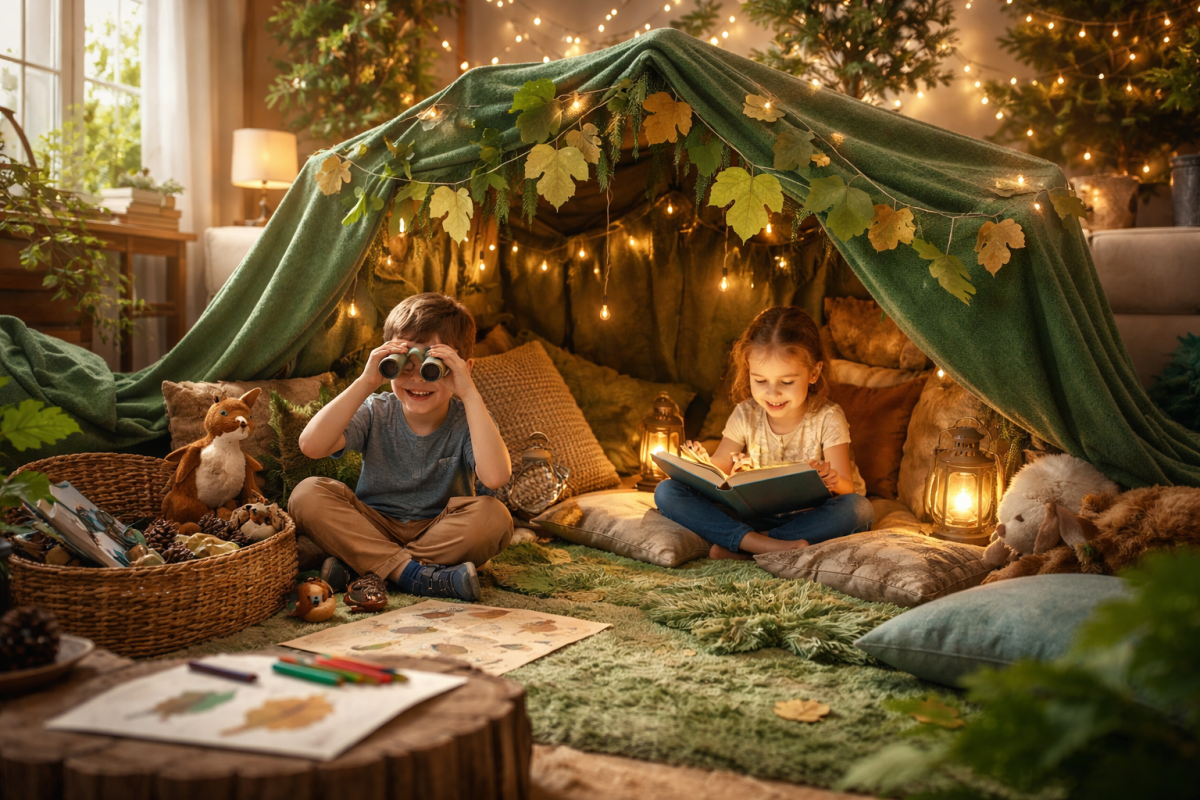


Children enjoying imaginative screen-free forest play in a cozy living room in 2026
In 2026, many families are trying to bring back something simple but powerful: childhood that feels hands-on, imaginative, and real. Trend reporting from Pinterest shows growing interest in offline learning, nature-based activities, and “screen-smart” routines, while recent coverage also points to drops in daily parent-child play and reading time in some families.
That is why the living room matters more than ever.
A living room does not have to stay just a room with a sofa and a screen. In the eyes of a child, it can become a forest trail, a pirate island, a reading cave, a puppet theater, a train station, a tiny art studio, or a magical kingdom made from blankets and chairs. When parents create even a little space for offline wonder, children often respond with more movement, more creativity, more conversation, and more joy. The American Academy of Pediatrics says healthy media guidance should focus on quality, context, and balance rather than one strict number for every child, and the OECD similarly emphasizes that screen use should not crowd out sleep, physical activity, and other important parts of childhood.
This is the quiet magic many parents are looking for in 2026.
Why families are turning back to screen-free play
Parents are not rejecting technology completely. They are looking for balance. They want children to enjoy stories, movement, creativity, and family time without every free moment being filled by a device. Pinterest’s 2026 parenting report highlights offline learning in nature and everyday life as a rising interest, and recent reporting on family routines shows concerns that reading and play are being squeezed by busier schedules and digital habits.
That shift makes sense. A large OECD review found that excessive screen time can negatively affect parts of children’s physical health and well-being, including sleep and physical activity, while the AAP’s current guidance encourages families to protect time for connection, rest, and free play.
For children, screen-free time is not empty time. It is often the time when imagination starts doing its best work.
When the living room becomes a forest
The idea is simple: instead of asking, “How do I stop my child from asking for a screen?” ask, “What can this room become today?”
A few cushions can become stepping stones across a river. A green blanket can become a forest floor. A flashlight under a table can become a cave for reading. Paper leaves taped to the wall can become clues in a nature treasure hunt. Stuffed animals can become woodland guides. Suddenly, a normal room becomes a place of movement, storytelling, and discovery.
This kind of play matters because children learn through active experience. They build language by describing what they see. They build confidence by inventing roles and solving small problems. They build emotional connection when adults join in, even for ten or fifteen minutes. Recent reporting tied declines in daily play and reading with children to wider concerns about language and literacy development, which makes small moments of imaginative family play especially valuable.
The most beautiful part is that it does not have to be expensive.
The best screen-free magic parents are loving in 2026
Story caves and reading corners
One of the easiest ways to bring magic back into the home is to create a reading hideaway. Drape a blanket over two chairs, add pillows, place a basket of books nearby, and let children crawl into their own little world. Reading for pleasure remains under pressure in 2026, with the National Literacy Trust reporting very low enjoyment and daily reading rates among children and young people, which makes home reading rituals more important, not less.
A reading cave turns books into an experience rather than a task. It tells children that stories are not homework. Stories are adventures.
For Bahrku, this idea fits perfectly with your family-friendly world of storytelling, imagination, and warm learning at home.
Indoor scavenger hunts
Parents love scavenger hunts because they combine movement, observation, and excitement. Hide paper leaves, animal pictures, or simple clue cards around the room. Ask children to find something soft, something green, something shaped like a circle, or something that belongs in the “forest.” Because Pinterest’s 2026 parenting trends point to more offline learning in everyday life, activities like this feel especially timely.
This kind of play keeps children active and curious without needing complicated materials.
Crafting a world by hand
Crafts are having a broader cultural moment. Recent reporting on creativity trends describes growing interest in analog hobbies and tactile activities, especially as people look for more meaningful hands-on experiences away from constant screen use.
For kids, that can mean making paper butterflies, cardboard binoculars, leaf crowns, animal masks, or a forest mural on a large sheet of paper. The point is not perfection. The point is making something real with their hands.
When children create a forest before they play in it, the room becomes even more magical because they helped build the world themselves.
Movement games and pretend journeys
A “forest” living room should not stay quiet for long. Children can tiptoe like foxes, stomp like bears, flutter like birds, or jump across “logs” made from cushions. Freeze games, rhythm games, and pretend journeys add healthy movement to indoor play. This matters because current research and reporting repeatedly connect children’s screen habits with reduced physical activity and concentration concerns.
When movement is built into play, children are not just entertained. They are learning to use their bodies confidently and joyfully.
Imagination baskets
A simple basket filled with a few open-ended items can spark a whole afternoon of play. Scarves, cardboard tubes, paper, crayons, toy animals, magnifying glasses, stickers, puppets, and child-safe flashlights can all become part of a changing “forest kit.”
Open-ended play is powerful because it allows children to direct the story. One day the basket becomes a camping adventure. Another day it becomes a fairy trail. Another day it becomes a rescue mission for lost woodland animals.
This kind of flexible play matches the wider 2026 shift toward experience-rich childhood routines rather than passive entertainment.
Why parents love this trend
Parents love screen-free magic at home for one simple reason: it feels human.
It does not require perfect parenting. It does not require a big budget. It does not require a giant playroom. It just asks for intention. A little imagination, a little time, and a willingness to let ordinary spaces become extraordinary.
There is also relief in it. Many families are tired of constant digital negotiation. They are tired of the glow of devices becoming the default answer to boredom. The AAP’s guidance reflects this shift by encouraging families to build healthy media habits around everyday life, relationships, and routines instead of relying only on blanket time limits.
A child who has a room full of possibilities is less likely to feel that fun only lives inside a screen.
What children gain from screen-free magic
When the living room becomes a forest, children are doing much more than “staying busy.”
They are building language when they narrate stories and ask questions. They are strengthening attention when they search for clues or listen to a read-aloud. They are practicing problem-solving when they build forts, arrange spaces, or invent rules for a game. They are growing emotionally when they role-play caring, helping, exploring, or overcoming little challenges. The broader research picture from OECD and current literacy reporting supports the value of protecting time for reading, movement, and real-world interaction.
And maybe most importantly, they are creating memories.
Years later, children rarely remember the exact video they watched on an ordinary afternoon. But they often remember the blanket fort. The flashlight story. The treasure map. The paper leaves on the wall. The parent who crawled on the floor and whispered, “Do you hear something in the trees?”
That is the kind of magic that lasts.
Why this topic fits Bahrku beautifully
Bahrku is already rooted in storytelling, learning, imagination, and family warmth. This title feels special because it turns a practical parenting topic into something emotional and memorable. It does not just say “screen-free activities.” It paints a picture. It invites families into a feeling.
That makes it strong for readers and strong for brands.
A post like this can naturally connect with children’s books, reading products, arts and crafts supplies, educational toys, storage solutions, healthy snacks, family lifestyle brands, and local businesses serving parents and children. Because the content is positive, useful, and family-centered, it creates a trustworthy environment for advertising and collaboration.
A gentle message for parents in 2026
Not every day needs a perfect activity plan. Not every room needs to look beautiful. Not every parent has endless time.
But even in busy homes, small moments can still become magical.
A ten-minute read-aloud under a blanket.
A scavenger hunt made from paper circles.
A toy animal rescue mission across the sofa.
A quiet drawing session where trees, birds, and mushrooms appear on the page.
A child laughing because, for a little while, the living room really did become a forest.
That is enough.
In a fast, digital world, children still need wonder they can touch. And in 2026, that may be one of the most important gifts we can give them. Trend data, literacy reporting, and child well-being guidance all point in the same direction: families benefit when everyday life leaves room for reading, play, movement, and imagination.
Final thoughts
When the living room becomes a forest, something bigger happens too. Home becomes more than a place where children pass the time. It becomes a place where they explore, imagine, and grow.
That is the real screen-free magic of 2026.
It is not about making childhood old-fashioned. It is about making childhood feel alive again.


