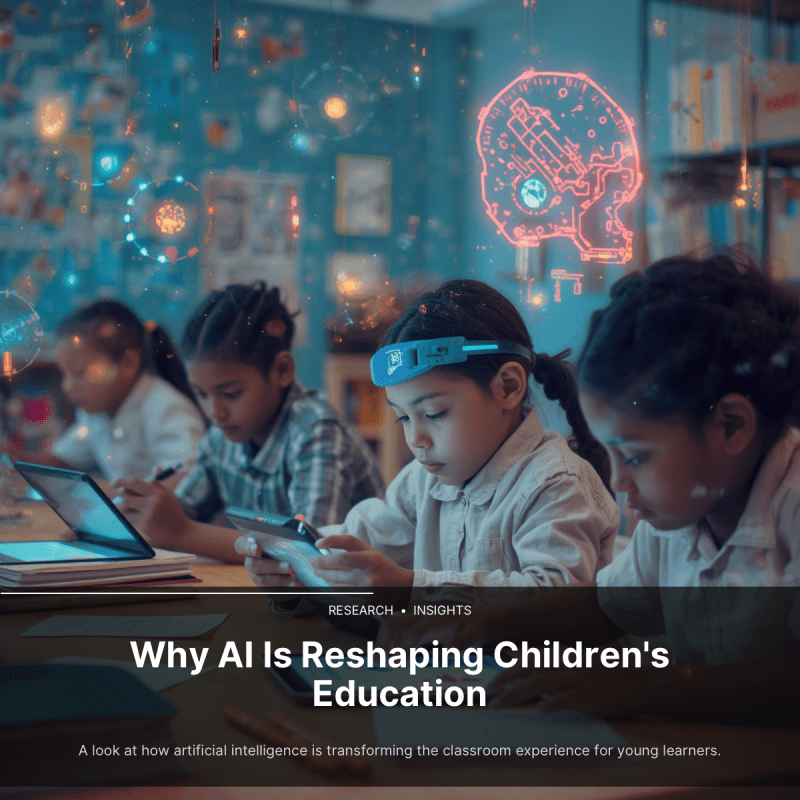

Artificial intelligence is no longer an emerging trend—it is becoming a permanent part of education. Schools, libraries, publishers, and educational technology companies are investing in AI-powered learning experiences that help personalize instruction, improve accessibility, and support students with different learning needs.
One of AI’s greatest strengths is its ability to adapt. Traditional classrooms often teach the same lesson to every student at the same pace, even though children learn in different ways. AI can analyze how a child responds to questions, identify strengths and weaknesses, and adjust future activities to provide the right level of challenge.
For example, if a child consistently struggles with fractions, an AI-powered learning platform can provide additional explanations, visual examples, and practice exercises until the concept becomes clear. Another child who has already mastered fractions can move on to more advanced topics without waiting for the rest of the class.
This personalized approach helps reduce frustration and keeps children motivated to learn.
AI Supports Different Learning Styles
Every child processes information differently. Some children remember what they read, while others learn best through listening, watching, or hands-on activities.
AI makes it easier to accommodate these differences by presenting information in multiple ways.
Visual Learners
Children who learn visually benefit from:
- Diagrams
- Illustrated stories
- Animations
- Mind maps
- Educational videos
Auditory Learners
Children who prefer listening can use AI to
- Hear stories read aloud.
- Practice pronunciation.
- Learn new languages.
- Listen to educational podcasts.
- Receive spoken explanations.
Hands-On Learners
Children who enjoy active learning can combine AI with the following:
- Science experiments.
- Building projects.
- Drawing activities.
- Coding challenges.
- Robotics kits.
- Educational puzzles.
This flexibility allows parents to create learning experiences that match each child’s interests and strengths.
Encouraging Independent Learning
One of the most valuable benefits of AI is that it encourages children to become independent learners.
Instead of waiting for someone else to provide every answer, children can ask questions, explore different viewpoints, and continue learning outside the classroom.
Examples include:
- “Why does the moon change shape?”
- “How do volcanoes erupt?”
- “Why do birds migrate?”
- “How do computers understand language?”
- “How does recycling protect the environment?”
Each question becomes the beginning of a learning journey rather than the end of a homework assignment.
Parents can further encourage curiosity by asking follow-up questions such as the following:
- What do you think?
- Can you explain it in your own words?
- Can you provide another example?
- What surprised you most?
These conversations strengthen both knowledge and critical thinking.
AI and Children’s Books
Books remain one of the most effective tools for developing imagination, vocabulary, empathy, and concentration.
Rather than replacing books, AI can enhance the reading experience by helping children:
- Understand difficult vocabulary.
- Discuss characters’ decisions.
- Predict future events in the story.
- Learn about the author’s message.
- Explore related topics.
- Discover similar books based on their interests.
This combination of traditional reading and modern technology creates richer learning experiences while preserving the joy of storytelling.
Preparing Children for Future Careers
Today’s children will enter a workforce shaped by automation, artificial intelligence, and rapid technological change. While no one can predict every future job, certain skills are expected to remain valuable across many careers.
Parents can help children develop these skills by encouraging the following:
- Curiosity and lifelong learning.
- Problem-solving through real-life challenges.
- Creativity in writing, art, music, and design.
- Collaboration through teamwork and group projects.
- Clear communication in speaking and writing.
- Digital literacy and responsible technology use.
- Adaptability when learning new tools and ideas.
These abilities will help children thrive in careers that may not even exist today.
A Parent’s Action Plan
If you’re wondering where to start, keep it simple:
- Read together every day, even for just 20 minutes.
- Use AI to explain difficult topics—not to replace learning.
- Encourage your child to ask thoughtful questions.
- Balance digital learning with outdoor play and creative activities.
- Celebrate effort, curiosity, and improvement instead of focusing only on grades.
- Review AI-generated information together and discuss why it may sometimes be inaccurate.
- Continue exploring books, museums, science centers, and educational experiences beyond the screen.
Children learn best when technology supports meaningful human interaction rather than replacing it.
Final Reflection
Artificial intelligence will continue to transform education, but the heart of learning will always remain the same: curiosity, creativity, perseverance, and strong relationships.
Parents who guide children with patience, encourage thoughtful questions, and create opportunities for discovery are helping build skills that last far beyond school. In Technology will change. Great parenting and a love of learning never go out of style.