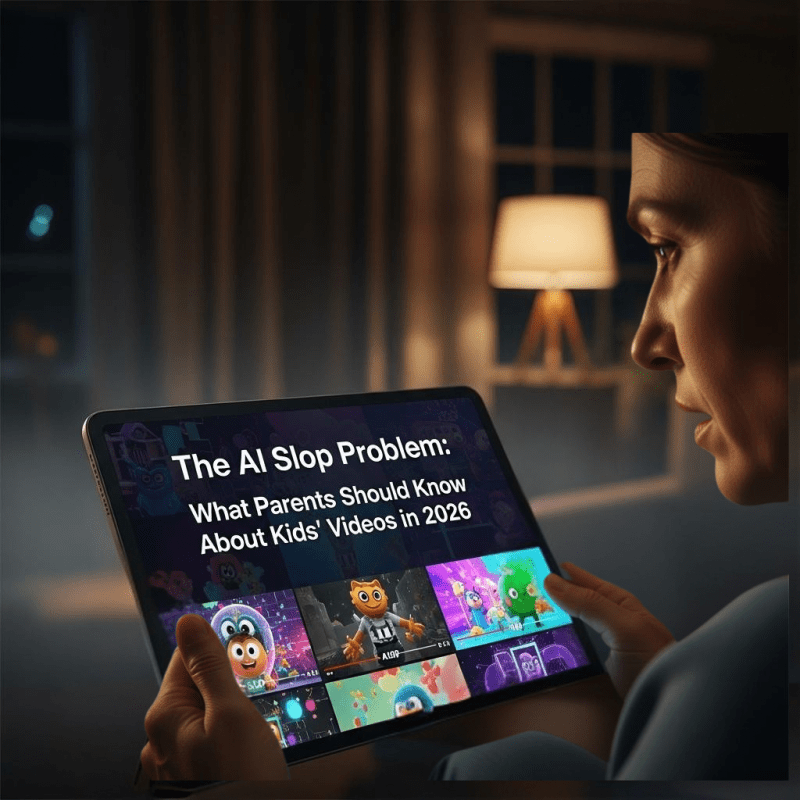
Many parents have recently experienced something unusual. A child clicks on one video, then another, and before long, the screen is filled with colorful, fast-paced clips that feel strangely empty. The characters look familiar but slightly off. The stories make little sense. The voices sound odd. The pacing is nonstop. Yet, children remain engaged.
This growing wave of low-quality, mass-produced AI-generated content is what many people now refer to as “AI slop.” It’s no longer just a niche concern. Last week, the Associated Press reported that over 200 organizations and child-development experts urged YouTube and Google to take stronger action against AI-generated videos aimed at children. They warned that this content can distort reality, overwhelm learning, and capture attention in unhealthy ways.
For parents, this raises a pressing question: what is going on, and what can families do about it?
What “AI slop” means
The term may sound harsh, but it captures something many adults recognize immediately. “AI slop” typically describes low-quality, quickly produced content generated with AI tools and distributed widely to gain clicks, views, or ad revenue. In children’s media, this can involve videos with repetitive plots, confusing visuals, poor narration, odd imitations of educational content, or mashups of characters and situations designed to keep attention rather than educate or entertain effectively. Recently, child advocates have focused particularly on videos that exploit recommendation systems instead of promoting healthy viewing.
What makes this issue concerning is that young children often cannot distinguish between high-quality content and something that merely pretends to be meaningful.
Why this has become a big issue in 2026
This situation arises from the intersection of two major trends. The first is the rapid growth of AI-generated content. It is now quicker and cheaper than ever to create videos, voices, songs, images, and animated clips using AI tools. The second trend involves how platforms reward quantity, novelty, and attention. Combine these, and you have a system where low-quality material can spread quickly if it successfully keeps children watching.
This is why over 200 advocacy groups and experts recently asked YouTube to clearly label AI-generated content, ban it from YouTube Kids, and provide parents with ways to disable it. They argue that this content can overshadow healthier offline activities and impact children’s development, especially for younger viewers.
This also relates to a broader family trend in 2026. Pinterest’s Parenting Trend Report indicates that parents are trying to raise “screen-smart kids” and are increasingly interested in offline learning and intentional routines. This suggests that many families feel uneasy about constant digital habits and are seeking better alternatives.
Why AI-generated kids’ videos feel different
Not all AI-assisted content is bad. Some creators use AI tools responsibly and still produce useful, creative, or age-appropriate work. The problem isn’t the existence of AI itself; it arises when AI is used to mass-produce shallow content that seems child-friendly but provides little real value.
Parents often describe these videos as strange, addictive, or unsettling. This reaction is understandable. Much of AI slop relies on bright visuals, rapid cuts, simple loops, and emotionally manipulative pacing. It often feels like content created by an algorithm initially and human care second.
Child advocates cited by the AP say this kind of material can distort children’s perceptions of reality, overwhelm their learning processes, and capture their attention in negative ways. They are particularly worried because younger children may not understand labels or disclosures, even when these exist.
What parents should watch for
One of the challenging aspects of this issue is that AI slop doesn’t always announce itself clearly. It can appear to be educational content at first glance. It can employ familiar nursery rhyme patterns, toddler-friendly color schemes, or beloved animal characters. It can even resemble the types of videos that children already know.
A few warning signs can help:
- The video feels repetitive without providing much learning or a story.
- The visuals may look polished in some respects but strangely inconsistent in others.
- The voices sound flat, unnatural, or emotionally detached.
- The pacing is extremely rapid, leaving little room for thinking or responding.
- The content seems designed to keep the child watching rather than aid in understanding.
- Different videos from the same channel appear mass-produced and interchangeable.
Parents usually notice these issues before they can label them. The content simply feels empty.
Why this matters beyond “bad videos”
This issue is not just about taste. It relates to how children use their attention. Children grow up surrounded by digital stimulation. When low-quality AI-generated videos occupy part of that space, they can crowd out reading, hands-on play, real conversations, creative boredom, and healthier forms of media. This is one reason the advocacy letter is so direct: critics argue that this content isn’t harmless filler. It interferes with the offline activities crucial for children’s healthy development.
This concern aligns with broader family patterns in 2026. Pinterest’s trend data indicates that parents actively seek screen-free activities, digital boundaries, and a rich home life. This effort is not isolated; it reflects a larger attempt by families to make childhood feel less automated and more grounded.
What parents can actually do
Parents do not need to become experts in AI to respond effectively. A few simple habits can lead to significant improvements.
- Watch with your child sometimes. It’s easier to identify poor-quality content when you view it together. Many parents only recognize AI slop once they sit down for a few minutes and really pay attention.
- Favor trusted creators over endless recommendations. Instead of allowing autoplay or suggestions to lead, it’s safer to stick to channels, publishers, and creators you already know and trust.
- Turn off autoplay when possible. This reduces the risk that one decent video leads immediately into a strange content spiral.
- Create more offline “default” options. If books, drawing tools, puzzles, sticker sets, or simple toys are easily accessible, it becomes simpler to say no to yet another random video.
- Talk to children in simple ways. Older kids, in particular, can grasp a basic explanation: not every video is made with care, and some content is primarily designed to keep viewers watching.
- Use a “quality check” question. A helpful habit is to ask after a video, “Did that teach you something, make you laugh in a good way, or tell a real story?” If the answer is no, that is valuable information.
Why this is also a search and social media story
This issue is important not just because children watch videos, but also because social platforms and video apps increasingly shape what families discover. Social media and video apps now act more like search engines for many people, especially regarding parenting tips, learning content, and children’s entertainment. This means low-quality content doesn’t only spread through passive scrolling; it also appears in recommendation loops and discovery systems. Trend analysis in 2026 increasingly describes social media as a search-driven environment where discoverability matters as much as follower counts.
For parents, this emphasizes the need to be more intentional about what their child discovers.
Why this topic fits Bahrku
This is a significant Bahrku topic because it links children, media, search behavior, and real family concerns in one timely article. It allows for a helpful, balanced discussion. There’s no need for alarmism; practicality is key.
It also aligns with broader themes: reading over passive scrolling, smart screen parenting, hands-on childhood, and helping families establish better digital habits.
Additionally, it has real search potential since the issue is current, emotionally relevant, and tied to a problem many parents are just beginning to recognize.
Final thoughts
The AI slop problem is not just about one bad video. It’s about what happens when children’s attention becomes a target for cheap, endlessly generated content. It highlights the difference between media created thoughtfully and content made solely to capture time. It also represents the growing challenge parents face in a digital landscape where not everything that appears child-friendly is genuinely beneficial for children.
The good news is that parents do not need a perfect solution. They just need a bit more awareness, some intentionality, and a few better defaults. Presently, even major advocacy groups agree that the problem is serious enough to call for stronger actions from platforms.