

Most picture books get opened twice and forgotten. A handful get read until the spine splits. The difference isn’t cute illustrations. It’s whether the book does something — teaches an emotion, sparks a question, or makes the child feel genuinely seen. This guide breaks down which titles for ages 2 to 7 earn that worn spine, and how to pick the right one for where your child is right now.
Why the book category matters more than the title
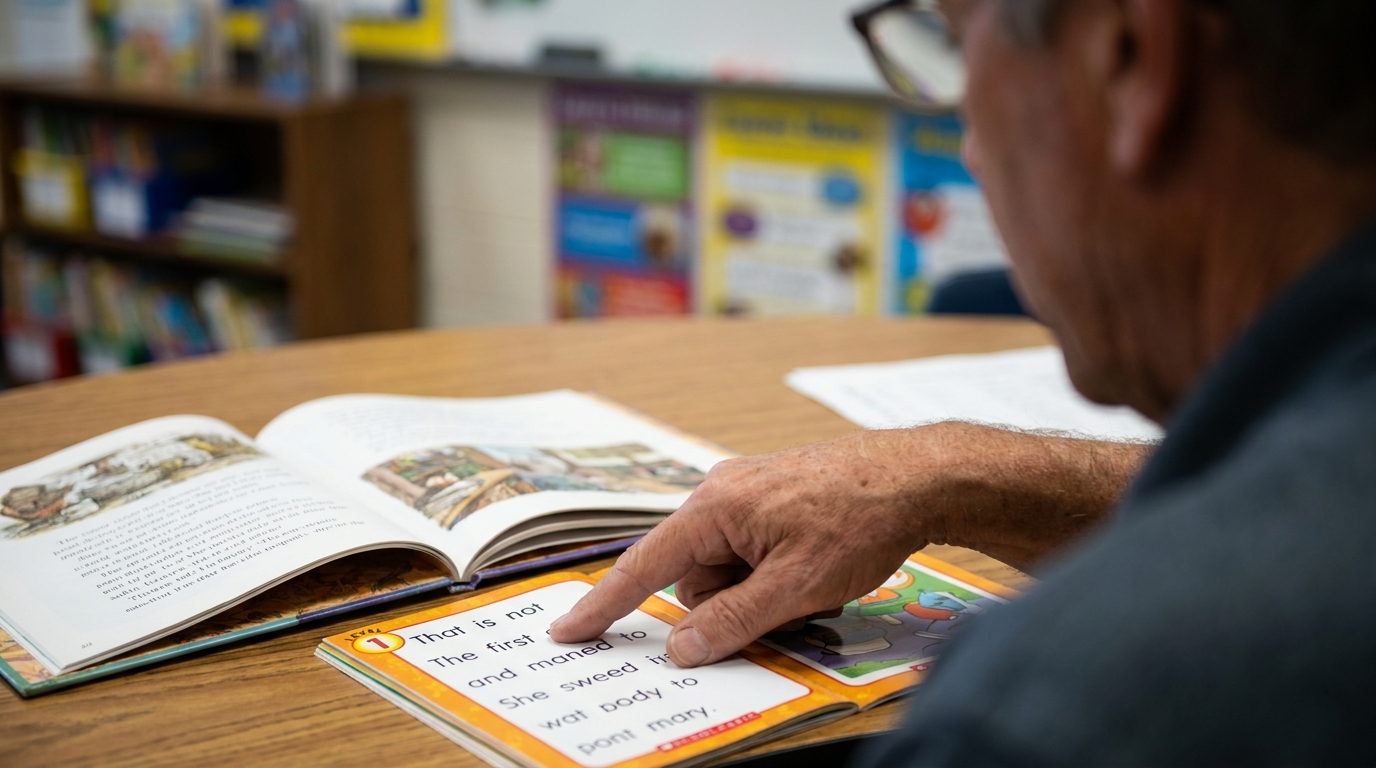
Before you look at any specific title, you need to know the difference between what’s on the shelf. The early reading world splits into two distinct formats, and mixing them up is the most common mistake parents make.
Picture books are not early readers. They’re meant to be read to a child, not by them. The text is rich, the vocabulary is adult, and the illustrations carry as much meaning as the words. Dad by Christian Robinson is a perfect example. The sentences are sparse but the emotional weight sits in the art. A 6-year-old reads the words; the feeling comes from staring at the page.
Early readers (sometimes called “levelled readers”) are books a child reads independently. The vocabulary is controlled, the sentences are short, and the goal is decoding practice. They’re scaffolded by level, typically Level 1 through 4, and they’re deliberately less literary. That’s not a flaw. It’s the point.
Buying a beautiful picture book and expecting a 5-year-old to read it alone sets everyone up for frustration. Handing a newly independent reader a Level 1 reader when they’re ready for a chapter book insults their ability. Match the format to the goal.
The books worth knowing by name
Not every title in this section is for every child. I’ve grouped them by what they actually deliver, because that’s how you should choose.
Books that handle emotions without being preachy
Dad by Christian Robinson (2023) stands apart in this category because it doesn’t explain itself. Robinson tells a story about a child imagining what their absent father might be doing. There’s no tidy resolution. No lesson spelled out at the end. The book trusts the child to feel something and sit with it, which is rare. I’d put this in the hands of any child aged 4 to 7 who has complicated family feelings, and also in the hands of children who don’t, because it builds empathy through ambiguity rather than instruction.
Most “emotions” picture books make the mistake of labelling everything. “She felt sad. Then she felt better.” Robinson doesn’t do that. The art does the emotional work.
When You Are Brave by Pat Zietlow Miller follows a similar instinct: the feeling first, the explanation second.
Interactive and concept books that build actual skills
ABC and alphabet books are not all the same. The ones worth buying do more than list letters.
| Book | What it actually teaches | Age range | What sets it apart |
|---|---|---|---|
| Chicka Chicka Boom Boom (Martin & Archambault) | Letter recognition, rhythm, sequencing | 2 to 5 | The rhyme scheme encodes letters in memory better than flashcards |
| Dr. Seuss’s ABC | Letter sounds, phonemic awareness | 3 to 5 | Each letter gets a full scene; repetition builds decoding instinct |
| AlphaOops! (Kontis & Catrow) | Alphabet order, humour, self-correction | 4 to 6 | Letters argue about their order; teaches metacognition through comedy |
| Z is for Moose (Bingham & Zelinsky) | Alphabet, narrative tension | 4 to 7 | The moose who misses his letter becomes a character study in feelings |
Animal books deserve their own note. The best ones layer facts and story together. National Geographic Kids early readers do this well at Level 1 and 2. The child gets a decodable text and real information about how penguins raise chicks or why frogs shed their skin. That dual load, story plus fact, is more cognitively demanding in the best way.
Adventure and imagination books
The Dino Door by Gerry Bailey sits in a sweet spot between concept book and adventure story. The premise, a door that leads to dinosaur territory, gives children the satisfaction of a “what if” scenario that’s clearly grounded in their own homes. The format works especially well for children aged 5 to 7 who are starting to construct their own stories. After reading it, most kids want to find their own “dino door.” That imaginative spillover is a good test of whether a book is doing its job.
A common mistake: parents often choose adventure books based on the topic the child likes, say, dinosaurs or space, without checking whether the book actually does something with that topic. A dinosaur book that just names species isn’t the same as one that puts the child inside an experience. Before buying, read the first four pages. If the child is a passive observer, the book is a poster. If they’re pulled into a decision or a question, it’s a story.
How to match a book to your child’s reading stage
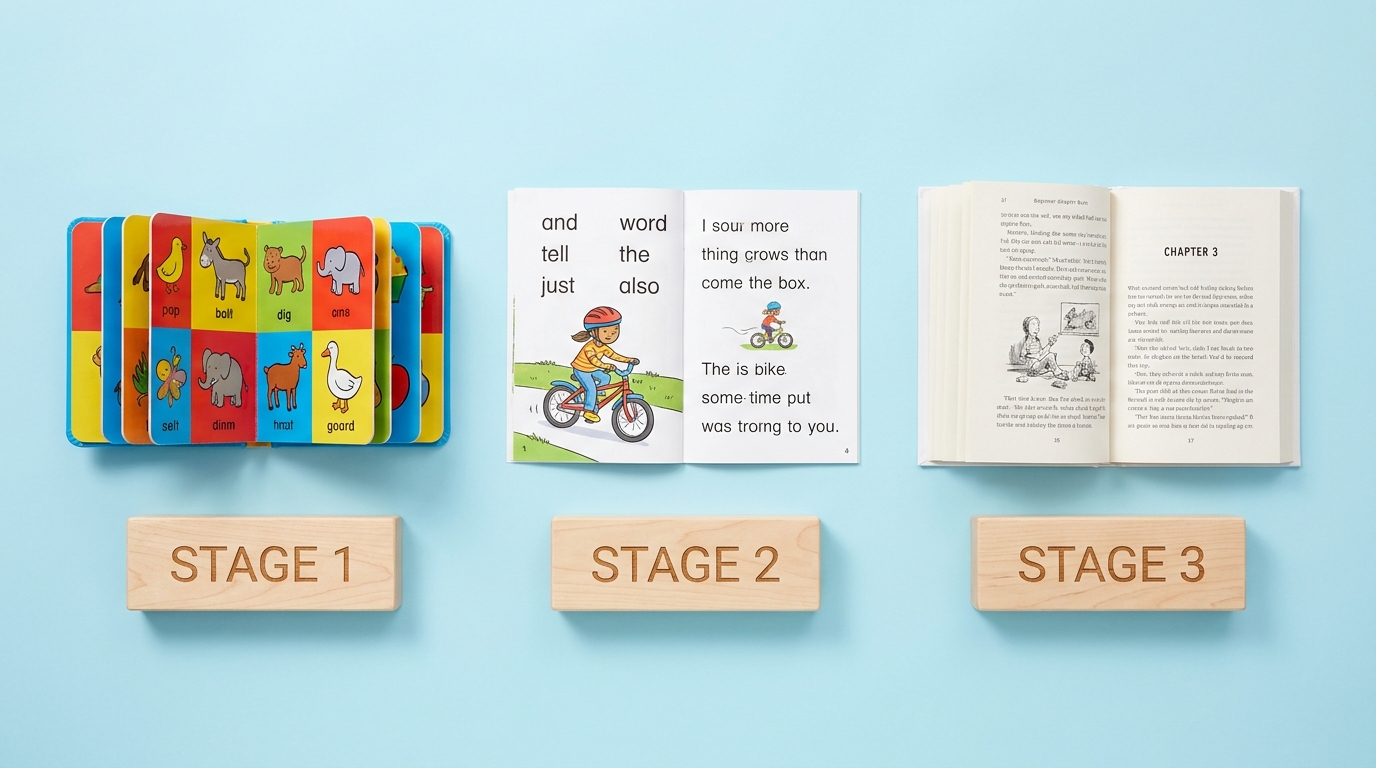
This is where most gift lists fall flat. They give you titles but not the framework for why.
Stage 1: Pre-reader (ages 2 to 4)
The child isn’t decoding anything yet. The goal is print awareness, vocabulary, and love of books. Choose picture books with:
- Repetitive phrases they can anticipate and “read” from memory
- Bold, clear illustrations that match the text closely
- Short page counts (under 32 pages works well)
Goodnight Moon, Brown Bear Brown Bear, and Robinson’s work all fit here. Don’t worry about “level.” There are no levels at this stage.
Stage 2: Emergent reader (ages 4 to 6)
The child is learning phonics and starting to decode simple words. This is where levelled readers earn their place. Level 1 readers use high-frequency words (the, is, and, I) and simple sentence structures. Most use 100 to 200 unique words.
At this stage, picture books are still read together. The child reads their Level 1 books independently. Both happen in the same week. There’s no competition between them.
Stage 3: Early independent reader (ages 5 to 7)
The child can decode unfamiliar words using phonics rules. Level 2 and Level 3 readers, slightly longer sentences, more plot complexity. Frog and Toad by Arnold Lobel sits at this level and is probably the most underrated early reader series in print. Each story is short enough to finish in one sitting but has actual character development.
What the research actually says about reading aloud
The single most documented finding in early literacy research is that reading aloud to children, regardless of their own reading level, improves vocabulary more than any app or phonics programme. The mechanism is exposure to words children don’t encounter in conversation.
The average adult conversation uses roughly 5,000 to 10,000 unique words. Picture books use a wider range. Dad by Robinson, for instance, includes the word “reflection” in a context where a child can infer its meaning from the image. That inferencing process, seeing a word, guessing the meaning from context, is exactly what fluent adult readers do constantly.
Reading aloud doesn’t stop being useful when a child can read independently. It just shifts function. Before they can decode: it builds vocabulary. After they can decode: it builds comprehension and exposes them to sentence structures they wouldn’t choose on their own.
A word on “educational” labels
Be sceptical of books marketed as educational. That label often means the book was designed for a classroom lesson and feels like one. The best picture books teach without announcing they’re teaching.
The Dot by Peter H. Reynolds has sold millions of copies and is used in schools worldwide, but it doesn’t read like a lesson. It reads like a story. The message, that creativity starts with a single mark, lands because you experience it with the character rather than being told it in a closing paragraph.
Books that explain their message in the final page are almost always weaker than books that trust the image to close the loop.
FAQ
At what age should a child start reading picture books on their own?
Most children start decoding simple books between ages 5 and 6, though the range is wide. Reading picture books independently comes later, typically 7 to 8, because the vocabulary is richer than levelled readers. Before that, picture books are a shared experience, not a solo task. Don’t rush it.
What’s the difference between a Level 1 and Level 2 early reader?
Level 1 books stick to common sight words and very short sentences, usually 3 to 5 words. Level 2 introduces slightly longer sentences, contractions, and a wider sight word vocabulary. Publishers vary in how they define levels, so reading the first page before buying tells you more than the number on the cover.
Is Dad by Christian Robinson suitable for children who don’t have an absent parent?
Yes. The book isn’t about absence as a problem to solve. It’s about imagination and connection. Children with present fathers read it as a story about love and what people mean to each other when they’re apart. The ambiguity in the art leaves room for different readings, which is part of why it works.
How many books should a child own at this stage?
There’s no formula, but depth beats breadth. Ten books read repeatedly build more vocabulary and more emotional connection than fifty books read once. A child who can recite Chicka Chicka Boom Boom from memory has internalised the alphabet better than one who completed a workbook on it.
Do interactive ABC books actually teach letters faster than traditional methods?
The honest answer is: for some children, yes, for others, no. Books like AlphaOops! and Chicka Chicka Boom Boom use narrative and rhythm to create memorable associations. Children who are strong auditory learners often do better with these than with flashcards. Children who respond better to visual pattern matching might do equally well with a good alphabet poster. Use the book, but watch what sticks.
Where to start if you’re buying one book today
If the child is under 4, buy Brown Bear Brown Bear or Chicka Chicka Boom Boom. Both have been in print for decades because they work at the most basic level of what a picture book needs to do: hold attention and encode language.
If the child is 4 to 6 and you want something that handles emotion without a lesson attached, Dad by Christian Robinson is the one I’d choose. It’s honest, it’s short, and it asks something of the reader.
If you’re buying for a newly independent reader aged 6 to 7, skip the generic Level 1 sets and go straight to Arnold Lobel’s Frog and Toad Are Friends. The reading level is accessible, but the stories have actual weight. That combination, easy to read, worth reading, is harder to find than it should be.


