AI tutoring isn’t coming to classrooms. It’s already there. Students from Grade 3 to graduate school are using tools like Khan Academy’s Khanmigo, Google’s NotebookLM, and ChatGPT to get homework explained, concepts simplified, and feedback at 11 pm when no teacher is available. The question isn’t whether schools should allow this. It’s whether they’re prepared to use it well.
Most aren’t. And the gap between how students are using AI and how schools are responding to it is where most of the real problems live.
What “personalized learning” actually means when AI does it

The phrase gets thrown around a lot. Here’s what it looks like in practice.
Traditional classroom instruction moves at one pace. A teacher with 28 students sets a rhythm that works for maybe a third of them. The rest are either bored or lost, and there’s not much anyone can do about it mid-lesson.
An intelligent tutoring system like Carnegie Learning’s MATHia does something fundamentally different. It tracks every response a student gives, adjusts the difficulty of the next problem based on the pattern of errors, and identifies whether a student is making a conceptual mistake (doesn’t understand what a variable is) versus a procedural one (knows the concept but miscalculates). Those two errors look identical on a paper test. MATHia treats them very differently because the fix is completely different.
When I worked through a demo of MATHia’s algebra module, it flagged a simulated student’s repeated sign errors as a working-memory issue rather than a conceptual gap, and suggested shorter problem sets rather than re-teaching. That’s a judgment a human tutor would reach too, but only after several sessions.
| Feature | Traditional Classroom | AI Tutoring System |
|---|---|---|
| Feedback timing | End of test or next class | Immediate, per question |
| Error diagnosis | Marks wrong | Categorizes error type |
| Pacing | Fixed for whole class | Adapts to individual |
| Available hours | School day only | Anytime |
| Teacher visibility | Summative grades | Granular learning data |
The data visibility point matters more than most people realize. Teachers using MATHia or DreamBox don’t lose control of learning. They get a dashboard showing exactly where each student is stuck before walking into class. That’s a different use of 45 minutes than re-teaching a concept to everyone when only six students need it.
The homework help problem (and where the line actually is)
Here’s the honest tension: students use AI to do homework. Not always to understand the homework. Those are different things, and conflating them is how schools end up with policies that don’t hold.
A common mistake is treating AI use as automatically academic dishonesty. That framework collapses immediately when you apply it consistently. A student who asks ChatGPT to explain photosynthesis three times until they get it isn’t cheating any more than they would be using a textbook. A student who pastes an essay question into ChatGPT and submits the output without reading it isn’t learning anything, but neither is the student who buys a SparkNotes summary.
The distinction that actually matters: Is the student engaging with the content or bypassing engagement entirely?
Tools built for learning enforce this differently:
- Khanmigo (Khan Academy’s AI tutor, built on GPT-4) refuses to give direct answers to math problems. It asks Socratic questions: “What do you know about the first step here?” Students hate it initially, then start to get it. That friction is intentional.
- ChatGPT and Claude will, by default, answer questions directly. They can be prompted to tutor rather than answer, but students rarely do this without guidance.
- Quizlet’s AI generates practice questions and explanations from uploaded notes, which is much closer to active recall than passive reading.
Most guides skip this, but the tool itself determines whether AI help builds or replaces understanding. Choosing the right tool for homework support isn’t a minor decision.
How schools are trying to balance ethics and screen time
The policies schools have landed on in 2025 and 2026 range from outright bans to full integration, and neither extreme works well.
Outright bans fail for an obvious reason: students have phones. Banning AI from school doesn’t prevent students from using it; it prevents them from using it with teacher guidance. That’s a bad trade.
Full unstructured integration fails for a different reason. Without explicit instruction on how to use AI as a learning tool, students default to the path of least resistance: paste question, get answer, move on. The skill being practiced then is copy-paste, not reasoning.
What actually works, based on what’s being piloted in districts like Pittsburgh Public Schools and across several Singapore secondary schools, is a framework I’d describe as scaffolded AI access:
- Explicit AI literacy instruction starting in middle school. Students learn how AI generates text, what hallucinations are, and how to verify outputs.
- Tool-specific assignments that require AI use in a defined way. Example: write a first draft, then use AI to critique it, then revise and explain each change you made or rejected.
- Process over product assessment. Grade the student’s reasoning about AI feedback, not just the final document.
- Time-limited AI-free tasks that aren’t presented as punishments. Timed writing, verbal explanation, whiteboard math. Not because AI is cheating, but because some skills only develop without it.
Screen time concerns in this context are real but often misframed. The worry isn’t hours-on-device in isolation. It’s whether the cognitive work is happening inside the student’s head or being offloaded entirely. A student spending 40 minutes using MATHia to work through algebra is doing more cognitive work than one spending 10 minutes copying an AI-generated solution, regardless of screen time counts.
Where human teachers remain irreplaceable
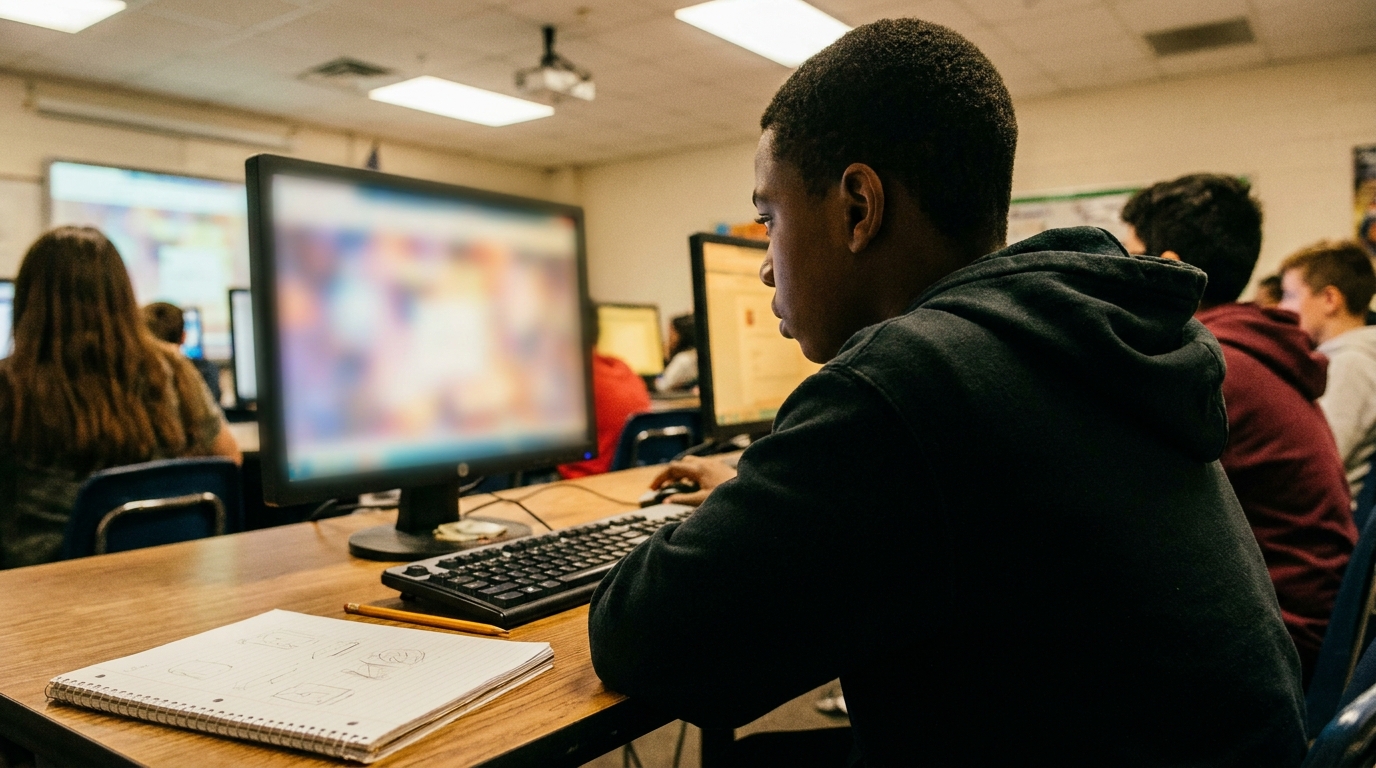
AI tutoring systems are genuinely good at a specific thing: delivering targeted practice at scale with immediate feedback. They’re not good at several things teachers do constantly.
A student who’s disengaged because something is happening at home won’t respond differently to an AI tutor. A student who’s embarrassed to say they don’t understand fractions won’t type that into a chat window either. The relational work of teaching, the noticing that something’s off, the side conversation, the building of trust that makes a student willing to fail publicly and try again, doesn’t transfer to software.
There’s also the problem of motivation architecture. AI tools can adapt content, but they can’t construct the meaning a teacher builds around why any of this matters. A math teacher who connects a student’s interest in basketball to probability isn’t just making a clever analogy; they’re building a reason to care. No current AI tutoring system does this reliably.
The best classroom uses I’ve seen treat AI as the practice layer and the teacher as the sense-making layer. AI handles drill, repetition, and feedback. The teacher handles discussion, context, and the question “so what does this mean for how you think?”
The tools worth knowing about, and the ones that overpromise
Not all AI education tools are equally useful. Here’s an honest breakdown of the major categories and what each actually delivers:
Intelligent tutoring systems (ITS):
- MATHia by Carnegie Learning — strongest evidence base for math learning outcomes, K-12 through algebra
- DreamBox — solid for elementary math, adaptive and well-designed
- Khanmigo — good for guided practice, limited subject depth outside Khan Academy’s existing content
AI writing and research tools:
- NotebookLM by Google — genuinely useful for students doing research; you upload sources, it answers questions and generates summaries only from those sources, which limits hallucination significantly
- Consensus — searches peer-reviewed literature and summarizes findings; better for older students
- ChatGPT and Claude — broad capability, low guardrails; require explicit instruction to use well in learning contexts
Overpromising tools to watch out for:
Anything marketed as an AI that “grades essays like a human” should be tested carefully. Current AI essay scoring struggles with genuine argumentation and rewards surface-level fluency. A student who writes stylistically smooth sentences with hollow reasoning often scores better than one who writes awkwardly but thinks carefully. That’s a real problem if teachers use AI scoring without review.
FAQ
Does using AI for homework count as cheating? It depends entirely on how it’s used and what the assignment is testing. Using AI to understand a concept is not cheating by any standard definition. Submitting AI-generated text as your own original work, when the assignment tests your writing ability, is. Schools that haven’t defined this clearly in their academic integrity policies will keep having this argument case by case, which is exhausting for everyone.
Are AI tutoring systems actually effective, or is this just marketing? Carnegie Learning’s MATHia has multiple independent studies showing meaningful learning gains compared to traditional instruction, particularly for students who start below grade level. DreamBox has similar supporting data. The evidence for broad, unstructured AI chatbot use in learning is much thinner. The distinction matters: purpose-built ITS tools with adaptive algorithms and validated pedagogy perform differently from general AI assistants used for homework.
How much screen time is too much when it includes AI learning tools? There’s no universal answer, and the American Academy of Pediatrics moved away from strict hour-limits for school-age children in 2016 because content and context matter more than raw time. A better question: is the screen time replacing physical activity, sleep, or face-to-face interaction? If not, and if the AI use is genuinely active rather than passive, the time concern is secondary.
Will AI tutors replace teachers? No, and any product that implies otherwise is either misrepresenting the technology or misunderstanding what teaching is. AI tutoring handles a narrow slice of what teachers do: content delivery and practice feedback. It doesn’t handle the relational, motivational, and contextual work that makes content stick. The more accurate frame is that AI handles the parts of teaching that shouldn’t require a person, freeing teachers for the work that does.
What’s the best way for a parent to set up AI learning support at home? Start with Khanmigo rather than ChatGPT if your child is in K-12 and uses AI for math or science. Its Socratic approach is slower and more frustrating short-term, but it builds the reasoning habit rather than the answer-retrieval habit. For older students doing research, NotebookLM is more reliable than open-ended AI because it stays grounded in the sources you provide. Have one explicit conversation with your child about the difference between using AI to understand something versus using it to avoid understanding something. That conversation alone changes the behavior more than any filter does.
Where to start this week
If you’re a teacher, try running one assignment through a “process over product” structure: have students submit a written explanation of what AI suggested, what they changed, and why. You’ll learn more about their actual understanding from that reflection than from the document itself.
If you’re a parent, install Khanmigo on your child’s device and spend 15 minutes watching how it handles a question they’d normally ask you. The way it refuses to answer directly but keeps asking “what do you already know?” is the model for how AI help should work. Everything else is just faster homework.