
Teachers are burning out at a rate that should alarm every parent, principal, and school board member in the country. The job has always been demanding, but something shifted in the last few years, and the warning signs are now impossible to ignore. This article breaks down what is actually driving teacher burnout, what the research and real-world results say about cell phone bans in schools, and what solutions have shown genuine traction.
The Burnout Crisis Is Real, and It Starts with Workload
Teaching has never been a 40-hour-a-week job, but the administrative load placed on classroom teachers has grown to a point where the actual teaching often feels secondary.
A 2023 RAND Corporation survey found that roughly 1 in 4 teachers reported frequent job-related stress, a rate nearly double that of the general working population. By 2025, district-level data from multiple states showed vacancy rates in hard-to-staff subjects like special education, math, and bilingual instruction running at 15 to 30 percent in urban schools.
What teachers consistently cite as their top stressors:
- Grading, documentation, and compliance reporting that bleeds into evenings and weekends
- Managing student behavior in under-resourced classrooms
- Lack of administrative support during discipline situations
- Stagnant salaries against rising cost of living
- Emotional labor from supporting students through trauma, poverty, and mental health crises
The workload issue is structural. One middle school teacher I spoke with described spending nearly two hours each night responding to parent emails alone, on top of lesson planning and grading. That’s not a personal time management problem. That’s a system that has loaded teachers with communication, data entry, and compliance tasks without removing anything to make room.
The Quiet-Quitting Pattern Schools Are Seeing
“Quiet quitting” in teaching doesn’t look like teachers slacking off in class. It looks like a veteran educator who used to run the drama club, mentor student teachers, and lead curriculum nights slowly pulling back to the minimum required by their contract.
This matters because schools run on discretionary effort. The enrichment programs, the after-school tutoring, the extra scaffolding for struggling students: none of that appears in a job description. When teachers disengage, students lose that margin.
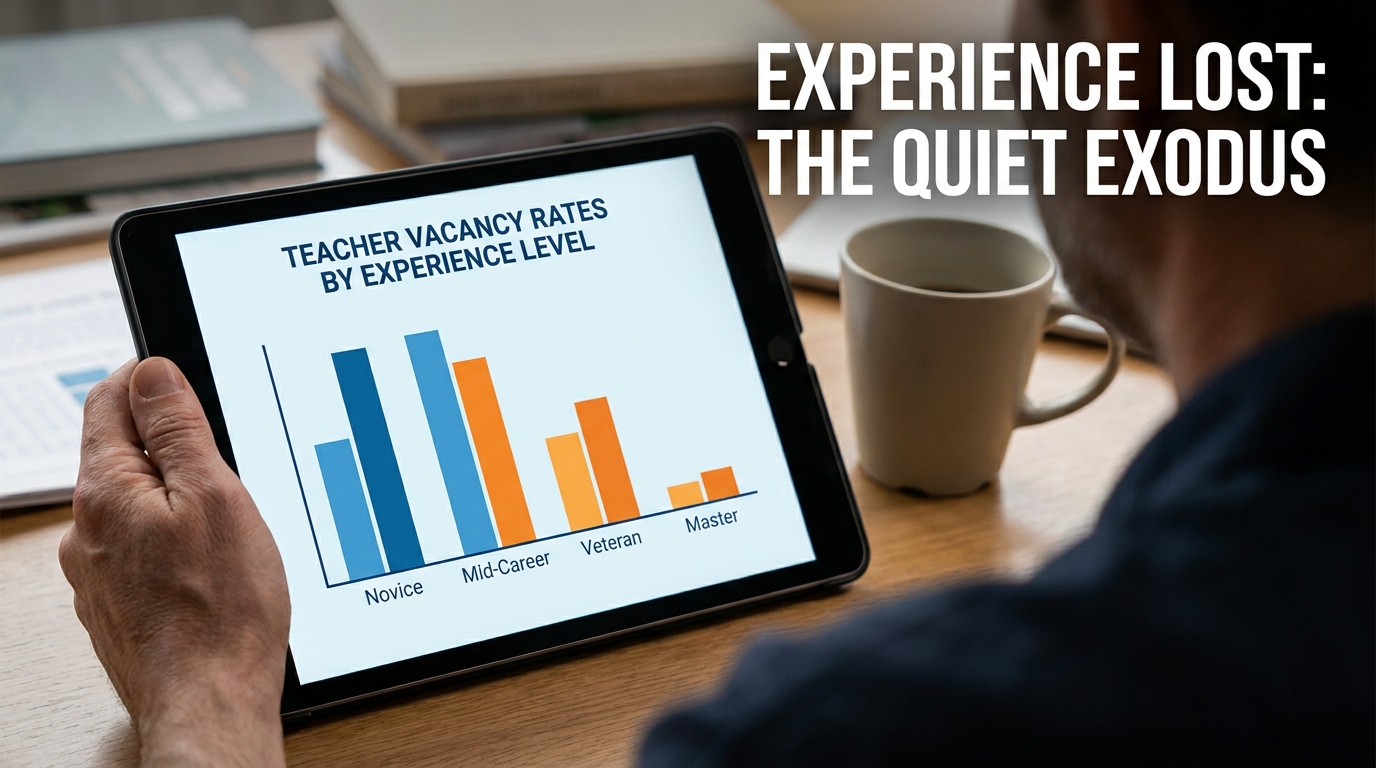
The teachers most likely to quiet-quit (or fully leave) share a common profile: mid-career educators in years 5 to 12, often the most skilled in a building, who feel invisible to leadership and undercut by poor working conditions. Newer teachers leave in the first three years. Veterans with 20-plus years often stay because of pension vesting. The middle cohort is what many districts are quietly hemorrhaging.
| Experience Level | Primary Exit Reason | Average Tenure in Current District |
|---|---|---|
| 0 to 3 years | Salary, classroom management overwhelm | Under 2 years |
| 5 to 12 years | Burnout, lack of support, better opportunities | 4 to 7 years |
| 15+ years | Rarely leave, often pension-anchored | 12+ years |
How Cell Phones Became a Classroom Crisis
The phone problem in schools didn’t arrive overnight. It crept in as smartphones became standard for middle schoolers, then elementary-age kids. By 2022, teachers were routinely competing with TikTok, Snapchat, and group chats for student attention during instruction.
What makes phones particularly disruptive isn’t just distraction during class. It’s the way they extend social dynamics into school hours. A conflict that starts on Instagram at midnight doesn’t stay online. It walks into the building the next morning and sits in your classroom.

Teachers report spending meaningful portions of class time managing phone-related behavior: confiscating devices, mediating drama that spilled in from social media, redirecting students who are texting under desks. In schools without clear policies, teachers enforce individually with no backup, which means inconsistent rules, constant negotiation with students, and the teacher absorbing all the conflict.
What the Evidence Says About Phone Bans
The “one school banned phones and scores jumped 25%” framing circulates often, and it is based on something real, but the details matter.
A widely cited study from the London School of Economics examined secondary schools in England before and after mobile phone bans were implemented. The researchers found that test scores for students improved meaningfully, with the largest gains concentrated among low-achieving students, who saw score increases of roughly 14 percent. High-achieving students saw smaller effects. The interpretation: students who were already engaged stayed engaged regardless of phone access. Students who struggled were the most helped by removing the distraction.
French national data from their 2018 school phone ban pointed in a similar direction: reduced disciplinary incidents and improved focus, particularly in middle school age groups.
What this means in practical terms:
- Bans are most likely to help the students who need the most help
- The benefit is not universal or automatic; implementation and consistency matter enormously
- Half-measures (phone pouches vs. full confiscation vs. “just don’t use it”) produce inconsistent results
| Policy Type | Ease of Enforcement | Student Compliance | Impact on Learning |
|---|---|---|---|
| Honor system (“put it away”) | Low | Inconsistent | Minimal |
| Pouch/lock-up at start of day | Medium | High when required | Moderate to strong |
| Full ban with collection point | High enforcement burden | High | Strong, especially for lower-achieving students |
| Hybrid (banned during class, allowed at lunch) | Medium | Moderate | Moderate |
Why Bans Alone Don’t Fix Burnout
Here is where schools get it wrong. Cell phone bans reduce a specific category of classroom disruption. They do not address the grading load, the administrative paperwork, the lack of counselors, or the impossible expectation that one teacher manages 30 students across wildly different ability levels.
Districts that implement phone bans and present them as the solution to teacher morale are solving the wrong problem with the right tool. The teachers I hear from who feel most supported are in schools where a few specific things are true:
- Administrators back teachers publicly during discipline situations
- Planning time is protected, not consumed by meetings
- There is a functioning and accessible mental health support pathway for students, so teachers are not doing crisis counseling
- Feedback from teachers about policy actually changes policy
The phone ban can be one piece of that. It removes a daily friction point. But teachers leaving the profession are not leaving primarily because of phones.
What Retention Efforts Actually Work
The interventions with the strongest evidence for keeping teachers in their roles tend to be practical and specific, not motivational.
Salary raises tied to retention benchmarks show stronger results than one-time bonuses. A 2024 report from the Learning Policy Institute found that states with sustained above-inflation salary increases saw measurable drops in teacher vacancy rates within two to three years.
Reduced administrative burden means auditing what teachers are actually required to document and cutting what doesn’t serve students. Some districts have piloted eliminating redundant data entry systems. The teachers who experience this describe it as immediate and significant relief.
Mentorship for mid-career teachers, not just novices, fills a gap most districts ignore. A structured peer support system gives experienced teachers something to grow into instead of away from.
School leadership quality is the variable that shows up most consistently in retention research. Teachers don’t leave schools, they leave principals. Specifically, they leave principals who are conflict-avoidant, who fail to address chronic student behavioral issues, and who communicate poorly. Leadership development for principals returns dividends in teacher retention that many districts under-invest in.
The Real Picture for 2026 and Beyond
The K-12 staffing situation is not uniformly catastrophic, but pockets of genuine crisis exist in specific subjects, specific geographies, and specific school types. Rural districts competing with urban salaries, high-poverty urban schools dealing with turnover every year, special education programs that have been chronically understaffed for a decade: these are the places where the system is most visibly straining.
Cell phone bans, where implemented well, are a legitimate tool. The evidence for their academic benefit is real, if not as dramatic as some headlines suggest. But they sit inside a much larger problem that involves compensation, working conditions, leadership quality, and the steady expansion of what society expects schools to handle.
Fixing teacher burnout requires treating teachers as skilled professionals with bounded working hours and legitimate needs, not as endlessly flexible public servants who can absorb whatever the system adds. The schools doing this well are not running experimental programs. They are applying basic management principles to a workforce that has been managed poorly for a long time.