


My nephew came home last October and said something I didn’t expect: “School is quieter now.” He’s 13, in 8th grade in New Jersey, and his district had just rolled out a full bell-to-bell ban. No phones from arrival to dismissal — including lunch. He didn’t love it. He also didn’t hate it as much as he thought he would. That slight shrug from a teenager is probably the most honest data point I’ve encountered on this topic.
The policy environment around phones in schools moved faster in the last 18 months than almost anyone predicted, and the research is now starting to catch up. Here’s what’s actually happening — which states have passed laws, what teachers are reporting in the classroom, what the studies show, and what the ban can’t do that you’ll need to handle at home.
Which States Have Passed Phone Bans (as of May 2026)
26 states have enacted laws requiring school districts to ban or limit cellphone use, with 22 of those laws passed in 2025 alone. That’s a pace of legislation nobody saw coming.
The strictest tier — full bell-to-bell bans covering lunch, recess, and passing periods, not just class time — includes:
- New York: Governor Hochul’s policy bans unsanctioned use of smartphones and other internet-enabled devices on school grounds for the entire school day, including classroom time, lunch, and study halls. New York is now the most populous state with a statewide bell-to-bell restriction.
- Georgia: In March 2025, Georgia passed the “Distraction-Free Education Act,” banning all personal electronic devices for students in grades K–8. The ban takes effect in July 2026. A separate law signed by Governor Kemp extends the ban to public high school students by the 2027–28 school year.
- Michigan: Governor Gretchen Whitmer signed House Bill 4141 on February 10, 2026, requiring school boards to prohibit students from using wireless communication devices during instructional time. Requirements take effect at the start of the 2026–2027 school year.
- Connecticut: In late April 2026, the Connecticut House passed a bill — with more than 75 percent support — prohibiting phones from morning bell to afternoon bell. The bill moved to the Senate, with Governor Lamont expected to sign it.
A second tier of states — including California, Ohio, Minnesota, and Arizona — passed laws requiring districts to adopt a policy without mandating a specific level of restriction. That flexibility sounds reasonable until you see what it produces: 77 percent of U.S. schools say they prohibit phones for non-academic use, but as many educators can attest, students don’t follow the bans or they are not enforced.
Five states — Connecticut, Maryland, Mississippi, South Dakota, and Washington — received failing grades from a coalition of advocacy groups including Anxious Generation and Smartphone Free Childhood US, which view a complete bell-to-bell ban as the “gold standard.”
What the Research Actually Says (It’s Complicated)
Most coverage of school phone bans leans toward one of two extremes: either “phones are ruining children” or “bans don’t work.” The actual research sits somewhere more textured and, frankly, more useful.
The strongest evidence: modest gains in test scores and attendance
The most rigorous U.S. study on this came from economists Figlio and Özek, who analyzed data from more than 130,000 students following Florida’s 2023 statewide phone ban. The policy was associated with improved attendance and test scores over time, suggesting that reducing distractions can enhance student focus and academic performance.
The study finds overall gains of 0.6 percentile points in test scores, rising to 1.1 percentile points when comparing only spring 2023 to spring 2025 scores. The effect was larger for male students (1.4 percentile points), white students (1.4 percentile points), middle and high school students (1.3 percentile points), and Black students (1.2 percentile points).
These numbers won’t look dramatic on paper. A 1.1 percentile-point improvement is not a transformation. What it is: a consistent directional finding across a very large sample, which matters more than the size of any single effect.
One complicating finding: enforcement of phone bans led to a significant increase in student suspensions in the short term. That’s worth taking seriously. When a new rule drops and enforcement is inconsistent or disproportionate, the disciplinary fallout can undercut the academic benefits — particularly for students who were already struggling.
The mental health evidence: genuinely mixed
While some studies show indirect benefits for student well-being, the evidence of direct benefits for student mental health is mixed.
University of Birmingham Professor Vicky Goodyear’s research, which covered more than 1,200 students, found no differences in mental health, academic performance, or well-being between schools with strict bans and those without. While restrictions cut down on in-school phone use, they didn’t meaningfully reduce students’ overall daily screen time.
That last point is the one most policy advocates sidestep: removing a phone for six hours doesn’t change what a kid does with it for the remaining 10. A ban creates a phone-free building; it doesn’t create a phone-free childhood.
A meta-analysis of 26 qualifying studies found that smartphone bans have a significant but small effect overall, with the impact more pronounced on social well-being than on academic performance.
What does show up clearly: classroom behavior
A study of students at a private high school implementing a zero-access phone ban found that most respondents perceived social benefits — including more frequent face-to-face conversations — while half perceived higher productivity during school. Most, however, perceived no change in academic performance.
Students feeling more socially present and teachers reporting fewer disruptions are real outcomes, even if test scores don’t move as dramatically. A quieter classroom where kids occasionally talk to each other at lunch is a different environment from one where every student is staring at Instagram during a ten-minute break.
What Teachers Are Actually Saying
Seventy-two percent of public high school teachers say cellphones are a major classroom problem, and 83 percent of educators support all-day restrictions with limited exceptions.
In a Virginia survey of nearly 300 teachers following the state’s phone ban implementation, 78 percent supported the policy, and 62 percent reported improved student behavior. Teachers described increased student engagement and stronger peer interaction as a result of reduced distractions, along with fewer classroom disruptions and better overall focus.
A separate survey of more than 1,000 middle and high school teachers found that with strict phone bans, 76 percent reported better student engagement and 70 percent noticed improved safety in schools.
The frustration comes not with the concept of banning phones but with the execution.
The enforcement problem
One major issue is inconsistent enforcement across staff, which undermines the credibility and effectiveness of the rules. Many teachers feel a lack of administrative support, making it difficult to uphold policies with authority.
A teacher at Seneca Valley High School in Maryland noted that it’s “less mean” to enforce the policy when every teacher follows the same rules — because students can’t argue that other teachers allow phones.
This is where most school bans quietly fail. A policy that 80 percent of teachers enforce and 20 percent ignore is not a policy — it’s a lottery. Students figure out which classrooms are safe to scroll in, and the rest of the ban’s credibility unravels. Students will say things like, “If I can do it in someone’s classroom, why can’t I do it here?”
Despite widespread adoption of school cellphone restrictions, compliance remains uneven according to a 2025 University of Southern California study — most students continue to use phones during the school day regardless of restrictions. More than half of teens surveyed did say enforcement was stricter than the year before, which at least suggests a directional shift.
The Yondr pouch debate
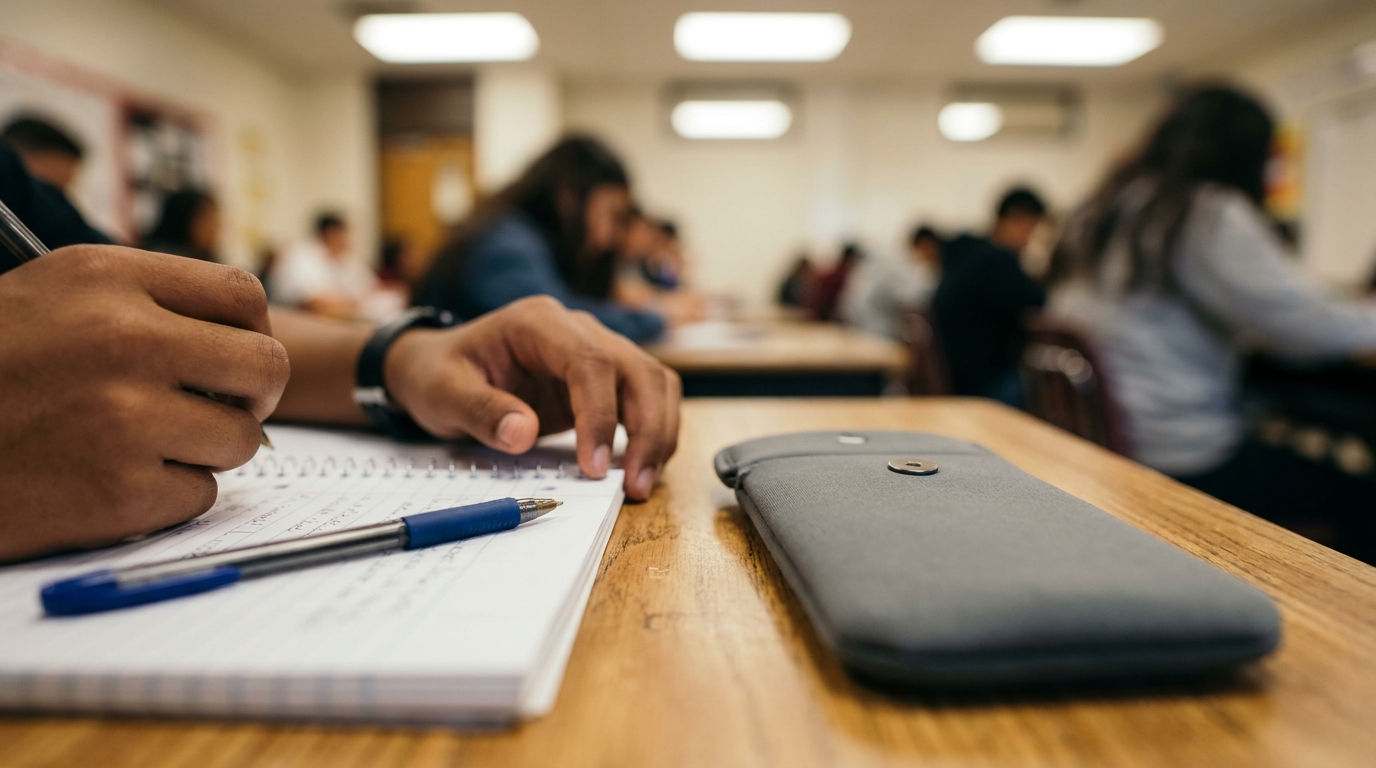
Many districts implementing bell-to-bell bans have turned to Yondr pouches — fabric cases with a magnetic lock that students carry all day and unlock at dismissal using a base unit. Over 2.5 million students currently use Yondr pouches across all 50 states.
Teachers generally like the certainty Yondr provides. Students are less enthusiastic. Students shared doubts that Yondr pouches reduced distractions or improved learning, and expressed a desire for less intrusive solutions rather than blanket prohibitions. Some districts have found the logistics burdensome enough to abandon the system. Sutter Middle School in Folsom, California discontinued Yondr after one year, switching to a simpler “off and away” policy where students keep phones in backpacks.
The off-and-away approach has lower overhead but creates a monitoring problem: you can’t see whether the phone in the backpack is off or just on silent. Schools that use it successfully tend to pair it with very clear, non-negotiable consequences and — crucially — staff who actually enforce it uniformly.
The Equity Issue Nobody Talks About Enough
New York’s prior statewide phone ban was lifted in 2015 in part because of stricter enforcement at schools serving students from low-income households compared to schools serving students from high-income households.
New York’s 2025 law actually tries to address this: beginning September 1, 2026, each district must publish a report on its website summarizing enforcement of the policy, including non-identifiable demographic data of students who faced disciplinary actions. If statistically significant enforcement disparities are identified, the report must include a mitigation action plan.
That’s a meaningful requirement that most states haven’t matched. When enforcement is discretionary — when teachers and administrators decide who gets a warning versus a referral — patterns of inequitable discipline tend to follow existing gaps. A phone ban that results in Black or low-income students being disciplined at higher rates than their peers has substituted one problem for another.
The Framework: How to Tell If Your School’s Ban Is Working
Most parents track a school phone ban by asking their kid, “Do you like it?” That’s the wrong question. Here’s a cleaner set of things to actually monitor — what I’d call the four-signal check:
| Signal | What to Look For | Red Flag |
|---|---|---|
| Consistency | Same rules in every classroom | “Mr. X lets us use our phones in 5th period” |
| Consequence clarity | Kids know exactly what happens on a first, second, third offense | Vague “referrals” with no follow-through |
| Storage method | Phones physically inaccessible (pouch) or clearly away (bag) | “Off and away” with no spot checks |
| Parental contact | School communicates how to reach kids in emergencies | No alternative plan for urgent messages |
If a parent can’t answer the first three from what their child reports within the first two weeks of a new policy, the ban is probably not being enforced uniformly.
What Parents Need to Do at Home
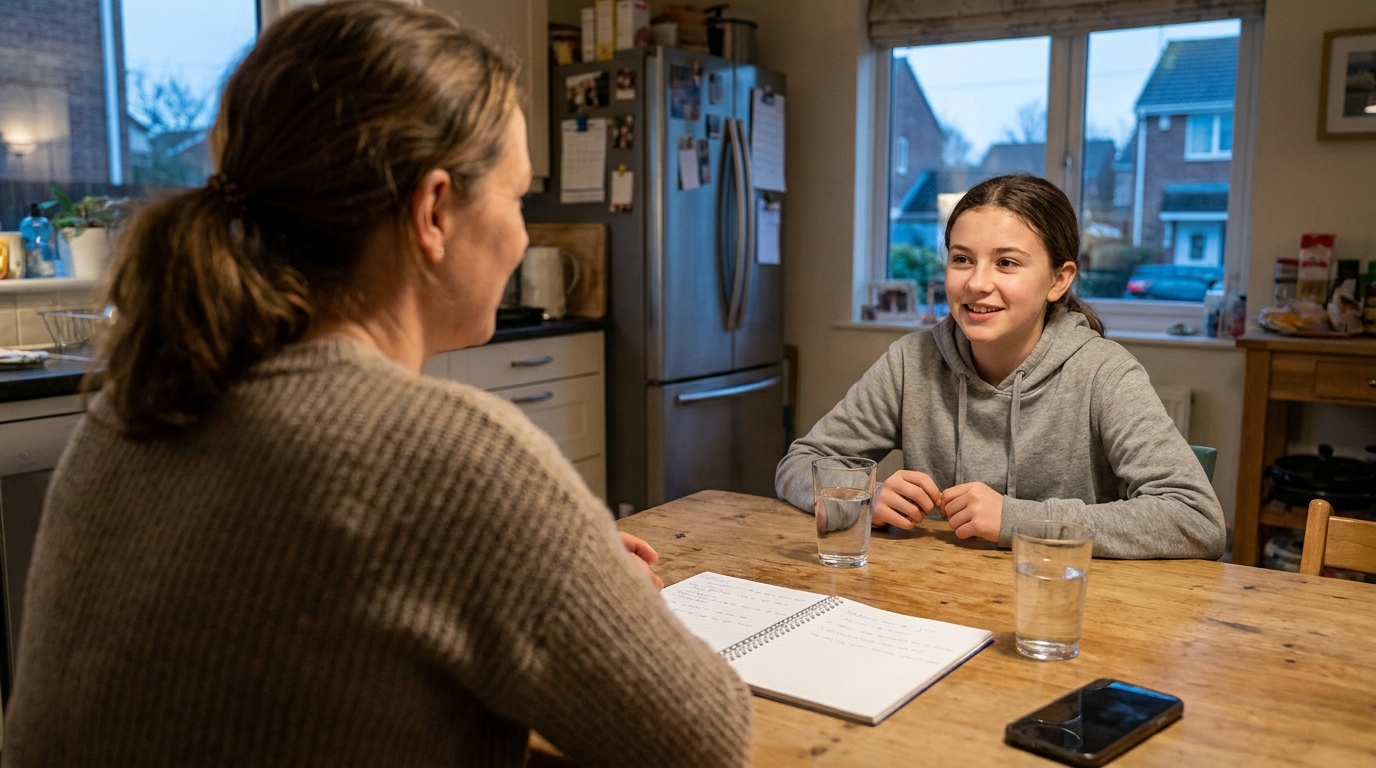
Here’s the part most articles skip: the ban covers maybe 35 hours a week. Your kid has roughly 73 waking hours outside of school. A phone ban doesn’t transfer its benefits to those hours automatically.
Researchers at Harvard have noted that school phone policies alone are not enough to address the issues seen in adolescents — and that when parents and schools send different messages about phones, teachers are left navigating that contradiction in the classroom.
A few things that are actually manageable without being draconian:
- Set a consistent charging location outside bedrooms. Phones charging in a common area overnight removes a significant portion of the late-night scroll time that drives sleep disruption. This costs nothing and takes about one family conversation to implement.
- Match the school’s structure on weekends. If your kid is phone-free from 8 AM to 3 PM on school days, a weekend with unlimited screen time from 7 AM onward essentially resets the habit. It doesn’t have to be banned — but a phone-free window of two to three hours in the morning on weekends keeps some consistency.
- Talk about what they did at lunch. This sounds small, but it serves a real purpose. If their school has a bell-to-bell ban and they’re actually spending lunch talking to people, they’ll have something to report. If they’ve found workarounds, they’ll be evasive. It’s a low-pressure check-in that opens the door to an actual conversation.
- Don’t text them during school. This is listed in EdWeek research as one of the biggest classroom distractions teachers deal with — parents messaging their kids on cellphones during the school day. A ban only works if the demand side cooperates too. If your kid has their phone locked in a Yondr pouch and you’re sending three messages between 10 AM and noon, you’re building anxiety around a device they can’t access.
The Honest Assessment
School phone bans are not a fix. They’re a reduction in a specific type of distraction during a specific window of the day, and the evidence suggests that reduction has real but modest benefits — particularly on attendance and test scores, more so for middle schoolers than high schoolers, and more so when enforcement is genuinely consistent.
Caroline Kistin, an associate professor at Brown University’s Hassenfeld Child Health Innovation Institute, notes that in many states, it will likely be a couple of years before schools develop and implement their policies and collect enough data to report on the effects. We’re in an early period. The states that passed laws in 2025 won’t have clean longitudinal data until 2027 or 2028 at the earliest.
What’s not in doubt: teachers want these policies, students adapt faster than they think they will, and a well-enforced ban does change the texture of a school day. My nephew’s “quieter” observation wasn’t a complaint. It was a description. Whether quiet translates into something measurable over three or four years — that part, nobody fully knows yet.



Good luck bro you’re doing a great job
Thank you so much for your kind words
Thank you🙏
Pingback: Why Most Kids’ Books Fail at Teaching Kindness (And How to Find Ones That Work) | Bahrku
Exactly — children are not happy all the time, and that’s what makes stories meaningful. Kids experience frustration, jealousy, sadness, fear, and confusion every day. The best children’s books don’t ignore these emotions; they help children understand and navigate them in a healthy, comforting way.
Pingback: Why Bedtime Stories for Children Create Happier Nights and Stronger Families in 2026 | Bahrku
Good luck