
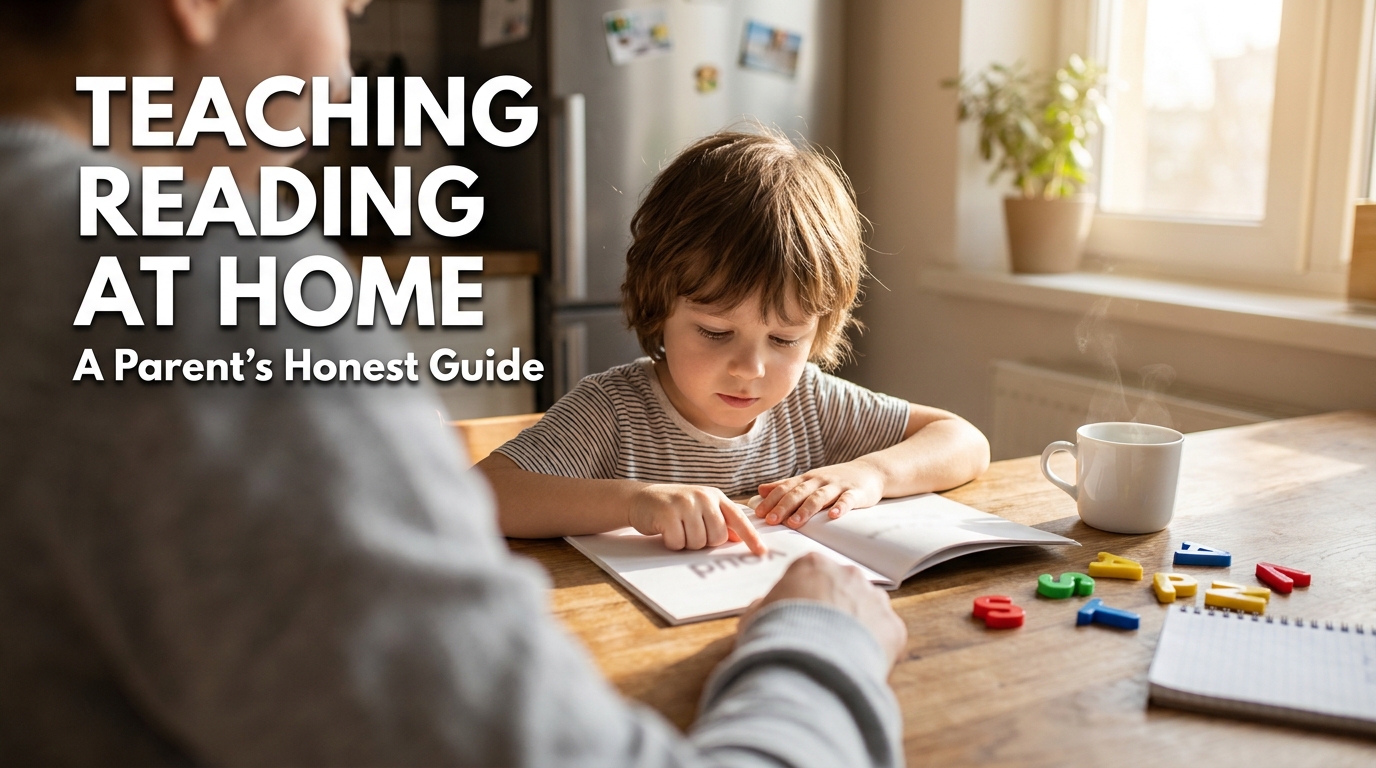

The first time I sat my older daughter down with a “Bob Book” at age 4, she stared at the page for maybe 90 seconds, said the word “cat,” and then asked if she could go outside. I thought I’d failed. I’d read three parenting books that week, ordered a $40 phonics workbook, and printed laminated flashcards the night before. She wanted juice.
That afternoon taught me the single most useful thing about teaching reading at home: the parent’s enthusiasm and the child’s readiness are almost never on the same schedule. Once I stopped pushing my timeline, my older one was reading short chapter books by 5 years and 4 months. My younger took until almost 6, and there was a stretch around age 5 where I genuinely thought something was wrong. Nothing was wrong. He just needed more time on the same step.
Start here: the one thing that matters more than the program you pick
Your child needs to be able to hear individual sounds in words before letters mean anything. This is called phonemic awareness, and it’s the step most parents skip because it feels too simple.
Try this right now with your kid, eyes closed, no books, no flashcards: say the word “sun” slowly and ask them what sounds they hear. A child who’s ready to read will say something like “sss… uh… nnn.” A child who isn’t ready yet will say “sun” or “the s one” or just look at you confused. If they can’t break a three-letter word into three sounds out loud, no phonics curriculum on earth will work yet. You play sound games for a few more weeks first.
I wasted six weeks with my son drilling letter sounds before I figured this out. He knew every letter sound cold. He still couldn’t read “cat,” because he couldn’t hear that “cat” was three separate sounds. Once I backed up and we spent two weeks just playing rhyming games and sound-segmenting games in the car, the reading clicked in under a month.
Quick readiness check (about 4 minutes)
- Rhyme detection: “Does ‘cat’ rhyme with ‘hat’? Does ‘cat’ rhyme with ‘dog’?”
- First sound: “What’s the first sound you hear in ‘mom’?” (Answer: “mmm” — not “M.”)
- Sound blending: You say “/c/ /a/ /t/” with pauses. They say “cat.”
- Sound segmenting: You say “fish.” They say “/f/ /i/ /sh/.”
If they nail 3 of 4, start phonics. If not, stay on sound games for a few more weeks. No reading yet.
The order to teach in (this part isn’t optional)
English looks chaotic, but the teaching order is fairly settled. I tried inventing my own sequence early on and it created gaps I had to fix later. Save yourself the months.
| Stage | What you teach | Roughly how long it took us |
|---|---|---|
| 1. Letter sounds (not names) | s, a, t, p, i, n first — these alone make ~15 readable words | 3–4 weeks per kid |
| 2. CVC blending | Consonant-vowel-consonant words: cat, pin, sit, tap | 6–8 weeks (daughter), 14 weeks (son) |
| 3. Digraphs | sh, ch, th, ck, ng — two letters, one sound | 3 weeks |
| 4. Common sight words | the, of, to, was, said, you — words that don’t follow rules | Ongoing, ~10 per week |
| 5. Long vowels with silent e | cake, bike, hope, cute | 4 weeks |
| 6. Vowel teams | ai, ee, oa, ou, oi | 6–8 weeks |
| 7. R-controlled vowels & multisyllable | car, bird, hurt; then breaking longer words into chunks | Several months, overlapping with real reading |
The order matters because each stage relies on the last. Don’t introduce silent-e words while a child is still hesitant on CVC. They’ll mix the rules and shut down.
Why “s, a, t, p, i, n” instead of A, B, C, D
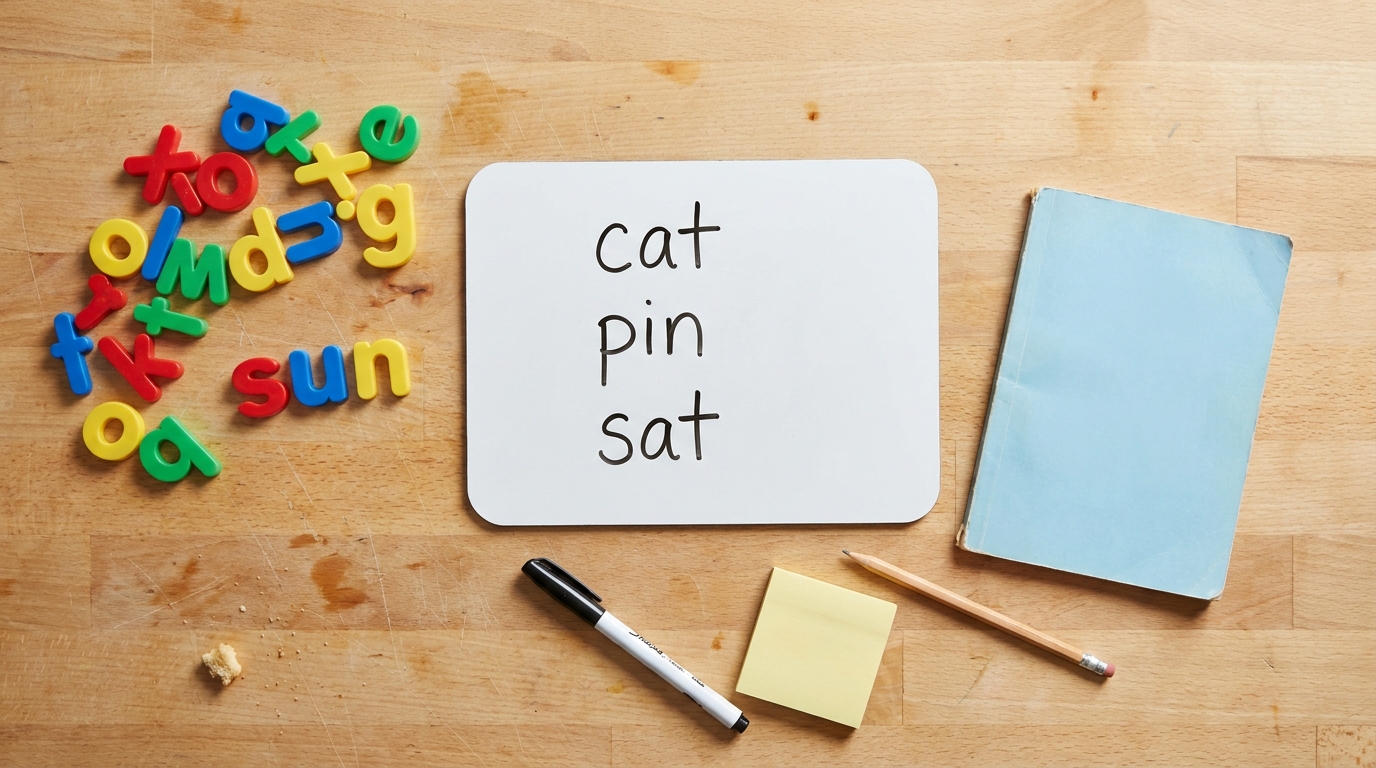
This was the single biggest unlock for us. Alphabetical order is a terrible teaching order because A, B, C, D doesn’t make many real words. S, A, T, P, I, N — those six letter sounds let a kid read and build actual words on day one: “sat,” “pin,” “tan,” “nap,” “sip,” “pat,” “sit,” “pan.” A child who reads three real words in their first lesson feels like a reader. A child who learns A, B, C, D in order spends four lessons before reading anything.
Most structured phonics programs (Jolly Phonics, Read Write Inc., the Orton-Gillingham tradition) use some version of this order. If a program starts with A-B-C, I’d skip it.
What a daily session actually looks like (by age)
I’ll give you the routines we actually ran, not the idealized version. Real days included refusals, snacks mid-lesson, and the dog interrupting.
Ages 3 to 4 — Pre-reading, sound play only

- Total time: 5 to 8 minutes, no more. Multiple times a day, never in one block.
- What we did: Rhyming games at meals (“What rhymes with spoon?”). Clapping syllables in names (“Han-nah, two claps!”). Silly first-sound games (“Banana starts with /b/. What else starts with /b/?”).
- What I avoided: Any worksheet. Any screen-based “learning to read” app. At this age, screens replaced talking, and talking is what builds phonemic awareness.
- Books we read TO them: Anything with rhyme and rhythm. Julia Donaldson books got read so many times I had “The Gruffalo” memorized by my second kid.
Ages 4 to 5 — Letter sounds and first words
- Total time: 10 to 15 minutes, once a day, ideally same time daily.
- Our slot: Right after breakfast, before any screen time. The pre-screen rule was strict; once cartoons happened, the lesson was over emotionally even if we tried.
- Structure: 2 minutes review old sounds, 3 minutes new sound, 5 minutes blending words with magnetic letters on the fridge, 2 minutes reading a tiny decodable book.
- Materials we used: Magnetic letters from a Melissa & Doug set (about $14 at the time), a small whiteboard, and the Bob Books Set 1 ($16-ish on Amazon). That was it for the first six months.
Ages 5 to 6 — Real reading practice
- Total time: 15 to 20 minutes of practice, plus 20+ minutes of being read to.
- Structure: They read aloud to me from a decodable book at their level. I’d correct gently, not constantly. After their reading, I’d read a much harder book to them — this is where vocabulary and story sense come from.
- What changed: I stopped using flashcards entirely. By this stage, real books do the work better.
Ages 6 to 7 — Fluency and stamina
- The goal stops being “can they read this word” and becomes “can they read smoothly enough to enjoy a story.” Re-reading the same easy book three nights in a row is genuinely the fastest way to build fluency at this stage. I doubted this until I saw it work.
- Introduce silent reading for 10 minutes a day. Sit nearby reading your own book. Don’t quiz them.
Sight words: the part everyone overcomplicates
Sight words are common words that don’t follow regular phonics rules — “the,” “said,” “was,” “of,” “are.” There are two camps online: drill them with flashcards, or never use flashcards. I tried both. The truth is boring and in the middle.
My approach: Teach a sight word the first time it shows up in a real book they’re reading. Write it on a Post-it, stick it on the fridge, point at it for a week. After about ten minutes total of exposure across that week, most kids own the word. Daily 20-card flashcard drills made my son refuse to read at all for nearly a week, so I stopped.
The Dolch list and Fry list are the standard sight-word lists, both freely available with a search. Don’t pay for a sight-word program. The lists are public domain and 90 years old.
Books to use, in the order we used them
| Reading stage | Series that worked for us | Rough price per set | Honest note |
|---|---|---|---|
| First decodables (CVC only) | Bob Books Set 1: Beginning Readers | $15–18 | The illustrations are plain. Kids don’t care. Pages are thin and tear if a 4-year-old is rough. |
| Early digraphs | Bob Books Set 2 / Usborne Phonics Readers | $15–25 | Usborne has nicer art. Bob Books has stricter phonics control. |
| Sight-word + simple stories | Elephant and Piggie (Mo Willems) | $10 each / library | The single thing that made my son LIKE reading. Borrow from library first. |
| Early chapter books | Frog and Toad, Henry and Mudge | $5–8 each used | Frog and Toad is gentler. Henry and Mudge has shorter chapters. |
| Fluency builders | Magic Tree House, Mercy Watson | $5–7 each used | Mercy Watson is illustrated heavily — good bridge before pure chapter books. |
Library before purchase, always. We bought four books my older daughter declared “boring” before I learned this lesson. The Junie B. Jones series specifically — she read three pages and refused.
The 3-second rule for when they get stuck on a word
This is the framework I wish I’d had on day one. When a child stalls on a word while reading aloud, parents instinctively jump in. Don’t. Count to three in your head. Most of the time, they figure it out in second two. If they don’t, you have a choice:
- Tap the first sound — point at the first letter and say its sound. Often enough.
- Cover the rest of the word — show them only the first chunk. They blend it themselves.
- Just tell them — if it’s a sight word or irregular word, telling them is fine. Don’t make them suffer through “yacht.”
The mistake I made for months was correcting every wobble. It taught my son to wait for me instead of attempting. When I switched to the 3-second rule, his reading independence jumped noticeably within two weeks.
The mistakes that cost me real time and money
- The $79 app subscription. Won’t name it. The interface was bright, the songs were catchy, and after two months of daily use my kid could recognize the app’s specific font but struggled with the same letters in a real book. Apps teach app-reading.
- Starting too early with the second kid. Because the first kid was easy, I assumed the second would be too at the same age. Three months of frustration before I accepted he wasn’t ready. The hardest part of teaching reading at home is the sample size of one in your other arm telling you what “normal” looks like.
- Reading “leveled readers” from the major school publishers. Many of these books use predictable patterns (“I see a dog. I see a cat. I see a fish.”) that let kids memorize without actually decoding. My daughter “read” four of these books fluently, then froze on a real sentence. Stick to decodable books in the early stages, not pattern books.
- Phonics flashcard apps timed for speed. Speed drilling made both kids anxious. Reading is not a race; treating it like one breaks the calm a beginner needs.
Where the popular advice is wrong (or at least oversimplified)
“Just read to them and they’ll learn naturally.” This is partly true and mostly not. Reading aloud to a child builds vocabulary, story sense, and a love of books — all essential. But the act of decoding written symbols into sounds is a learned skill that most children don’t pick up by osmosis. Some do; most need explicit teaching. The “natural reader” stories you hear are real but rare, and waiting for it to happen has real costs if it doesn’t.
“Whole language vs phonics is settled — phonics wins.” Mostly true based on the reading research consensus over the past 20 years, but the way “phonics” gets sold to parents is often a stripped-down version that ignores vocabulary, comprehension, and motivation. A kid who can decode but hates books isn’t a reader yet. Phonics is necessary; it’s not sufficient.
“Start as early as possible.” Some kids are genuinely ready at 3 and a half. Most aren’t ready until 4 and a half to 5 and a half. Pushing a 3-year-old who isn’t ready can create a negative association with reading that takes years to undo. A child who starts at 6 catches up to a child who started at 4 within a year, usually. Earlier isn’t better; matched-to-readiness is better.
What to do when it isn’t clicking after months of effort
I’ll be honest about what I don’t know here: I’m not qualified to diagnose anything. But after roughly four months of consistent daily practice with no visible progress, it’s worth talking to your child’s pediatrician or a school reading specialist. Dyslexia affects an estimated 1 in 5 children to some degree, and early identification matters. The signs I’d watch for, based on what specialists I’ve spoken to mentioned: persistent letter reversals past age 7, trouble with rhyming well into kindergarten, family history of reading struggles, or a child who can memorize stories but can’t decode unfamiliar words at all.
This is the one area I’d strongly recommend not relying on parent intuition or internet advice. Get a professional eye on it.
A realistic week at our kitchen table
For a parent who wants a template, here’s roughly what a Monday-through-Friday looked like when my son was 5 and mid-CVC stage:
- Monday: 12 minutes. Review last week’s sounds, introduce “ch.” Build 6 words with magnetic letters. Read one Bob Book pages 1–4.
- Tuesday: 10 minutes. He didn’t want to. We did 5 minutes of rhyming games in the car on the way to the grocery store instead. Counted it.
- Wednesday: 15 minutes. Same Bob Book, all pages. He read two words wrong, I let one slide.
- Thursday: 10 minutes. New Bob Book. He read 80% of it. Big confidence day.
- Friday: Skipped. He went to a birthday party. I felt guilty for about 20 minutes, then got over it.
Five days, roughly 50 minutes total. That’s the real pace. Anyone telling you their kid does an hour of reading instruction daily at age 5 is either exceptional or exaggerating.
If you do nothing else this week
Pick one thing from below tonight. Not all of them. One.
- Run the 4-question readiness check at dinner. You’ll know within minutes where you actually stand.
- Order or borrow Bob Books Set 1 if your child has letter sounds down.
- Put the screen-based reading app away for two weeks and replace it with 10 minutes of you-and-them at the fridge with magnetic letters.
- Read aloud to them tonight from a book one full level above what they can read themselves. Don’t quiz. Just read.
The thing nobody tells you is that teaching your kid to read at home is mostly about showing up for fifteen minutes a day for about eighteen months. It’s not glamorous. There’s no secret method. The parents whose kids read well at six aren’t the ones with the best curriculum; they’re the ones who kept the daily appointment even on the days nobody felt like it.