


The number is stark and worth sitting with: 58% of U.S. public schools reported a growing number of students seeking mental health services, according to the National Center for Education Statistics’ 2023 School Pulse Panel survey. That’s not a regional blip. That’s more than half of schools across every ZIP code, income level, and grade band reporting the same pressure at the same time.
What most articles about this topic skip is the practical gap — the space between a parent noticing something is off and actually knowing what to do Monday morning. This article is written to close that gap. The warning signs below are organized by age because a withdrawn 7-year-old looks nothing like a withdrawn 15-year-old, and conflating the two causes parents to miss or misread what’s in front of them.
Why Schools Are the Right Place to Start This Conversation
Kids spend roughly 180 days a year, six or more hours a day, in school. Teachers and counselors often see behavioral shifts before parents do — not because parents aren’t paying attention, but because the social pressure that triggers anxiety or withdrawal tends to live at school, not at home.
When I spoke with a licensed school psychologist about this (she works in a mid-size suburban district in the Mid-Atlantic region and asked not to be named), she told me something that reframed how I think about early signs: “We don’t worry most about the kid who cries in the hallway. We worry about the one who used to run to the cafeteria and now eats alone without explanation.” The absence of a behavior, she said, is often louder than the presence of a new one.
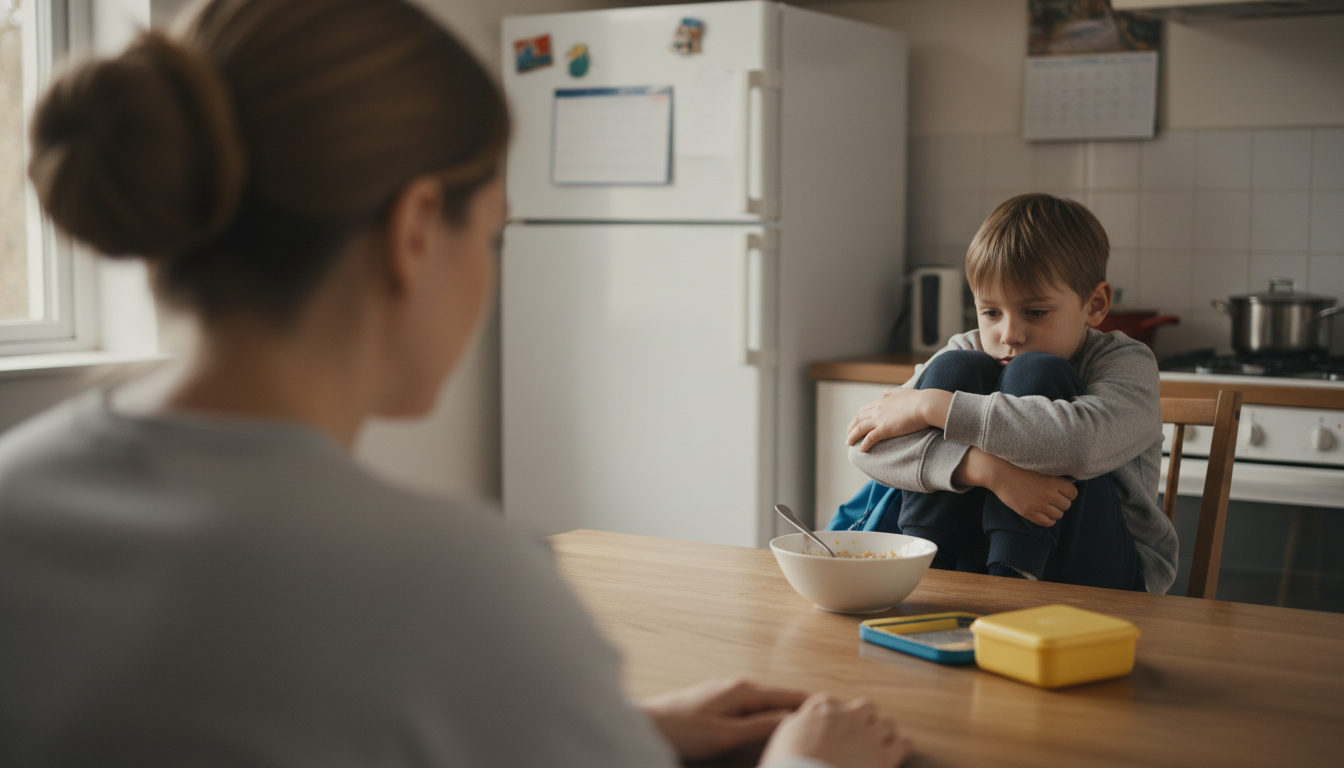
That observation has stuck with me. It means the checklist parents actually need isn’t “does my child seem sad?” — it’s “what did my child used to do that they’ve quietly stopped doing?
Warning Signs by Age Group
Ages 5–8: Elementary School
Young children don’t have the vocabulary to say “I feel anxious.” What they do instead is act it out physically or regress to behaviors they’d outgrown. The signs at this age are easy to dismiss as developmental phases, which is exactly why they get missed.
- Frequent stomachaches or headaches on school mornings with no medical cause found after a pediatrician visit. The American Academy of Pediatrics notes that somatic complaints — physical symptoms without a clear organic source — are one of the most common presentations of anxiety in children under 9.
- Bedwetting after being dry for 6+ months, or returning to thumb-sucking or baby talk.
- Refusal to go to school that escalates beyond the occasional complaint — specifically, crying, clinging, or physical symptoms that appear only on school days and resolve on weekends.
- Nightmares or new sleep disruptions lasting more than two weeks.
- Sudden drop in enthusiasm for a previously loved activity — a child who loved drawing and has stopped completely, without any explanation.
- Excessive worry about parents being safe while the child is at school (separation anxiety that reappears after a period of absence).
One thing worth flagging here: at this age, regression symptoms look like behavioral problems to untrained eyes. A second-grader who starts having accidents at school is likely to be disciplined rather than supported if the adults around her don’t know what they’re looking at.
Ages 9–12: Upper Elementary and Middle School Transition
This is the age band where social comparison kicks in hard and self-consciousness sharpens. The warning signs shift from physical regression to social withdrawal and self-criticism.
- Suddenly not wanting to see friends they previously spent every weekend with — particularly when they can’t give a clear reason.
- Harsh self-talk about their own intelligence or appearance. “I’m stupid” said once after a bad grade is different from “I’m always the dumbest one” said repeatedly and about multiple situations.
- Grades dropping across multiple subjects, not just one. A single class drop often signals a teacher conflict or subject difficulty. Across-the-board decline more often signals something affecting attention and motivation globally.
- Changes in eating at school — not eating lunch, throwing food away, or making comments about weight that sound borrowed from somewhere else.
- Increased secrecy about phones or devices, especially when combined with emotional distress after putting the phone down.
- Explosive reactions to small frustrations at home that are out of proportion with the trigger. This one is counterintuitive — kids this age often hold it together at school and detonate at home, where they feel safe enough to fall apart.
| Age Range | Most Common Presentation | Easy to Mistake For | Key Distinguishing Factor |
|---|---|---|---|
| 5–8 | Physical complaints, regression | Normal phases, attention-seeking | Symptoms appear only on school days |
| 9–12 | Social withdrawal, self-criticism | Preteen moodiness | Multiple domains affected simultaneously |
| 13–18 | Isolation, risk behaviors, disengagement | Teenage rebellion | Change from baseline, not just intensity |
Ages 13–18: Middle and High School
Adolescent mental health warning signs are the most documented and simultaneously the most frequently rationalized away by adults. “Teenagers are supposed to be moody” is true. It’s also used to explain away signs that warrant a closer look.
The key distinction at this age isn’t the presence of distress — adolescence is inherently distressing — it’s the change from that individual kid’s baseline. A naturally introverted 16-year-old who prefers her room isn’t a red flag. A 16-year-old who was the social anchor of her friend group and has been isolating for three weeks is a different conversation.
- Sleeping significantly more or less than their normal — not just late weekend sleep, but difficulty getting out of bed at all, or being awake at 2 a.m. on school nights consistently.
- Losing interest in goals they had strong feelings about: a student who was focused on college applications who abruptly says it doesn’t matter; an athlete who quits their sport mid-season without clear reason.
- Giving away possessions. This one should never be rationalized. If a teenager starts giving away meaningful items — a gaming setup, jewelry, clothing they loved — take it seriously and talk directly.
- Statements of hopelessness about the future, even when framed casually or as dark humor. “I probably won’t even be here for that” deserves a direct follow-up question, every time.
- Unexplained marks on arms or legs, or consistently wearing long sleeves in warm weather.
- Using alcohol or marijuana to manage moods rather than socially. The pattern matters — not just whether they’ve tried something, but whether they’re using it to feel normal or to sleep.
- School refusal that resurfaces after years of absence. By high school, a student who can no longer get to school is signaling significant distress, not defiance.
What School Mental Health Resources Actually Look Like in 2025–2026
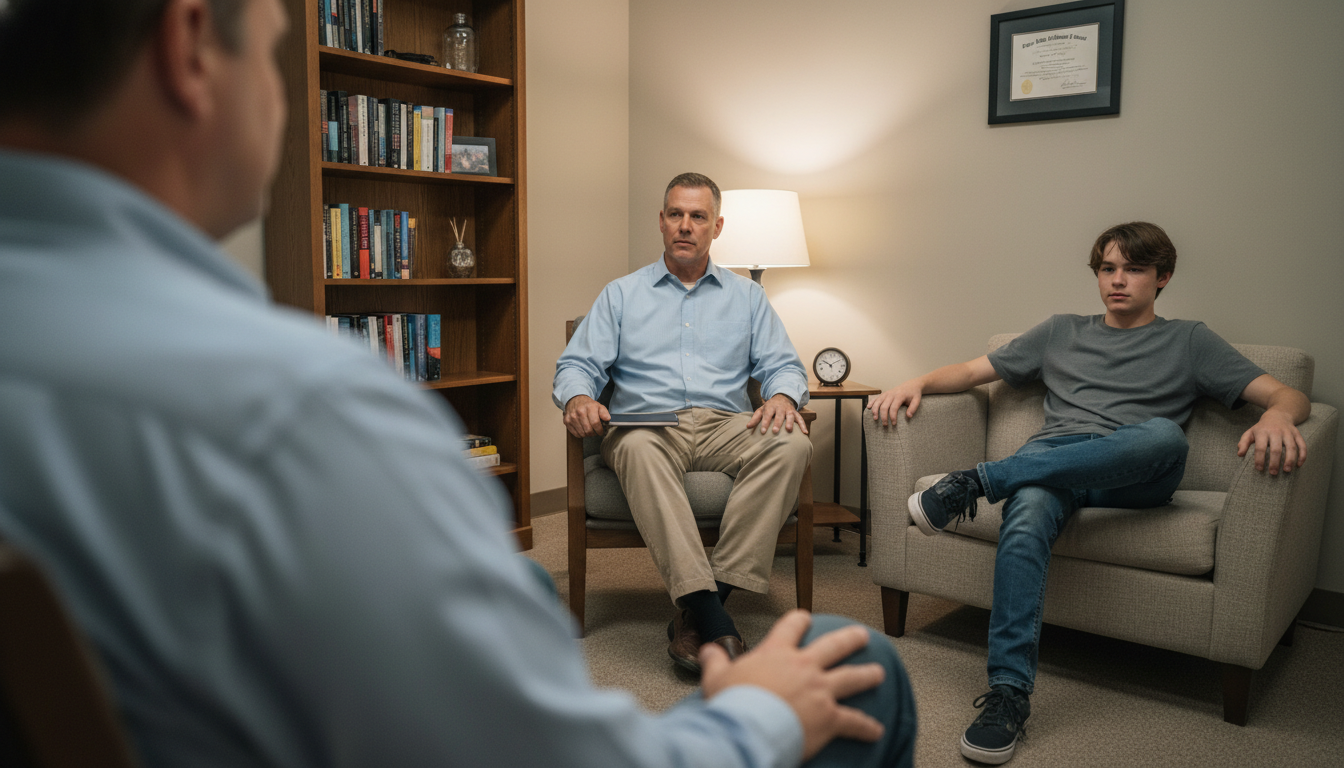
The phrase “school counselor” covers an enormous range of actual capacity. In a well-funded district, your child’s school might have a licensed clinical social worker, a school psychologist, and a counselor — each with distinct roles. In an under-resourced district, one counselor might carry 400 students on their caseload, which the American School Counselor Association recommends should be no higher than 250:1. (As of the 2023–2024 school year, the national average was approximately 408:1.)
Knowing what your school actually has changes how you use it.
| Role | Primary Function | Can They Provide Therapy? | Who to Contact Them For |
|---|---|---|---|
| School Counselor | Academic planning, crisis support, college prep | No — brief support only | Academic stress, social conflict, initial concerns |
| School Psychologist | Evaluation, learning disabilities, crisis response | Rarely — depends on district | Suspected learning issues, 504/IEP needs, crisis |
| School Social Worker | Family systems, community resources, case management | Sometimes — brief intervention | Home stressors, attendance issues, outside referrals |
| Outside Therapist (via school partnership) | Ongoing clinical therapy | Yes | Diagnosed conditions, ongoing treatment |
How to Actually Connect with School Staff (Not Just Email Into a Void)
Most parents email the counselor and wait. Counselors get dozens of emails a week from parents, many of which are about scheduling. If you believe your child is struggling, call the main office and ask to speak with the counselor directly. If it’s urgent, say so using the word “urgent.” Schools have protocols that kick in when that word is used.
Before that call, write down:
- Specific behavioral changes you’ve observed, with approximate dates when they started
- Whether your child has said anything to you directly, even if vague
- Whether anything at home has changed (divorce, move, loss, new sibling, financial stress)
- What you’re asking for — do you want the counselor to check in with your child? Do you want a referral to an outside therapist? Do you want a 504 accommodation process started?
Coming in with a clear ask makes it easier for the counselor to help you. “I’m worried about my daughter” is a starting point. “I’ve noticed she’s not eating lunch and has had two crying episodes on Sunday evenings — I’d like you to check in with her this week and let me know what she says” is something a counselor can actually act on.
Practical Parent Strategies — What Has Actually Worked
The Ride-Home Window
I’ve heard this from multiple school mental health professionals and parents who’ve navigated this: the 10 minutes after school pickup, when a child is in the backseat and you’re not making eye contact, is often when they’ll say the thing they’ve been holding all day. No direct questions. Radio off. “How was it?” is fine. Then silence. The absence of eye contact makes it easier for some kids, especially 9–13, to say something real.
Direct questions like “Are you okay?” or “Why are you sad?” often produce one-word answers. Parallel activity — driving, cooking together, walking — lowers the interpersonal stakes enough that kids will sometimes volunteer what they won’t answer to.
When to Get a Professional Involved and How
Parents frequently ask how to know if their child needs therapy versus a rough patch that will resolve. There’s no clean answer, but a useful rough rule: if the change in behavior or mood has lasted more than three weeks, affects more than one area of life (school, friendships, home, sleep), and isn’t explained by an obvious temporary stressor (a breakup, a move), it’s worth a professional consultation. That consultation doesn’t commit you to ongoing therapy — it gives you more information than you have now.
Finding a pediatric therapist through insurance is notoriously slow. A few things that speed this up:
- Call your pediatrician first. They often have warm referral relationships with local therapists and can sometimes get a faster intake appointment than a cold call from a parent.
- Ask your school social worker for a community resource list — most schools maintain one that includes sliding-scale options and telehealth providers who accept Medicaid.
- The SAMHSA National Helpline (1-800-662-4357) is free, confidential, and can provide referrals to local mental health services regardless of insurance status. As of 2025, they’ve expanded their pediatric-specific referral database significantly.
- University training clinics often have shorter wait lists than private practices because graduate students provide therapy under licensed supervision. The cost is usually much lower.
What Not to Do — The Mistakes That Set Things Back
Minimizing is the most common one. “You have so much to be grateful for” is well-intentioned and almost always lands as invalidating to a child in distress. It tells them they’re wrong to feel what they feel, which makes them less likely to bring it up again.
Interrogating is the second. Back-to-back questions in a worried voice — “Why didn’t you tell me? How long has this been going on? Who did this? What happened?” — read as panic to a child, and panic from a parent shuts kids down fast. One question at a time. Slow pace. Long pauses.
Promising confidentiality and then breaking it causes real damage, especially with teenagers. If you say “you can tell me anything and I won’t tell anyone,” and then you call the school the next morning, you’ve confirmed to your child that disclosing wasn’t safe. Be honest upfront: “I’ll keep this between us unless I’m scared you might get hurt. Then I have to do something about it, even if you’re angry with me.”
How to Talk to Your Child About Therapy Without Making It Worse
The framing matters more than most parents realize. Telling a child “you need to see a therapist” positions therapy as a consequence of being broken. Framing it as “I want you to have someone to talk to who isn’t me, because there are probably things you can’t say to your mom without worrying about her reaction” is both more accurate and more palatable.
For teenagers especially, giving them some agency in the process helps. Letting them look at two or three therapist profiles and pick the one who feels least off-putting gives them a small stake in the process. A teenager who chose their therapist is more likely to actually talk in the room.
School-Specific Programs Parents Should Know About
Multi-Tiered Systems of Support (MTSS)
MTSS is a federal framework — supported under the Every Student Succeeds Act — that structures school-based mental health support into three tiers. Tier 1 is school-wide prevention (social-emotional learning programs, anti-bullying frameworks). Tier 2 is targeted support for students who need more (small groups, check-in systems). Tier 3 is individualized intervention for students with the highest needs.
Parents can ask specifically which tier their child is receiving support at, and what the criteria are for moving between tiers. This is public information and schools are required to have it documented.
504 Plans vs. IEPs for Mental Health Conditions
If your child has a diagnosed mental health condition — anxiety disorder, ADHD, depression, PTSD — they may be eligible for accommodations under Section 504 of the Rehabilitation Act, which is separate from special education and generally faster to access than an IEP.
| Feature | 504 Plan | IEP (Individualized Education Program) |
|---|---|---|
| Eligibility threshold | Disability that substantially limits a major life activity | Disability affecting educational performance requiring special education |
| Common mental health uses | Extended time, reduced workload, quiet testing room, flexible attendance | Intensive academic and behavioral support, specialized instruction |
| Required diagnosis? | Yes, documented disability | Yes, one of 13 IDEA categories |
| Average time to put in place | 2–6 weeks from request | 60 days from consent to evaluate |
| Parent rights | Prior written notice, procedural safeguards | Full IDEA procedural safeguards, dispute resolution |
To request either, contact the school counselor or special education coordinator in writing (email creates a date-stamped record). State that you are making a formal request for an evaluation under Section 504 or IDEA. The clock starts when the written request is received.
What to Do If Your School Doesn’t Have Adequate Support
Some schools — particularly in rural districts and those serving low-income communities — have no school psychologist at all. Roughly 30% of U.S. school districts had no school psychologist as of the 2021–2022 National Association of School Psychologists workforce data.
In those cases, parents have a few options outside the school building:
- Community Mental Health Centers (CMHCs) receive federal block grant funding and are required to serve anyone regardless of ability to pay. They’re in every state.
- Federally Qualified Health Centers (FQHCs) provide mental health services on a sliding fee scale and are searchable by ZIP code through HRSA’s Find a Health Center tool at findahealthcenter.hrsa.gov.
- Telehealth pediatric therapy has expanded significantly post-2020. Platforms that partner with Medicaid and CHIP, like those accessible through state behavioral health authorities, now serve a broader geographic range than before.
- Your state’s Parent Training and Information Center (PTI) — every state has one, funded under IDEA — provides free advocacy support to parents navigating school systems. The CPIR database at parentcenterhub.org lists them all.
The Harder Conversation: When a Child Won’t Talk
The situation many parents find themselves in — and the one that feels the most helpless — is noticing something is wrong and having a child who refuses to discuss it. This is especially common with middle and high schoolers.
A few things worth knowing:
Silence isn’t the same as refusal. Sometimes a kid can’t talk yet — the emotional language isn’t there, or they’re still processing something that happened. Keeping the door visibly open without pressure (“You don’t have to talk, but I want you to know I’ve noticed and I’m not going anywhere”) is different from badgering. The former is sustainable. The latter closes the door.
Third-party adults sometimes reach kids that parents can’t. A coach, an aunt, an older sibling, a family friend — someone who doesn’t carry the weight of being Mom or Dad. If you suspect your child is struggling and they won’t open up to you, asking another trusted adult to spend time with them isn’t giving up. It’s expanding the net.
A therapist can see a child even if the child is resistant, with parental consent (rules vary by state for teens 14+). The first session is often about building a relationship, not excavating feelings. Most kids who go to a therapist angry come back having said more than they expected.
What’s Not Settled: Where the Research and the Practice Diverge
It’s worth being honest about the limits of what we know here.
The relationship between social media use and adolescent mental health is more complicated than either side of the debate acknowledges. Jean Twenge’s research points to strong correlations between heavy social media use and increased depression rates in teen girls. Jonathan Haidt has made this argument at length in his 2024 book The Anxious Generation. But other researchers, including Candice Odgers at UC Irvine, argue the effect sizes are small and the causation hasn’t been cleanly established — that anxious kids may seek out social media rather than social media creating anxious kids. Both sides have published in peer-reviewed journals. I don’t think the science is settled, and any parent or article that tells you otherwise is oversimplifying.
What does seem more established: the content consumed and the way it’s consumed matters more than raw screen time. A teenager passively scrolling comparison content at midnight is a different risk profile than the same teenager using a platform to maintain friendships with peers they also see in person.
The other area of genuine uncertainty is long-term outcomes for school-based mental health interventions. We have good evidence that school-based programs improve short-term outcomes — identification, help-seeking behavior, reduced stigma. Long-term outcome data is thinner, partly because kids move, change schools, and tracking is hard. The honest answer is that we know school support is better than nothing and that early identification matters, but the optimal model is still being worked out.


